There is a food court somewhere in the middle of America that has become, without anyone quite planning it, a perfect metaphor for the most contentious arguments in our national life. Walk past the entrance and the place you’ll notice first — the one with the longest lines, the warmest bread smell drifting into the corridor, the quiet hum of satisfied conversation — is the Italian restaurant. It’s been there the longest. It built the building. The tile work around the doorframe is hand-painted in green, white, and red. A chalkboard by the door announces the day’s specials in Italian script. The menu is unapologetically Italian.
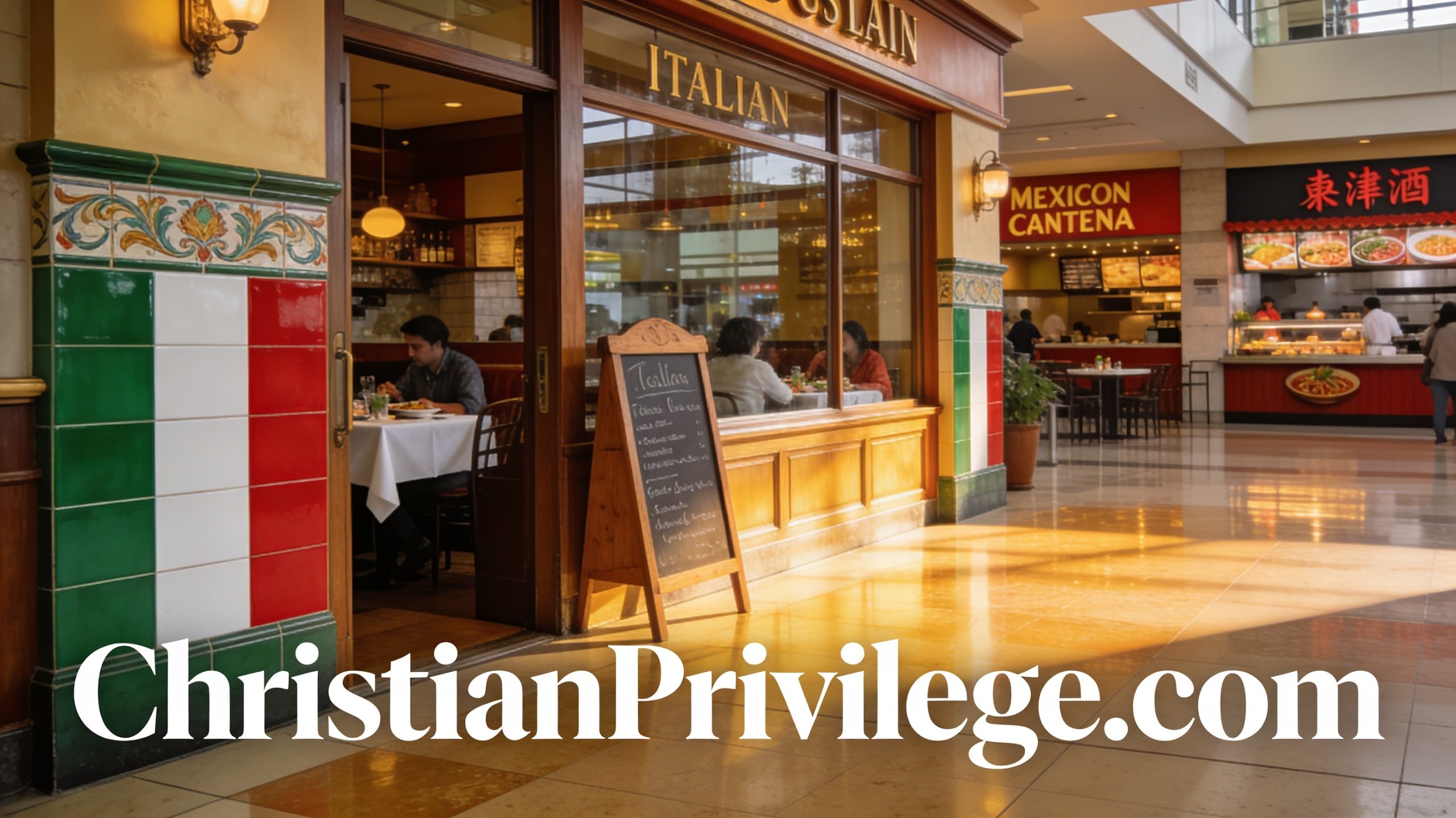
Next door is a Mexican restaurant. Next to that, a Thai place. Down at the end of the hall, an Indian kitchen, a Greek gyro counter, a Chinese buffet. This is America. There is room for everyone.
And yet — somewhere nearby — a customer is standing in front of the Italian restaurant with a legal pad, itemizing grievances. The garlic bread doesn’t come with hot sauce. The dessert menu doesn’t include churros. The background music is Pavarotti, not mariachi. The colors on the wall aren’t his colors. He calls this privilege.
This article is an attempt to respond — calmly, thoroughly, and with some respect for both the customer and the cuisine.
Christian Privilege and the Recipe That Built the Restaurant
Before a single customer walks through the door of a restaurant, someone has already made a thousand decisions. They picked a concept. They studied recipes handed down through generations. They sourced specific ingredients — San Marzano tomatoes, ’00’ flour, aged Parmigiano-Reggiano — because those ingredients, prepared in those ways, produce that food. They signed a lease in a building they helped design. They hung the tricolor flag in the window not to exclude anyone, but to tell the truth about who they are and what they make.
America was built like that.
The founders of this nation were not vague about the ingredients. They were not embarrassed by the recipe. They named it plainly and repeatedly, in public documents and private correspondence, in speeches and prayers and state proclamations.
John Adams, signer of the Declaration of Independence and second President of the United States, said it as directly as language permits: “Our Constitution was made only for a moral and religious people. It is wholly inadequate to the government of any other.” He went further: “The general principles on which the fathers achieved independence were the general principles of Christianity. I will avow that I then believed, and now believe, that those general principles of Christianity are as eternal and immutable as the existence and attributes of God.”
George Washington, in his Farewell Address — the document that served as the nation’s parting instruction manual from its first president — was unambiguous: “Of all the dispositions and habits which lead to political prosperity, religion and morality are indispensable supports. In vain would that man claim the tribute of patriotism, who should labor to subvert these great pillars of human happiness, these firmest props of the duties of men and citizens.” He added a warning that rings louder with each passing generation: “Let us with caution indulge the supposition that morality can be maintained without religion… reason and experience both forbid us to expect that national morality can prevail in exclusion of religious principle.”
Benjamin Franklin, standing before the Constitutional Convention in the summer of 1787 when the entire enterprise was on the verge of collapse, did not reach for a philosophy textbook. He reached for prayer. He told the assembled delegates: “I have lived, Sir, a long time, and the longer I live, the more convincing proofs I see of this truth — that God governs in the affairs of men. And if a sparrow cannot fall to the ground without His notice, is it probable that an empire can rise without His aid? We have been assured, Sir, in the sacred writings, that ‘except the Lord build the House, they labor in vain that build it.'”
Thomas Jefferson, principal author of the Declaration of Independence, inscribed the theology directly into the founding document: “God who gave us life gave us liberty. Can the liberties of a nation be secure when we have removed a conviction that these liberties are the gift of God? Indeed I tremble for my country when I reflect that God is just, that his justice cannot sleep forever.”
Patrick Henry, the firebrand of the Revolution, declared that “Being a Christian… is a character which I prize far above all this world has or can boast.” Noah Webster, who gave America its language and its earliest schools, wrote that “The religion which has introduced civil liberty is the religion of Christ and His apostles… to this we owe our free constitutions of government.” John Jay, the first Chief Justice of the United States Supreme Court, stated plainly: “Providence has given to our people the choice of their rulers, and it is the duty, as well as the privilege and interest of our Christian nation, to select and prefer Christians for their rulers.”
These are not fringe voices. These are the men who wrote the documents, fought the war, built the courts, and opened the restaurant.
The Italian restaurant was opened by Italians. It serves Italian food. It has always said so, clearly, on the flag above the door. What the critics call “Christian privilege” is, in most cases, simply the flavor of the food that was always being served.
Christian Privilege and the Customer Who Wants Mexican Food at the Italian Place
Now we come to the complaint itself.
The customer at the counter has a list. He has catalogued every way in which the Italian restaurant is not a Mexican restaurant: the menu doesn’t offer tacos, the staff doesn’t speak Spanish, the holiday decorations are Italian. He has given this list a name — “Italian Privilege” — and submitted it to a legal journal.
The critics of so-called Christian privilege in America have produced exactly this kind of list. One widely cited checklist, compiled by academic Lewis Z. Schlosser, includes such observations as: “It is likely that state and federal holidays coincide with my religious practices,” “I can talk openly about my religious practices without concern for how it will be received by others,” and “I can be sure that when someone in the media is referring to God, they are referring to my God.”
This is a list of complaints that the Italian restaurant serves Italian food.
Yes, the holidays on the national calendar are mostly Christian holidays. That is because America was overwhelmingly built by Christians who wrote the calendar. Yes, the assumptions in public discourse often reflect Christian norms. That is because those norms were the social, moral, and philosophical foundation on which the republic was constructed. This is not a conspiracy of exclusion. It is the natural expression of a civilization’s heritage — the same way that the Italian restaurant plays Puccini instead of flamenco, not to insult the Spanish, but because that is who they are.
The complaint assumes that the alternative to a Christmas holiday is a more equitable society. In fact, the alternative is simply a society with a different flavor — one shaped by someone else’s founding assumptions. Every civilization has them. The question is only which ones, and whether we are honest about them.
Christian Privilege and the Other Restaurants Right Next Door
Here is what the complaint almost always leaves out: the other restaurants are right there.
America’s First Amendment does not merely tolerate religious diversity — it actively protects it. Muslims, Jews, Hindus, Buddhists, Sikhs, atheists, and practitioners of every other faith or no faith at all are legally free to worship, organize, build institutions, start schools, run for office, publish newspapers, broadcast their views, and establish communities according to their own values. The food court is open. The other restaurants have empty tables.
No one is required to eat at the Italian place. No one is prevented from going next door.
If the complaint is that Christmas falls on a federal holiday and Diwali does not — the remedy is not to eliminate Christmas from the calendar. It is to advocate for Diwali recognition in the appropriate forums, or to enjoy your own celebration with the liberty that the First Amendment guarantees. The Italian restaurant being open on Tuesdays does not prevent the Mexican restaurant from being open on Tuesdays.
The critics often frame religious diversity as a problem that Christian dominance creates. But in fact, America’s religious diversity exists because of the moral and legal framework that Christianity built into the republic. The very pluralism that critics celebrate — the legal protection that allows them to criticize the majority religion publicly and without fear — is a product of a civilization that believed human beings were made in the image of God and therefore possessed inherent dignity and conscience that no state could rightfully override.
Benjamin Rush, Signer of the Declaration and “Father of Public Schools Under the Constitution,” wrote that “Christianity is the only true and perfect religion; and in proportion as mankind adopt its principles and obey its precepts, they will be wise and happy.” The pluralism critics want is, ironically, one of the dishes the Italian restaurant has always served.
Christian Privilege and the Features That Draw People to the Restaurant
Now for the most interesting part of the conversation.
Suppose the customer with the legal pad admits something. He admits that he actually likes eating at the Italian restaurant. He likes that it is calm and well-ordered. He likes that the prices are reasonable. He likes that the staff treats him with a particular dignity — politely, personally, as though he matters. He likes that the table linens are clean and the atmosphere is generally peaceful.
He wants those features. He just wants them without the Italian food.
This is not a small concession. It is, in fact, the whole argument.
The orderliness, the dignity, the relative peacefulness of the environment — these are not incidental to the Italian restaurant’s identity. They are a product of it. They come from the same source as the food. They emerge from a worldview that holds human beings to be morally responsible creatures accountable to a God who demands honesty, charity, self-restraint, and the treatment of others as you would be treated yourself. The Golden Rule is not a coincidence of the décor. It is the recipe.
John Adams understood this when he wrote that “We have no government armed with power capable of contending with human passions unbridled by morality and religion.” The stability and justice and relative peace that make America worth immigrating to, worth complaining about from within, worth demanding rights inside of — these are downstream consequences of the Christian moral architecture that critics say must be dismantled.
The Founders were explicit. Jedidiah Morse, pastor and geographer of the founding era, wrote: “To the kindly influence of Christianity we owe that degree of civil freedom, and political and social happiness which mankind now enjoy. In proportion as the genuine effects of Christianity are diminished in any nation, either through unbelief, or the corruption of its doctrines, or the neglect of its institutions — in the same proportion will the people of that nation recede from the blessings of genuine freedom, and approximate the miseries of complete despotism.”
Daniel Webster, Secretary of State and “Defender of the Constitution,” was equally direct: “Whatever makes men good Christians, makes them good citizens.” The quiet atmosphere in the Italian restaurant and the excellent service are not marketing decisions. They are moral convictions expressed in tablecloths and menus.
The critical question then becomes: If you love the features of a civilization built on Christian moral foundations, do you believe those features can survive the removal of the foundation?
Christian Privilege and the Mexican Restaurant That Could Learn Something
If a customer genuinely prefers the ambiance of the Italian restaurant — the peacefulness, the cleanliness, the dignified service — but wishes it served Mexican food, there is an obvious and honest solution: go to the Mexican restaurant and suggest that they cultivate the same virtues.
This is not mockery. It is a serious point.
If other religious, cultural, or philosophical communities want the social fruits that have historically grown from Christian civilization — stable families, ordered communities, individual dignity, limited government, free expression, charitable institutions, rule of law — the productive course is to examine what produced those fruits and consider whether their own traditions can generate similar outcomes.
In many cases, they can. Judaism shares the Hebrew Bible. Many Islamic scholars have argued for legal order and human dignity from Quranic sources. Many secular humanists have argued that Enlightenment reason can sustain the social order. These are legitimate projects. They deserve to be pursued — at the other restaurants, by the communities that believe in them.
What is not productive is to stand at the counter of the Italian restaurant and demand that it replace its kitchen with a different one. The moment the Italian restaurant stops being Italian — the moment it tries to serve every cuisine on earth in the name of fairness — it will become what every tourist-trap fusion restaurant becomes: a place that does everything adequately and nothing well. The calming smell will disappear. The warm bread will be replaced by something from a corporate supplier. The people who came for the atmosphere will leave to find it somewhere else. And they will be right to leave.
Noah Webster understood this dynamic clearly: “I am persuaded that no civil government of a republican form can exist and be durable in which the principles of Christianity have not a controlling influence.”
A nation that abandons the moral architecture of its founding does not become pluralistic. It becomes incoherent. It doesn’t serve everyone’s food. It serves no one’s food well.
Christian Privilege and Why People Come to America in the First Place
This brings us to the final and most uncomfortable question.
People from all over the world have been immigrating to America for four centuries. They come from countries with their own religions, their own food, their own flags. They come because something about America — something specific, not generic — drew them. The stability. The freedom. The opportunity. The rule of law. The dignity of the individual. The sense that a person could build something and keep it.
These things did not arise from a secular void. They arose from a specific civilization with a specific heritage. As Joseph Story, Associate Justice of the Supreme Court appointed by James Madison and “Father of American Jurisprudence,” wrote: “I verily believe Christianity necessary to the support of civil society. One of the beautiful boasts of our municipal jurisprudence is that Christianity is a part of the Common Law. There never has been a period in which the Common Law did not recognize Christianity as lying at its foundations.”
The people who came to America — and who still come — came for the Italian food. They came because the Italian restaurant had something no other restaurant in their part of the world was offering. They were free to bring their own recipes, practice them at home, open their own restaurants next door. Millions have. That is the beauty of the food court.
But to arrive at the Italian restaurant, enjoy the bread, appreciate the atmosphere, benefit from the centuries of craft that went into the space — and then demand that the Italian restaurant stop being Italian in order to be fair — is not a call for justice.
It is the ingratitude of someone who wants the flower without the root.
Conclusion: Christian Privilege and the Restaurant That Must Remain Itself
The concept of “Christian privilege,” as it has been developed in academic literature, assumes that the majority religion’s visibility in American public life is evidence of oppression rather than evidence of heritage. It mistakes the flavor of a civilization for an act of discrimination against those who prefer different flavors.
America was built as an Italian restaurant. The founders said so. They prayed the prayers, wrote the documents, named the sources, and hung the flag in the window. They also — and this is the part often forgotten — built extra chairs and welcomed anyone who wanted to come in. The First Amendment is not a compromise of the founders’ Christian convictions. It is, in many ways, an expression of them: the conviction that conscience is sacred, that God alone is Lord of the conscience, and that no earthly power should coerce belief.
The other restaurants are open. The food is different. The communities they serve are real and legitimate. America has room for all of them, and Christian civilization — not despite but because of its own principles — made it so.
The man with the legal pad is welcome to stay. The bread is warm. The atmosphere is good. The flag in the window has always been honest about where he is.
But no one is going to change the menu.
All founder quotations are drawn from primary source documents and authenticated historical records.