Major Criticisms of Christian Privilege in America
A Scholarly Survey of the Principal Critiques
See Responses to Critics of “Christian Privilege” in America
Introduction
The concept of “Christian privilege” refers to the social, cultural, legal, and institutional advantages that accrue to Christians in American society by virtue of their status as the dominant religious majority. First formally named in the academic literature by Lewis Z. Schlosser in 2003, the concept has since been elaborated by sociologists, education scholars, legal critics, psychologists, and civil liberties advocates. The following report catalogs the major criticisms of Christian privilege in America, presenting each critique in the words of its most prominent scholarly and activist voices. No attempt is made here to refute or qualify these critiques; they are presented to speak for themselves.
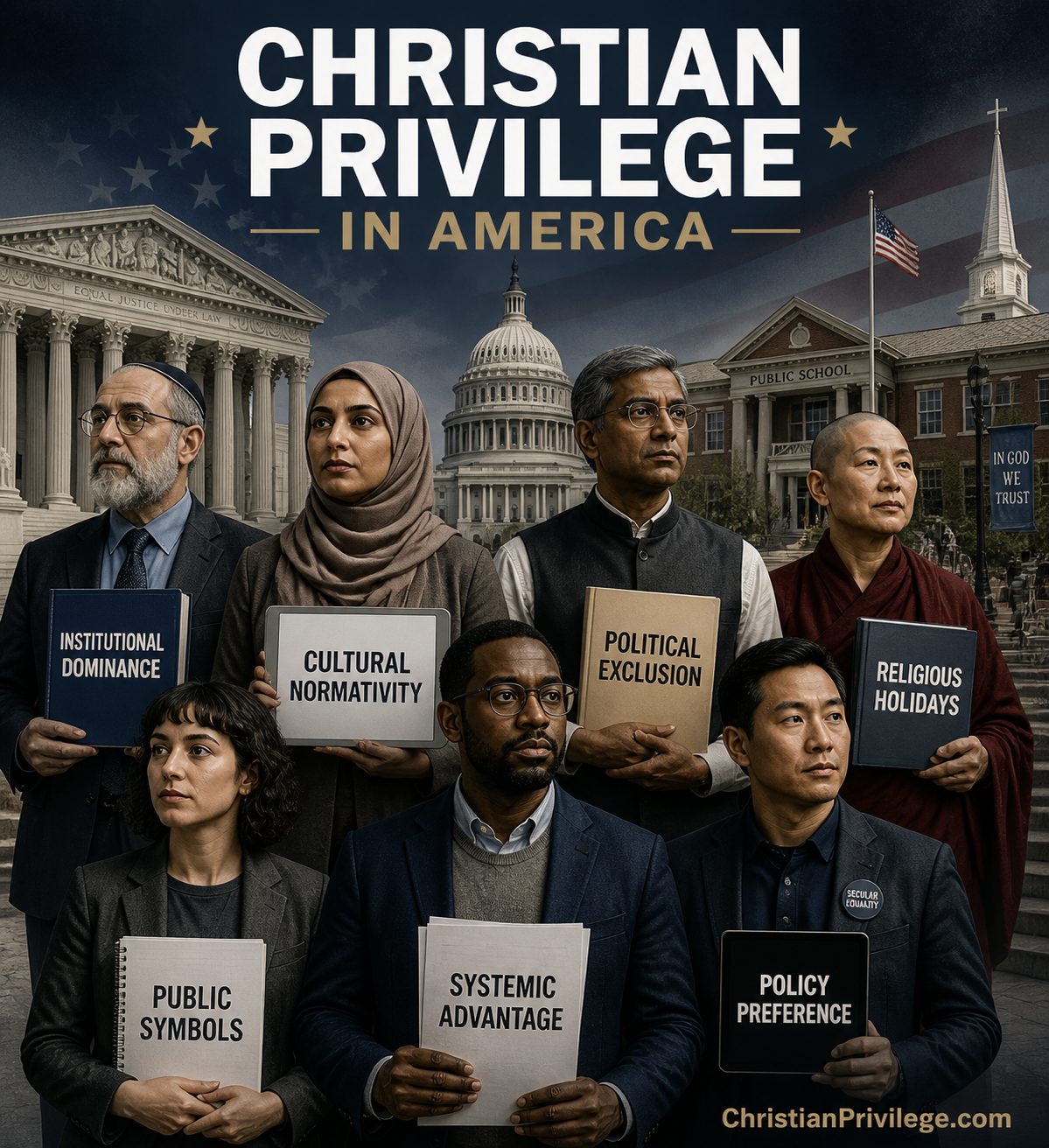
1. The Invisibility of Privilege: Christian Privilege as an “Unearned, Unacknowledged” Advantage
The Critique of Christian Privilege as Structurally Invisible
The foundational criticism of Christian privilege is that it operates largely invisibly — that is, Christians routinely benefit from systemic religious advantages without recognizing them as advantages at all. Drawing on Peggy McIntosh’s landmark 1989 framework of the “invisible knapsack” of white privilege, scholars argue that Christian Americans similarly carry an unmarked set of religious benefits that are so normalized as to be imperceptible to those who hold them.
Lewis Z. Schlosser, whose 2003 article in the Journal of Multicultural Counseling and Development introduced the concept to scholarly discourse, defined Christian privilege as the “conscious and unconscious advantages often afforded to the Christian faith” in the United States. Schlosser compiled an extensive checklist of forty such advantages to make the invisible visible. Among them:
See Responses to Critics of “Christian Privilege” in America
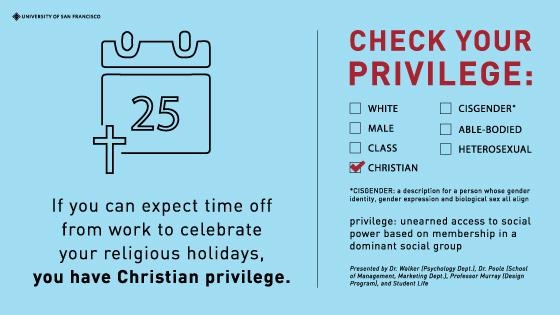
“The elected and unelected officials of my government probably are members of my religious group.”
Warren J. Blumenfeld, professor of multicultural and international curriculum studies and co-editor of Investigating Christian Privilege and Religious Oppression in the United States, described the structural nature of the advantage as “the seemingly invisible, unearned, and largely unacknowledged array of benefits accorded to Christians.” Blumenfeld further argued that “Christian privilege might nevertheless be one of the most extensive yet concealed contributors to the marginalization of non-Christian people.”
See Responses to Critics of “Christian Privilege” in America
Sam Killermann, social justice advocate and author of the “30+ Examples of Christian Privilege,” summarized the privilege structurally, noting that Christians can “expect to have time off work to celebrate religious holidays” and that “politicians responsible for your governance are probably members of your faith” — and that those politicians “can make decisions citing your faith without being labeled as heretics or extremists.”
Khyati Y. Joshi, professor of education at Fairleigh Dickinson University and author of White Christian Privilege: The Illusion of Religious Equality in America (NYU Press, 2020), argues that “pervasive Christian privilege prevails in the United States today” and that this privilege is embedded so deeply in national laws, practices, values, norms, and language that it passes unnoticed by the majority.
2. The Entanglement with White Supremacy: Christian Privilege and Racial Hierarchy
The Critique of Christian Privilege as Inseparable from White Supremacy
A second major critique argues that Christian privilege in America cannot be understood in isolation from white racial privilege — that the two have been historically and structurally intertwined since the founding of the republic.
Khyati Y. Joshi makes this argument the central thesis of her book. In her own words:
See Responses to Critics of “Christian Privilege” in America
“Christian privilege in the United States has always been entangled with notions of White supremacy,” such that White Christian privilege in particular is deeply embedded in the nation’s laws, practices, values, norms, and even language.
Joshi further argues that “Christianity’s overwhelming social power shapes America today, even when religious discrimination is mistaken for racism or obscured in debates over immigration or national identity.” The publisher’s summary of her book states that “anything not white, Western, and Christian is seen as abnormal” in American society.
In explaining her motivations, Joshi has stated in interview: “I’ve seen the growing literature coming out on whiteness over the last decade and a half… and I always thought that there was an element missing. That the religion element wasn’t getting highlighted… It’s also personal for me. As a racial and religious minority, I’ve been discriminated against and ostracized because of both. I could see white privilege, but I could also see Christian privilege, and then sometimes I’m seeing white Christian privilege.”
Philip Gorski (Yale University) and Samuel L. Perry (University of Oklahoma), co-authors of The Flag and the Cross: White Christian Nationalism and the Threat to American Democracy (Oxford University Press), trace this entanglement historically over three centuries. They write that:
See Responses to Critics of “Christian Privilege” in America
Gorski has further articulated the racialized double standard at the heart of Christian privilege: “When white Christians make claims on other Americans, they do so in the name of national unity and solidarity. But when racial and religious others make claims on white Christians, they are refused in the name of individual rights and personal accountability. In other words, heads, whites win. Tails, everyone else loses.”
Warren J. Blumenfeld likewise addressed this intersection, arguing that Christian privilege draws on the same structural logics as white supremacy — that a majoritarian Christian population “actively benefits from their status, much in the way that white Americans benefit from white supremacy.”
3. The Colonial Legacy: Christian Privilege and the Doctrine of Discovery
The Critique of Christian Privilege as Rooted in Colonialism and Indigenous Dispossession
Critics argue that Christian privilege in America is not merely a contemporary cultural phenomenon but has deep legal and theological roots in the colonial conquest of indigenous peoples — specifically in the Doctrine of Discovery, a set of 15th-century papal decrees that authorized Christian monarchs to claim sovereign dominion over any lands occupied by non-Christians.
Khyati Y. Joshi devotes substantial attention to this foundational moment. She explores the effects of the 16th-century papal document, noting that “The Doctrine of Discovery authorized any Christian monarch who ‘discovers non-Christian lands has a right to claim a superior and paramount title to these lands'” and argues that it was used to justify the conquest of Indigenous people in the United States. The roots of Manifest Destiny itself, she argues, can be found in these papal decrees.
The World Council of Churches has described the Doctrine in stark terms, stating that “The Doctrine mandated Christian European countries to attack, enslave and kill the Indigenous Peoples they encountered and to acquire all of their assets.” This doctrine was not merely historical — it was cited in an 1823 U.S. Supreme Court decision (Johnson v. M’Intosh) and as recently as 2005.
The Canadian Museum for Human Rights notes that “The Doctrine of Discovery is a legal and religious concept that has been used for centuries to justify Christian colonial conquest. It advanced the idea that European peoples, culture and religion were superior to all others.”
Paul Kivel, social justice educator, director of the Christian Hegemony Project, and author of Living in the Shadow of the Cross: Understanding and Resisting the Power and Privilege of Christian Hegemony (New Society Publishers, 2013), traces the contemporary effects of these colonial roots. He writes:
See Responses to Critics of “Christian Privilege” in America
Kivel further argues that “Christian hegemony punishes the poor, criminalizes sexuality, rationalizes destruction of the environment, and contributes to our seemingly endless ‘war on terror.'”
Warren J. Blumenfeld provides the historical scaffolding for this critique, arguing that Christian privilege has a “historical foundation” within a United States context that stretches from the earliest colonial period to the present day and that “the roots and legacies of Christian hegemony and privilege within a United States context” are encoded into the nation’s social institutions.
See Responses to Critics of “Christian Privilege” in America
4. The Religious Normativity Problem: Christian Privilege in Public Education
The Critique of Christian Privilege in Public Schools and Higher Education
One of the most extensively documented criticisms of Christian privilege concerns its presence in public education — in school calendars, curriculum, classroom culture, and holiday observances — despite constitutional guarantees of church-state separation.
Warren J. Blumenfeld has written extensively on this critique. In his foundational 2006 essay in Equity & Excellence in Education, he argues that Christian privilege continues in public schools, even though the Supreme Court has clarified the ways in which the First Amendment relates to public schools through rulings in Abington v. Schempp (1963) and Engel v. Vitale (1962). He contends that:
“The presumption that America is foundationally Christian is being challenged, really for the first time. There is no going back.” (quoting Harvard religion scholar Diana Eck approvingly)
The ERIC summary of Blumenfeld’s essay notes that it “investigates the concept of domination and subordination, Christian privilege, and the subtle and not-so subtle promotion of Christianity in public schooling and in the larger United States society” by drawing on Young’s (1990) “faces of oppression” and Hardiman and Jackson’s (1997) “levels of oppression.”
Kenyan Burke and Cory Segall, authors of Christian Privilege in U.S. Education: Legacies and Current Issues (Routledge), argue that religion has never actually left public education despite legal rulings. Their work contends that religion “remains in the language and metaphors of education, in the practices and routines of schooling, in conceptions of the ‘child’ and the ‘teacher'” and in assumptions about the role of schools. The book examines “not whether Christianity has a place in public education but, rather, the very ways in which it is pervasive in a legally secular system of education even when religion is not a topic taught in school.”
Jeremy F. Price, in a 2023 American Educational Research Association presentation titled “Framing Christian Privilege in Schools in an Age of Christian Nationalism,” identified how rising Christian nationalism has “led to the reification of Christian privilege and an increase in the oppression of minoritized communities in schools,” including Jews, Muslims, Sikhs, Hindus, the LGBTQIA+ community, and overlapping identities.
Research published in the ERIC database (EJ1203046) found that “most teachers/administrators adopted what we are calling Christian ignorance — a structural ignorance rooted in normative cognitive schemas that creates and maintains Christian privilege” in U.S. elementary schools, even while Christmas continued to be widely celebrated in public spaces.
Paul Kivel has written specifically about education as a site of Christian hegemony, arguing that “Christian institutions have also played a deep, founding, and shaping role in US school systems… because we identify ‘oppression’ as the systematic, daily, routine dominance and mistreatment of a target group by a nontarget group, we in effect identify such ‘isms’ as racism and sexism as hegemonies. An easily understood, obvious example of Christian hegemony in the United States is the observance of Christmas, observed throughout the business and civic world as a holiday that saturates all aspects of US culture for believers, nonbelievers, and ‘secular’ Christians alike for more than a month every year.”
5. The Calendar and Workplace: Christian Privilege in Time and Employment
The Critique of Christian Privilege Embedded in National Holidays and Workplace Culture
Critics argue that the American public calendar — with its guaranteed federal holidays for Christmas and Good Friday — structurally advantages Christian employees and students while forcing non-Christians to navigate workplace and school obligations during their own sacred observances.
Lewis Z. Schlosser’s checklist places this at the very top: “It is likely that state and federal holidays coincide with my religious practices, thereby having little to no impact on my job and/or education.” He further observes that Christians can “share my holiday greetings without being fully conscious of how it may impact those who do not celebrate the same holidays” and can be “sure that people are knowledgeable about the holidays of my religion and will greet me with the appropriate holiday greeting.”
Warren J. Blumenfeld specifically flagged the celebration of Christian holidays in public schools as a key manifestation of Christian privilege, documenting how “the celebration of Christian holidays” continues in public educational settings in ways that marginalize students of other faiths.
The student newspaper of Rollins College documented the on-the-ground impact plainly: “None of the religious holidays were given days off, except for the most celebrated Christian ones. From Rosh Hashanah to Yom Kippur, to Diwali, and finally to Ramadan, these holidays occur on school days when students are expected to be on top of their game.” The author concluded: “Christian holidays have privileges that other religious holidays are denied.”
Diversity consultants and workplace inclusion scholars have identified a structural double standard: “most of the world’s major cultural and religious celebrations don’t fall in December… Yet which observances receive automatic visibility, paid days off, and organizational acknowledgement? This imbalance reflects what scholars call ‘Christian cultural hegemony,’ a system that positions Christianity as the default norm, while rendering other traditions secondary or invisible.”
Blumenfeld and colleagues argue that the religious calendar problem reflects a deeper social truth: Christian privilege entrenches an identity norm such that “this system of benefits confers dominance on Christians while subordinating members of other faiths as well as non-believers. These systemic inequities are pervasive throughout society. They are encoded into the individual’s consciousness and woven into the very fabric of our social institutions.”
6. The Law and the Courts: Christian Privilege in Government and Jurisprudence
The Critique of Christian Privilege Embedded in American Law, Government, and the Supreme Court
Critics — including legal scholars, civil liberties advocates, and religious freedom organizations — have argued that American law and courts have consistently privileged Christianity over other faiths, in apparent contradiction to the Establishment Clause of the First Amendment.
Barry W. Lynn, ordained minister in the United Church of Christ and former executive director of Americans United for Separation of Church and State, captured the paradox: “I think we have a dizzying level of religious freedom in this country, particularly if you’re in the religious majority.” Lynn spent decades arguing in court that the government must not “promote religion” or use it “as an excuse to discriminate against others.”
Americans United for Separation of Church and State argued directly that “In light of these changes [increasing religious diversity], this is exactly the wrong time for our courts to assert a position of privilege for Christianity — yet that is exactly what they are doing.” The organization cited the Supreme Court’s 2019 ruling in American Legion v. American Humanist Association — permitting a 40-foot government-owned Latin cross to remain on public land — as a signal example.
The ACLU responded to that same ruling by stating that it “ignores our constitutional commitment to official religious neutrality and is a slap in the face to non-Christian veterans.” The ACLU further noted Justice Ginsburg’s dissent, which held that the Latin cross is an “exclusively Christian symbol” that “has never shed its Christian character.”
Khyati Y. Joshi uses Supreme Court jurisprudence to demonstrate that the law has systematically protected Christian practices while denying equivalent protection to minority religions. One striking example she cites is the Court’s “willingness to protect Christian Hobby Lobby workers’ objections to birth control, but not the controlled use of Peyote for Native American spiritual practices.”
The Freedom From Religion Foundation (FFRF) has been the most vocal organizational voice on this point. In response to President Trump’s 2025 “Anti-Christian Bias Task Force,” FFRF Co-President Annie Laurie Gaylor declared:
The FFRF further argued that Trump’s order “is nothing more than a political ploy to advance Christian nationalism and undermine the separation of church and state” and creates “a privileged class for certain Christian churches and followers.”
7. Faith-Based Initiatives: Christian Privilege in Government Funding
The Critique of Christian Privilege in Federal Grants and Faith-Based Programs
A sustained line of criticism focuses on how government funding — particularly through the White House Office of Faith-Based and Community Initiatives (OFBCI) established by President George W. Bush — has disproportionately flowed to Christian organizations while enabling employment discrimination.
Research cited in Investigating Christian Privilege and Religious Oppression in the United States found that “grants from President George W. Bush’s faith-based initiatives disproportionately benefited Christian organizations, with minimal funding directed towards Jewish, Muslim, Hindu, or Atheist groups.”
Congressman Bobby Scott documented the legal mechanism by which this preferential funding was enabled, noting that Executive Order 13279 (2002) “made it easier for churches and other faith-based organizations to receive federal money by letting them circumvent certain anti-discrimination laws.” Scott concluded that “the Bush administration began allowing discrimination with federal money for the first time since the 1960s.”
The First Amendment Encyclopedia (MTSU) summarizes the constitutional critique: “Critics charge that the initiatives violate the establishment clause by delegating government functions to religious organizations and funding institutions whose secular and religious activities are inseparable. They fear that the religious freedoms of recipients are jeopardized by religious indoctrination.”
According to the Stanford Social Innovation Review, critics argued that faith-based programs “in fact tilt it [the playing field] toward religious organizations” — noting one case where the Department of Veterans Affairs cut the budget of a large secular homeless shelter “while awarding grants to many religiously run shelters” and told religious applicants that “their religious roots would help.”
Paul Kivel connects government funding patterns to the broader structure of Christian hegemony, arguing that Christian dominance permeates economic power: “the concentration of power, wealth, and privilege” flows to a predominantly Christian power elite.
8. Sexual and Gender Minority Rights: Christian Privilege and LGBTQ Discrimination
The Critique of Christian Privilege as a Driver of Opposition to LGBTQ Rights
Critics have argued that Christian privilege — particularly the institutionalized power of Christian majorities to define moral norms — has operated as a primary structural barrier to legal equality for sexual and gender minorities in America.
Nathan R. Todd, professor of community psychology at the University of Illinois at Urbana-Champaign, led a landmark 2020 study published in the American Journal of Community Psychology examining this dynamic. His research found that:
Barry W. Lynn identified the underlying driver: “I think fundamentally, the real power behind the anti-choice movement in regard to abortion and the opposition to the rights of LGBT Americans is fundamentally religious.”
Philip Gorski and Samuel Perry note in The Flag and the Cross that Christian nationalism — the most politically active expression of Christian privilege — is “strongly associated with efforts to constrain the liberties of perceived outsiders” and “predicts greater opposition to same-sex marriage, and restricting access to abortion services for women.”
Andrew Whitehead, sociologist at Indiana University–Purdue University Indianapolis and author of American Idolatry: How Christian Nationalism Betrays the Gospel and Threatens the Church, has documented through empirical research that Christian nationalism “operates… in much the same way” across religious traditions, predicting a view that “black Americans and minorities don’t face any more discrimination than do white Americans” while simultaneously organizing against the rights of LGBTQ Americans.
9. Atheists and Non-Believers: Christian Privilege and the Marginalization of the Non-Religious
The Critique of Christian Privilege as It Excludes Non-Believers and the Religiously Unaffiliated
Critics have highlighted a dimension of Christian privilege that extends beyond the treatment of religious minorities to encompass the structural exclusion and social stigmatization of atheists, agnostics, humanists, and the religiously unaffiliated — the so-called “nones.”
The International Humanist and Ethical Union documented in its Freedom of Thought report that “the U.S. has long been home to a social and political atmosphere in which atheists and the non-religious are made to feel like lesser Americans or non-Americans,” and that “a range of laws limit the role of atheists in regards to public duties, or else entangle the government with religion to the degree that being religious is equated with being an American, and vice versa.” The report noted that at the time of writing, the state constitutions of Arkansas, Maryland, Mississippi, North Carolina, South Carolina, Tennessee, and Texas prohibited atheists from holding public office.
American Atheists made the constitutional argument forcefully in the context of the Supreme Court case Tanzin v. Tanvir (2020): “Giving religious believers privileged access to the courts would turn nonreligious Americans into second-class citizens. It’s unconstitutional, and Justice Ginsburg would have fought it tooth and nail.”
Warren J. Blumenfeld specifically includes non-believers as targets of Christian privilege’s oppressive structure, arguing that the system of benefits “confers dominance on Christians while subordinating members of other faiths as well as non-believers.”
Khyati Y. Joshi argues that “the privilege that American Christians enjoy… results in the oppression of members of religious minorities and atheists.”
Phil Zuckerman, Professor of Sociology and Secular Studies at Pitzer College and founder of the first secular studies program in the United States (established 2011), has documented through comparative sociological research the marginalized standing of secular Americans and the stigma they face in a society where religious identity — specifically Christian identity — is equated with moral worth and civic belonging.
Lewis Z. Schlosser captured the asymmetry at the individual level: “I can be sure that when someone in the media is referring to G-d, they are referring to my (Christian) G-d.”
10. Religious Pluralism Betrayed: Christian Privilege and the Myth of Equal Religious Freedom
The Critique of Christian Privilege as a Betrayal of America’s Promise of Religious Pluralism
A final, overarching critique is that Christian privilege fundamentally contradicts the founding promise of religious freedom and pluralism that America claims as a core national value.
Diana Eck, Professor of Comparative Religion and Indian Studies at Harvard University and founder of Harvard’s Pluralism Project, has argued that the presumption of Christian normativity poses the defining civic challenge of contemporary America. She articulates the “new American dilemma” as the tension between a professed commitment to pluralism and the structural reality of Christian dominance:
Eck’s analysis of the American religious landscape, developed in her book A New Religious America: How a “Christian Country” Has Become the World’s Most Religiously Diverse Nation, challenged “the presumption that America is foundationally Christian” as increasingly untenable in the face of genuine religious diversity.
Khyati Y. Joshi characterizes religious equality in America as “an optical illusion” — her book’s subtitle explicitly names The Illusion of Religious Equality in America. She argues:
Warren J. Blumenfeld, Khyati Y. Joshi, and Ellen Fairchild, in their edited anthology Investigating Christian Privilege and Religious Oppression in the United States, argue that Christian privilege and religious oppression are in “symbiotic relationship”: “oppression toward non-Christians gives rise to Christian privilege in the United States, and Christian privilege maintains oppression toward non-Christian individuals and faith communities.”
Philip Gorski and Samuel Perry close their analysis with an argument about the stakes for democracy itself: “The future of American democracy… will depend on whether a broad spectrum of Americans — stretching from democratic socialists to classical liberals — can unite in a popular front to combat the threat to liberal democracy posed by white Christian nationalism.”
The Freedom From Religion Foundation frames the issue as constitutional rather than merely cultural, asserting: “The U.S. Constitution guarantees freedom of religion and a secular government — not special privileges for any one faith.”
11. Mental Health and Counseling: Christian Privilege in Therapeutic Settings
The Critique of Christian Privilege as a Barrier to Mental Health Equity for Non-Christians
A growing body of scholarship in counseling psychology argues that Christian privilege permeates mental health services, making them unwelcoming and potentially harmful to non-Christian clients — and that the counseling profession has been slow to address this structural bias.
A 2024 study published in the Journal for Social Action in Counseling & Psychology found that non-Christian participants “often experienced the normalization of Christianity as the dominant worldview as oppression; they frequently felt they were treated as strangers who did not belong.” Related themes in the research included “Systemic Invisibility,” “Treated as an Enemy,” “Demeaned, Attacked, and Under Threat,” and “Attempts to Force Religious Conformity.”
The researchers concluded that “non-Christians might avoid counseling, or experience hesitancy, for fear that their religious beliefs could be misunderstood or overlooked. Mistrust of practitioners can be a meaningful obstacle to non-Christian clients availing of mental health services.”
The same research argues that Christian privilege in therapeutic settings could result in “the possible pathologization of non-Christian practices and neglect of non-Christian people,” suggesting that “scrutinizing Christian norms would nonetheless appear vital to ensure the oppression that can arise from Christian privilege is not enacted” through clinical practice.
The scholars further note a paradox for those in the dominant group: “there is often an intellectual, material, moral/spiritual, psychological, and social cost to dominant group membership. This can include heightened feelings of guilt and fear, disconnection from those who are perceived as different, and ignorance of one’s own culture and history.” They argue that dismantling Christian privilege in mental health settings “could not only promote equality for non-Christians encountering oppression but could potentially enable people with a Christian background to live a more fulfilled and authentic life.”
Amanda Ann Gregory, a licensed clinical social worker, has identified Christian privilege as having a “direct impact on mental health,” contributing to “feelings of anger, unsafety, confusion, and grief for both Christians and non-Christians” and to what she describes as religious trauma.
Warren J. Blumenfeld applied his framework of “five faces of oppression” to the psychological toll on non-Christians, identifying Powerlessness, Exploitation, Marginalization, Cultural Imperialism, and Violence as dimensions of the oppression non-Christians experience under Christian-privileged social structures.
This report presents scholarly and critical perspectives on the concept of Christian privilege in America. It draws on peer-reviewed research, academic books, civil liberties advocacy, and sociological studies. The critiques are presented in the words of their authors and advocates, without refutation or qualification, as a survey of the documented scholarly, legal, and activist discourse on this subject.