Christianity, at its core, is a faith system built on the twin commandments to love God with all one’s heart and to love one’s neighbor as oneself — a framework that has demonstrably shaped the most consequential nation in human history. The United States of America did not emerge from a vacuum. Its founding documents, its institutions, its culture of ordered liberty, and its eventual self-correction on historic moral failures all draw meaningfully from a Christian theological inheritance. To acknowledge this is not to claim the nation has been perfectly Christian — it has not — but rather to observe that its greatest achievements reflect Christian ideals applied faithfully, and its greatest failures reflect those same ideals abandoned or distorted. The modern critique of “Christian privilege” frames this legacy through a lens of grievance and structural power theory, and while it occasionally identifies genuine failures in Christian practice, its foundational assumptions stand in deep tension with Scripture. This paper examines the core Christian values, their scriptural grounding, their expression in American life, the honest acknowledgment of imperfect practice, and finally a systematic engagement with the claims of Christian privilege, showing where those claims invert Christian teaching and where the societies built on their logical conclusions demonstrate a far graver threat to human flourishing.
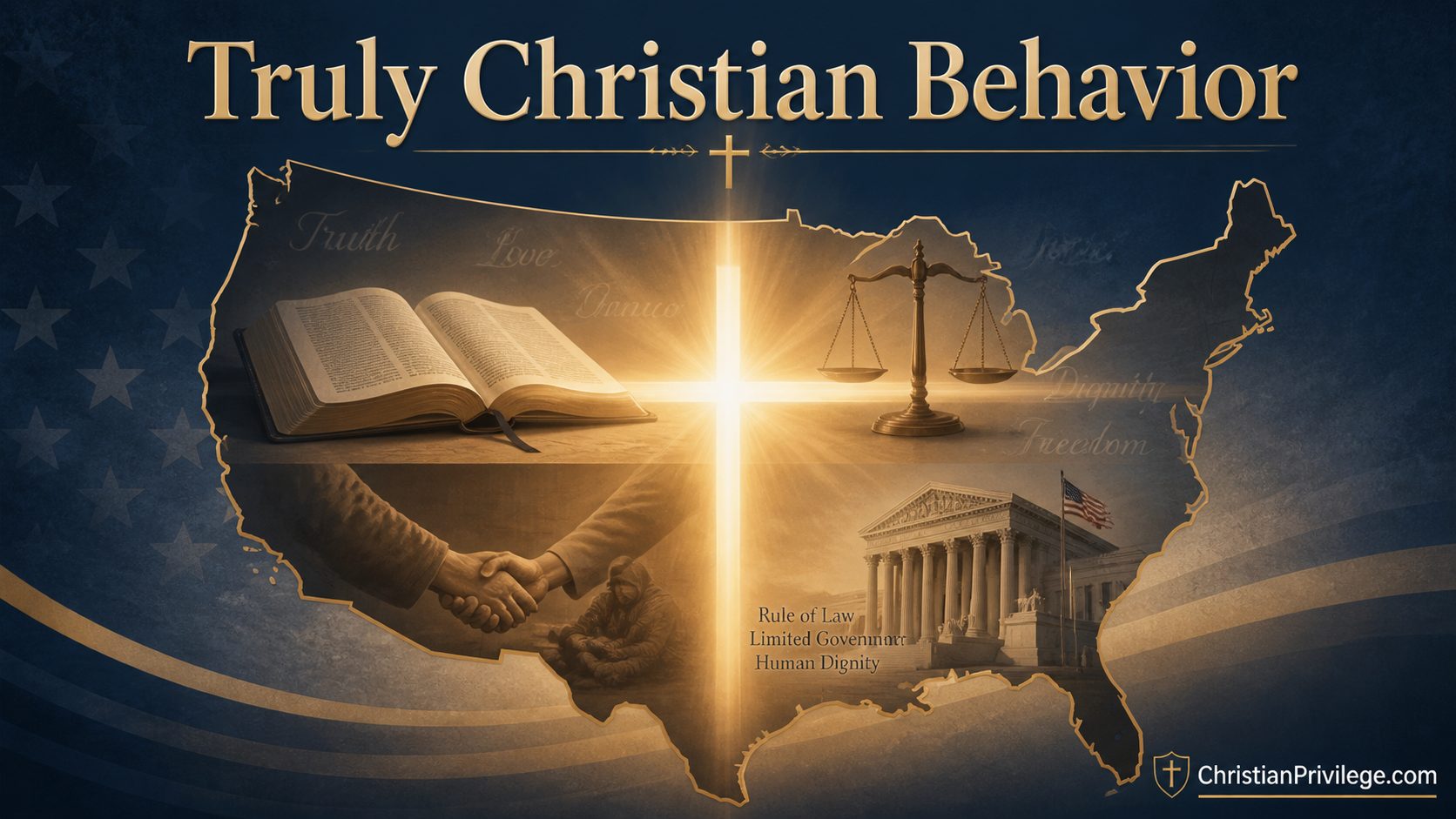
Core Christian Values
Love of God and Neighbor
Christianity is organized around a moral architecture that Jesus himself identified when asked to name the greatest commandment. In Matthew 22:37–40, he answered that the greatest commandment is to love God fully, and the second is to love one’s neighbor as oneself; on these two commandments depend the whole Law and the Prophets. This is not a peripheral statement — it is the axis on which the entire biblical revelation turns.
From this root, several foundational values branch out:
-
The Dignity of Every Human Being (Imago Dei): Genesis 1:27 declares that God made humankind in his own image, conferring on every person an inherent dignity that no human power can confer or remove.
-
Justice and Righteousness: Micah 6:8 commands believers to do justice, love kindness, and walk humbly with God, while Leviticus 19:15 forbids injustice in judgment.
-
Stewardship and Honest Labor: 2 Thessalonians 3:10 grounds the moral significance of willing labor and personal responsibility.
-
Limited, Accountable Government: Romans 13:1–4 teaches that government is a servant of God for good, not an autonomous absolute power.
-
Rule of Law Applied to All Equally: Proverbs 14:34 declares that righteousness exalts a nation, but sin is a reproach to any people.
-
Care for the Poor and Vulnerable: Matthew 25:35–40 presents feeding the hungry, clothing the naked, and welcoming the stranger as acts done to Christ himself.
-
Freedom of Conscience: Acts 5:29 teaches that believers must obey God rather than men, which contributed to the Christian tradition of liberty of conscience.
The Servant Nature of Christian Power
Scripture consistently inverts worldly understandings of authority. In Mark 10:42–45, Jesus teaches that whoever would be great must be a servant, and that the Son of Man came not to be served but to serve. This rebukes any use of “privilege” as domination and establishes service as the proper Christian use of influence.
Christian Values and the American Founding
Four Pillars in the Constitutional Order
A study of the Founding Era supports the conclusion that America’s founding was deeply shaped by a broadly Christian theological framework, even though the United States was not established as a theocracy. Four Christian principles in particular shaped the Founders’ thinking:
-
Humanity Made in God’s Image: The belief that all people bear God’s image informed the Declaration’s claim that all men are created equal and endowed by their Creator with unalienable rights.
-
Human Sinfulness Requires Checks on Power: The framers’ support for separation of powers, federalism, and constitutional restraints reflects a Christian view of fallen human nature.
-
God as the Source of Moral Standards: Early American legal thought assumed that civil law was accountable to a moral order above the state.
-
Religious Liberty as a God-Given Right: The founders’ defense of conscience rights reflected the belief that faith must be freely given, not coerced by government.
Founders’ Own Words
The testimony of major founders and early statesmen reflects this influence. John Adams wrote that the principles behind independence were the general principles of Christianity, and John Quincy Adams said that the Declaration laid the cornerstone of human government upon the first precepts of Christianity. Benjamin Franklin described Jesus’s moral system as the best the world ever saw or is likely to see, and George Washington connected Christian religion to the formation of a greater and happier people. The Heritage Foundation’s analysis concludes that America’s founding was deeply shaped by Christian moral truths while remaining hospitable to people of other faiths.
America as the Greatest Nation
The fruits of this Christian-influenced founding are visible in American freedom, prosperity, and global influence. The United States accounts for nearly 40% of global research and development expenditures while representing less than 5% of the world’s population. American institutions remain globally significant in research and innovation, and the 2026 Index of Economic Freedom reported that the United States recorded the greatest improvement among advanced economies. The nation that rooted rights in the Creator eventually became a leading force in the abolition of slavery, the defeat of fascism, resistance to communist totalitarianism, and the expansion of liberty and opportunity.
Imperfect Practice
The Standard and the Practitioners
Christianity does not teach that its adherents are sinless; rather, it teaches that all have sinned and fall short of God’s glory. The biblical pattern is that people and institutions often fail the standard they profess, and the proper response is repentance and reform rather than abandonment of that standard. This distinction matters because many valid critiques of Christian behavior are themselves rooted in Christian moral assumptions about justice, truth, and repentance.
Slavery and the American Church
The gravest failure of American Christianity was its accommodation of chattel slavery. Some Christians and churches constructed theological defenses of slavery, even though that institution contradicted the imago Dei, Galatians 3:28, and the biblical demands of justice and neighbor-love. This was not an expression of Christian values, but a betrayal of them.
The Christian Remedy to Christian Failure
The abolition movement was itself profoundly Christian. William Wilberforce was explicitly motivated by his evangelical conversion in his campaign against the British slave trade, and Frederick Douglass stood in the tradition of Christian abolitionism. Christian abolitionists such as Charles Finney denounced slavery as sin and demanded that professing Christians repent of it. The pattern is instructive: the strongest remedy to Christian failure came from Christians returning to Christian principles.
Jim Crow and Ongoing Correction
This failure extended into Reconstruction and the Jim Crow era, when white Christian institutions often defended racial hierarchy. Yet the Civil Rights Movement was again led by Christians, including ministers and churches, who appealed to the same biblical truths about human dignity and justice to challenge segregation and legal inequality.
Engaging the Criticisms of Christian Privilege
The modern framework of Christian privilege, developed in academic and activist contexts and discussed in works such as Joshi’s White Christian Privilege and reviews of it, argues that Christians in America enjoy structural and cultural advantages denied to religious minorities and the nonreligious. Some of these criticisms identify genuine failures in Christian conduct, but others depend on assumptions that conflict with biblical teaching and with the historical record of liberty.
Criticism 1: Christian Holidays Are Privileged
Critics argue that Christmas and Easter receive civic recognition while the major observances of other faiths often do not, which can disadvantage non-Christian students and workers. That concern can reflect a real need for fairness and charitable accommodation, which aligns with the biblical command to love one’s neighbor. But the broader claim that majority cultural expression is inherently oppressive finds no support in Scripture, which instead teaches coexistence with charity and conscience, not cultural erasure.
Criticism 2: Christians Can Express Faith Publicly More Freely
Critics note that Christians can often wear symbols, display faith, and speak openly in public without the same level of suspicion faced by some other groups. Violence or hostility toward Sikhs, Muslims, Jews, or any other minority is a moral evil that Christians should oppose on explicitly biblical grounds. But protecting minorities from hostility does not require suppressing Christian public witness; the American protection of public religious expression is part of a liberty tradition deeply influenced by Christian convictions about conscience.
Criticism 3: Christianity Is Treated as the Norm
Critics argue that Christians can assume their holidays, vocabulary, and moral references will be widely recognized, whereas others must explain themselves. Christians should respond to this reality with humility and hospitality, not arrogance. Yet every society has inherited norms and shared reference points, and the relevant moral question is not whether a majority heritage exists, but whether that heritage treats outsiders justly and welcomes them as neighbors.
Criticism 4: Christianity Is Linked to White Supremacy
Some critics contend that Christian privilege in the United States has always been entangled with white supremacy. It is true that some white Christian institutions weaponized Scripture in defense of racial hierarchy, and that history must be named honestly. But Scripture itself teaches the opposite principle: Galatians 3:28 rejects ultimate status hierarchies before God, and Acts 10:34–35 teaches that God shows no partiality. Christianity’s global and scriptural trajectory is toward the equal dignity of all people, not racial supremacy.
Criticism 5: Christian Dominance Marginalizes Non-Christians and Atheists
Some arguments redefine oppression so broadly that the mere fact of Christian cultural majority becomes a form of oppression. Scripture does not support that redefinition. Instead, the Christian tradition helped produce the framework of religious liberty that protects non-Christians and atheists alike, a point emphasized by Georgetown’s Christianity & Freedom project and scholarship on the Christian roots of religious freedom. The biblical problem is not that Christians may possess influence, but that they often fail to use any influence they have in service to others.
Criticism 6: Christian Nations Are Not Demonstrably Better
Critics often point to secular Scandinavian societies as evidence that Christian values are unnecessary for human flourishing. Those societies are indeed high-functioning, but they were also shaped over centuries by Lutheran moral culture, including social trust, work ethic, and public responsibility. Low church attendance is not the same thing as the absence of Christian civilizational inheritance, and the broader global record shows that explicit secularism by itself does not reliably produce freedom or dignity.
The Paradox of Privilege
There is a real theological paradox here. Scholarship on the paradox of Christian privilege argues that when Christianity becomes too comfortable with state favor or cultural dominance, it can lose focus on its sacred calling. That concern is consistent with Scripture, which presents the church at its best when it serves rather than rules and bears witness through truth, charity, and sacrifice. A Christianity that uses influence merely to preserve social status is departing from the servant ethic of Christ.
Societies That Rejected Christian Values
The inverse test of a value system is what happens when it is consciously rejected. The Black Book of Communism and related summaries document between 85 and 100 million deaths under Marxist-Leninist regimes in the 20th century. Regimes such as the Soviet Union, Maoist China, and North Korea specifically targeted Christianity and other independent moral communities because people who believe rights come from God rather than the state are inherently resistant to total control.
The nations that rank worst for religious freedom and human rights today are not marked by an excess of Christian values. Reporting on recent lists of the world’s worst violators includes countries such as North Korea, China, Iran, Afghanistan, and Eritrea. These cases illustrate what can happen when the imago Dei, liberty of conscience, and moral limits on state power are removed from the organizing principles of public life.
Conclusion
Truly Christian behavior is not triumphalism, nor is it capitulation to a theory that reduces Christianity’s moral inheritance to oppression. It is the humble and courageous practice of love of God and love of neighbor, combined with repentance for real failures and fidelity to the truths Scripture teaches about human dignity, justice, conscience, and service. America’s greatness is inseparable from these values, its failures have been failures to live up to them, and its future strength depends more on recovering them faithfully than on dismantling them. The alternative systems that explicitly rejected these principles have been tried, and their historical fruits are among the darkest in recorded history.