Christian Privilege and the Strange Logic of the New Orthodoxy
The modern critique of Christian Privilege presents itself as a campaign for neutrality, fairness, and a truly inclusive public square. But when you follow its logic to the end, it does not create neutrality at all. It creates a new orthodoxy—one that does not merely ask Christianity to share space, but demands that Christianity surrender moral legitimacy whenever it enters public life.
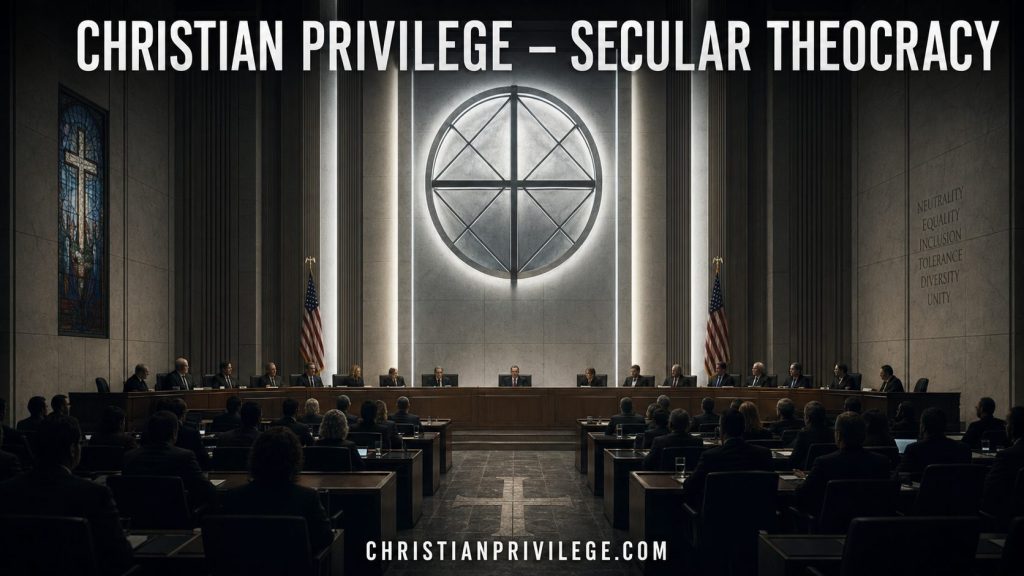
That is the irony at the center of the Christian Privilege debate. A theory that claims to oppose cultural domination often smuggles in its own preferred creed: religion is acceptable only when privatized, muted, and stripped of its power to shape common life. Christianity may be tolerated as a personal hobby, much like gardening or knitting, but the moment it informs public judgment, educational vision, legal reasoning, or civic aspiration, it is recast as suspect—evidence of “privilege,” “hegemony,” or unfair advantage.
This is not pluralism. It is not even secularism in the classic American sense. It is a kind of secular theocracy, where one set of moral assumptions claims exemption from the very scrutiny it directs at everyone else.
Christian Privilege and the Myth of the Empty Public Square
The central fantasy in the rhetoric around Christian Privilege is the belief that public life can be made ideologically empty. According to this vision, if Christian arguments, Christian symbols, Christian vocabulary, and Christian assumptions are pushed to the margins, society will finally become neutral. But there has never been such a thing as a vacuum in public morality.
A society will always privilege something. If it does not privilege biblical language about human dignity, it will privilege some alternative language of dignity. If it does not draw on Christian assumptions about conscience, rights, responsibility, sin, mercy, and justice, it will still draw on some rival set of assumptions, even if it pretends those assumptions are merely “objective,” “modern,” or “universal.”
That is why the attack on Christian Privilege often feels less like a request for equal treatment and more like a demand for unilateral disarmament. Christianity is told to enter the public square only after removing the very beliefs that make it Christian. It may speak, but only in translated language approved by its critics. It may participate, but only as a guest in a house it helped build.
Christian Privilege and the Founders’ Warning
The American founders knew what happened when religion and state fused too tightly, because they had inherited the wreckage of that arrangement. The historical record is not flattering. Colonial America was not a serene interfaith paradise; it was often, as the Smithsonian notes, an “awkward, frequently embarrassing and occasionally bloody tale.”
That bloody history matters because it teaches the right lesson—and the critics of Christian Privilege often draw the wrong one. The lesson was not that Christianity must be banished from public life. The lesson was that the state must not become the manager of souls. Roger Williams argued for a “high wall” between church and state not because he wanted public life sterilized of religion, but because he wanted conscience protected from political corruption and coercion.
James Madison made the same point from another angle. The state, he argued, had no business sponsoring Christian instruction because the power that could elevate Christianity in general could just as easily elevate one Christian sect over another. That is not an argument against Christianity. It is an argument against government pretending it can arbitrate ultimate truth without eventually abusing everyone.
The old American arrangement was not anti-Christian. It was anti-coercion. It assumed that religious conviction was too important to be manipulated by the state and too deeply human to be reduced to administrative categories.
Christian Privilege and the Return of a State Creed
Here is the natural disaster built into the modern critique of Christian Privilege: in trying to eliminate one alleged moral establishment, it lays the groundwork for another. Once public Christian influence is redefined as a problem in itself, power must be given to some authority to measure, regulate, and reduce that influence. And once that happens, a new state creed is born.
Imagine the system required to implement the anti-Christian Privilege vision consistently. Public schools would need standards for identifying excessive Christian assumptions in curriculum, holidays, literature, and speech. Employers would need policies distinguishing between protected private belief and impermissible public religious influence. Courts would increasingly treat visible Christian moral reasoning not as a normal part of democratic life, but as a contaminant requiring neutralization.
In other words, a society supposedly fleeing religious domination would create an apparatus for sorting acceptable and unacceptable belief. It would replace the village priest with the compliance officer. It would swap the catechism for the sensitivity memo. The creed would change, but the pressure to conform would remain.
That is why the critique of Christian Privilege is so often shallow. It points to majority presence and assumes oppression. It notices cultural inheritance and calls it injustice. It sees moral influence and labels it domination. But it does not think seriously enough about the machinery required to dismantle those things.
Christian Privilege and the Difference Between Influence and Imposition
A free society must distinguish between influence and imposition, and much of the Christian Privilege framework fails that test. Influence is unavoidable in any democracy. Every citizen, every community, every tradition attempts to persuade. Imposition happens when the state uses coercive power to compel belief, suppress dissent, or punish conscience.
Those are not the same thing. A church speaking into public debate is influence. A parent arguing from Christian conviction at a school board meeting is influence. A legislator explaining a moral position in biblical terms is influence. None of that is equivalent to a state church, mandatory creed, or civil punishment for heresy.
But the rhetoric around Christian Privilege frequently collapses these categories. It treats Christian visibility as if it were establishment. It treats Christian argument as if it were coercion. It treats Christian social inheritance as if it were proof of illegitimacy. Once that confusion takes hold, democracy itself starts to look like oppression whenever Christians participate in it effectively.
That is an impossible standard. In a nation with deep Christian history and millions of Christian citizens, “neutrality” cannot mean the disappearance of Christian influence. The only way to achieve that would be to restrict Christians more than everyone else. And the moment a system must discriminate in order to appear neutral, it has ceased to be neutral.
Christian Privilege and the Self-Defeating War on Cultural Inheritance
The campaign against Christian Privilege also suffers from a deeper contradiction: it often borrows moral capital from the civilization it is trying to discredit. American ideals of conscience, equality, reform, and human worth were shaped through many streams, but Christianity was one of the largest and most enduring among them.
Even the American story of religious liberty is inseparable from Christians fighting other Christians over the limits of civil power, eventually producing a political settlement in which no one could be forced into uniformity. That is one reason the attempt to portray Christianity as merely an alien or oppressive residue feels historically thin. It ignores the fact that Christianity was not just part of the problem in American history; it was also part of the argument that helped solve the problem.
This does not mean every Christian act in history was noble. The record plainly includes persecution, violence, anti-Catholicism, sectarian panic, and legal discrimination. But that record proves too much for the critics’ case. It shows that the danger lies not in Christianity’s mere public presence, but in any system—religious or secular—that claims too much authority over conscience.
To attack Christian Privilege as if the solution is to erase Christianity from public formation is like trying to cure a patient by draining all the blood. The disease may be real in places; the proposed treatment is fatal.
Christian Privilege and the Bureaucracy of Suspicion
If the anti-Christian Privilege project were implemented honestly, daily life would become governed by suspicion. Christian schools would be presumed socially dangerous unless constantly audited. Churches serving the poor would be scrutinized for the theological assumptions behind their service. Employers, teachers, and public officials would learn to translate or conceal Christian convictions lest they be accused of exercising unfair cultural power.
This is how soft authoritarianism grows—not always through open persecution, but through reputational management, professional fear, and institutional gatekeeping. People are not dragged into court for confessing belief; they simply learn that belief carries a social tax whenever it refuses to stay private.
The result is not peace. It is resentment, fragmentation, and a more tribal society. Christians conclude, not without reason, that they are being asked to participate in public life only on the condition that they deny the sources of their public reasoning. Non-Christians are taught to interpret ordinary Christian presence as a civic threat. The public square becomes less a meeting ground than a minefield.
In that environment, everyone becomes more ideological, not less. Every tradition fights harder for institutional shelter because no one trusts the referees. The promise of liberation gives way to permanent grievance.
Christian Privilege and the American Alternative
The wiser American path is neither Christian domination nor anti-Christian purification. It is a constitutional order in which government does not establish religion, citizens remain free to argue from religious conviction, and no group is asked to disappear in order for others to belong.
That arrangement is messier than the critics of Christian Privilege would like. It means living with public disagreement. It means hearing arguments grounded in traditions one does not share. It means accepting that the public square is not sterile and never will be. But messiness is the price of freedom, and it is far cheaper than the cost of ideological cleansing.
America did not become more free by abolishing religious voice. It became more free by limiting the state and protecting conscience. The genius of that model is that it does not require Christians to rule, and it does not require Christians to pretend they are not Christians.
Christian Privilege and the Danger of Winning the Argument
That is the final problem with the attack on Christian Privilege: if its strongest version actually won, it would produce the very thing it claims to oppose. It would create a society where one moral vision controls the acceptable boundaries of public speech, institutional participation, and civic respectability. It would install a new priesthood of experts, a new orthodoxy of approved language, and a new index of invisible sins.
And because this orthodoxy would call itself neutral, it would be even harder to challenge. Old establishments at least had the honesty to admit they were establishments. The new one insists it is merely fairness while it quietly rewrites the terms of citizenship.
That is why the social criticisms of Christian Privilege are often shallow, dangerous, and impossible to implement. They are shallow because they confuse influence with oppression. They are dangerous because they invite bureaucratic policing of conscience. And they are impossible to implement without building a rival system of favoritism that punishes Christians for remaining visible participants in the nation they helped shape.
A free country does not solve the problem of religious power by manufacturing a secular creed and calling it justice. It solves it by refusing to let the state become anyone’s church.