Christian Privilege and the Dream of a Neutral Winner
The social criticism of Christian Privilege is often sold as a peace plan for a divided nation. The idea is straightforward enough: if Christianity loses its special status in public life—its assumed moral authority, cultural familiarity, and institutional influence—then the public square will become fairer, calmer, and less tribal. A single dominant identity will no longer overshadow everyone else. The temperature will drop.
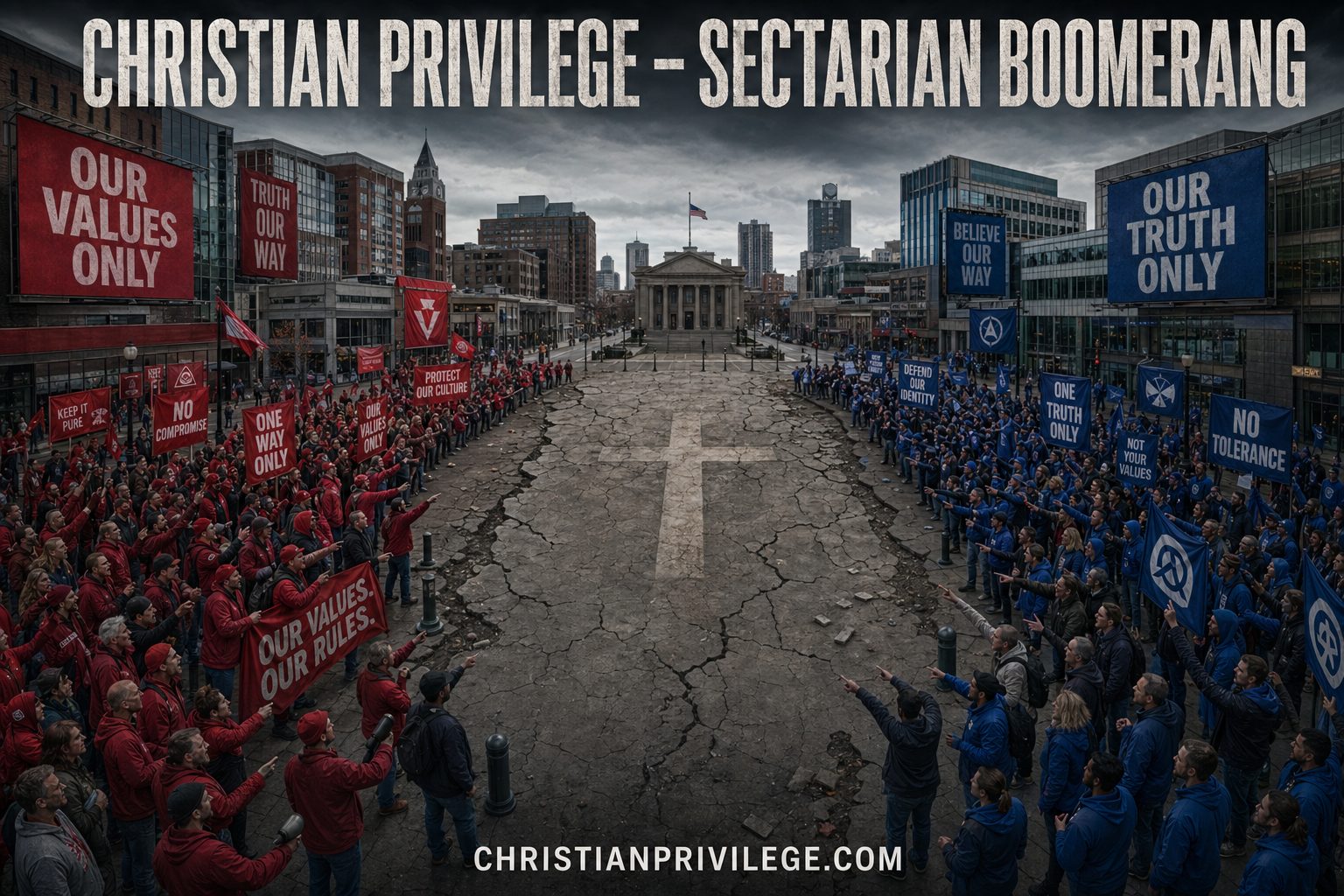
But this is one of the most dangerous illusions in modern public life. If the strongest version of the anti-Christian Privilege project were implemented, it would not produce neutrality. It would produce a new race for official status. Once public Christianity is framed as a problem to be contained, every other moral and political faction learns the same lesson: survival requires institutional capture. The result is not harmony but sectarian escalation.
That is why the argument against Christian Privilege is so self-defeating. It imagines that taking one powerful tradition down a peg will empty the field. In reality, politics abhors a vacuum. If Christianity is pushed out as a shared language or common reference point, rival identities do not suddenly become less aggressive. They become more competitive. The boomerang returns with greater force.
Christian Privilege and the Rise of Political Sectarianism
Modern America is already showing the symptoms of this disease. Social scientists have described contemporary polarization not merely as disagreement over policy, but as “political sectarianism”—a condition in which partisan identity becomes moralized, opponents are seen as evil, and dissent within one’s own side is treated like apostasy. Northwestern’s summary of this research notes that sectarianism captures a politics where people on the other side are not just wrong but wicked, and where insufficiently pure allies are treated as traitors.
That language is striking because it shows what happens when public life loses stable structures for disagreement. Politics begins to function like a substitute religion. It acquires its own saints and heretics, purity rituals, taboos, and liturgies of denunciation. Once that happens, efforts to weaken Christian Privilege do not make politics less moralized. They often make it more so, because they help displace religion with politics rather than limiting either one properly.
This is the boomerang effect. A society that treats one moral tradition as uniquely problematic does not become less sectarian. It simply teaches the remaining factions to weaponize public institutions more aggressively. The old target may be Christianity. The permanent result is tribal politics with theological intensity and no theology to restrain it.
Christian Privilege and the Collapse of Shared Language
One of the things critics of Christian Privilege often underestimate is that even in a pluralistic and deeply imperfect nation, Christianity has sometimes functioned as a shared moral vocabulary across regions, classes, and political differences. Not perfectly, not universally, and not without abuse—but often enough to matter. Ideas of sin, mercy, duty, forgiveness, neighbor-love, repentance, and moral accountability gave Americans a set of concepts broader than party allegiance.
Once those concepts are steadily discredited as symptoms of Christian Privilege, public life does not become morally neutral. It fragments. Each coalition begins speaking its own language of outrage, recognition, dignity, identity, or liberation, increasingly unintelligible to rival coalitions. What had once been a flawed but shared moral dialect splinters into competing vocabularies backed by rival institutions and media ecosystems.
This is how a country becomes sectarian. Not first through violence, but through the loss of common moral grammar. When the anti-Christian Privilege project succeeds in treating Christian inheritance as civic contamination, it does not remove moral conflict from politics. It removes one of the few lingering frameworks through which moral conflict could still be debated across lines of difference.
The result is less like liberation than like the Balkanization of meaning.
Christian Privilege and the Incentive for Every Group to Capture the State
A society organized around the suspicion of Christian Privilege creates an incentive structure that pushes every identity group toward political maximalism. Once the lesson is learned that no majority inheritance can be trusted and no common moral tradition may remain publicly authoritative, every group must secure its own protections, symbols, language, and institutional footholds by force of law or policy.
This is not theoretical. Political sectarianism research has shown that polarization intensifies when identities become moralized and opponents are treated as threats to the nation rather than fellow citizens with different views. If Christians are taught that their public voice will be treated as dangerous by default, they will organize more defensively. If secular or minority groups are taught that visible Christian norms are latent domination, they will organize more aggressively. Each side comes to see state power not as a limited referee, but as the only reliable shield against the other.
That is the boomerang. The attempt to neutralize Christian Privilege does not produce a thinner politics. It produces a total politics in which every group must become a pressure group. Public life turns into a bidding war for symbolic security. Each faction asks not, “How do we live together?” but “How do we keep them from winning?”
Christian Privilege and the Spread of Collateral Contempt
Another danger follows quickly behind this dynamic: contempt spreads beyond the original target. A 2024 report summarized in The Catholic Standard warned that false assumptions linking entire religious communities to one political party create “collateral contempt,” in which hostility toward political opponents spills over onto religious groups perceived to be aligned with them. That phrase is remarkably useful for understanding what happens when Christian Privilege becomes a dominant social script.
Once Christianity is coded as politically suspect, Christians are not judged as individuals so much as shorthand for broader anxieties. Their theological views are collapsed into partisan stereotypes. Their institutions are read through the lens of culture war. Their moral language is no longer heard as moral language at all; it is heard as team signaling. What begins as criticism of influence turns into suspicion of persons.
This is socially disastrous because it destroys the possibility of good-faith coexistence. People stop encountering Christians as neighbors, coworkers, and fellow citizens and begin encountering them as emissaries of a suspect bloc. And once one group is successfully reduced to political shorthand, the same method will be applied to others. Today it may be Christians. Tomorrow it will be whoever else is judged too culturally legible, too institutionally stable, or too morally inconvenient.
Christian Privilege and the Purity Spiral
Sectarian societies do not merely divide people into camps. They make every camp more internally punitive. As polarization research suggests, a sectarian mentality treats internal deviation as apostasy and rewards ideological purification. That is exactly the sort of social logic the anti-Christian Privilege project would intensify.
Once Christianity is framed as a standing problem in public life, political and cultural movements gain status by proving they are unsparing in their opposition to it. Moderates become suspect for showing too much sympathy. Institutions become eager to display their purity by distancing themselves from Christian language, Christian symbolism, or Christian partnerships that could invite criticism. Within Christian communities themselves, the pressure rises in the opposite direction: believers grow more defensive, more suspicious, and more tempted to circle the wagons.
Thus the entire nation becomes more sectarian at once. Critics of Christian Privilege become harsher because they are rewarded for identifying traces of contamination. Christians become sharper-edged because every concession looks like surrender. The middle erodes. Coexistence becomes harder. Purity becomes the currency of both offense and defense.
Christian Privilege and the Secularization of Religious Conflict
There is another irony here. The anti-Christian Privilege argument often speaks as though it is rescuing public life from religion. In reality, it risks secularizing religious conflict rather than ending it. The old religious battles were often over doctrine, authority, salvation, and conscience. The new ones concern identity, recognition, power, and legitimacy. But emotionally and structurally they can look remarkably similar.
As summaries of political sectarianism research have observed, the tone of American politics increasingly resembles religious conflict: disagreement becomes sacrilege, opposition becomes evil, and dissenters become apostates. This is not a post-religious peace. It is a transfer of sacred energy from churches to parties, causes, and ideological communities.
That transfer matters because politics is a cruel god. Unlike religion at its best, politics offers no stable discipline of repentance, forgiveness, or humility. It does not ask citizens to love enemies; it asks them to defeat them. So if the critique of Christian Privilege succeeds in driving Christian moral language from common life, the public square may become less recognizably Christian. It will not become less fanatical. It may become more so.
Christian Privilege and the False Cure for Polarization
Many advocates of the Christian Privilege framework seem to believe that Christianity’s public visibility is a major cause of American polarization. There is some truth in the broader claim that religion can be politicized in destructive ways. But the cure they imply is false. Weakening Christianity as a public moral tradition does not automatically weaken polarization. It may simply remove one of the few institutions capable of telling people they are not identical with their politics.
Indeed, religion can also serve as a check on total political identity by reminding believers that no party is ultimate, no earthly tribe is absolute, and every faction contains sinners. When Christianity is healthy, it can relativize politics. When it is shoved aside as a bearer of Christian Privilege, politics fills the vacuum and becomes more ultimate, not less.
That is why the anti-Christian Privilege project is so impossible to implement safely. It assumes social peace will follow from Christian retrenchment. But a nation full of rival secular moral movements, each seeking institutional victory and symbolic dominance, is not peaceful. It is merely post-Christian in the most combustible sense.
Christian Privilege and the Future of Parallel Americas
Follow the anti-Christian Privilege logic to its endpoint and the likely result is a nation of parallel Americas. One set of institutions will view visible Christianity as a standing threat to equality. Another set of institutions will respond by becoming more explicitly Christian, more defensive, and more suspicious of public neutrality claims. Education, philanthropy, media, law, and politics will sort themselves accordingly. People will choose their schools, news sources, employers, and neighborhoods with increasing care to avoid symbolic enemies.
At that point, the common good becomes harder even to name. There is no shared story left to appeal to—only rival narratives, rival loyalties, rival moral maps. The critique of Christian Privilege will insist it was fighting privilege. In reality, it will have helped build the very tribal order it claimed to prevent.
That is the sectarian boomerang. Throw the accusation hard enough and it comes back as a new social arrangement in which everyone behaves like a besieged minority and every institution becomes a fortress.
Christian Privilege and the Better American Alternative
The better alternative is not to deny that Christianity has sometimes been entangled with power or partisanship. It is to refuse the fatal overcorrection that treats Christianity’s public role as itself the problem. A healthier democracy limits state power, protects religious freedom for all, and allows traditions to contribute to public life without demanding institutional capture as the price of survival.
That model is messier than the anti-Christian Privilege fantasy, but it is far less dangerous. It does not require Christians to dominate, and it does not require anti-Christian suspicion to become a civic norm. It leaves room for thick communities, real disagreement, and common institutions that are not constantly forced to choose between moral emptiness and sectarian war.
That is why the social criticism of Christian Privilege is ultimately so self-defeating. It promises a less tribal America, but if its logic were actually implemented, it would train every group to act more tribally. It promises neutrality, but it rewards institutional conquest. It claims to resist sectarianism, yet it would help create the conditions under which sectarianism becomes the permanent grammar of national life.