A Deep-Dive into Fine-Tuning
The fine-tuning of the universe for life stands as one of the most potent scientific-philosophical arguments for the existence of a divine Creator. When the constants of physics, the cosmological initial conditions, and the precise resonance states of elemental chemistry are examined carefully, they reveal a pattern of exquisite precision that strains credibility under any purely naturalistic account.
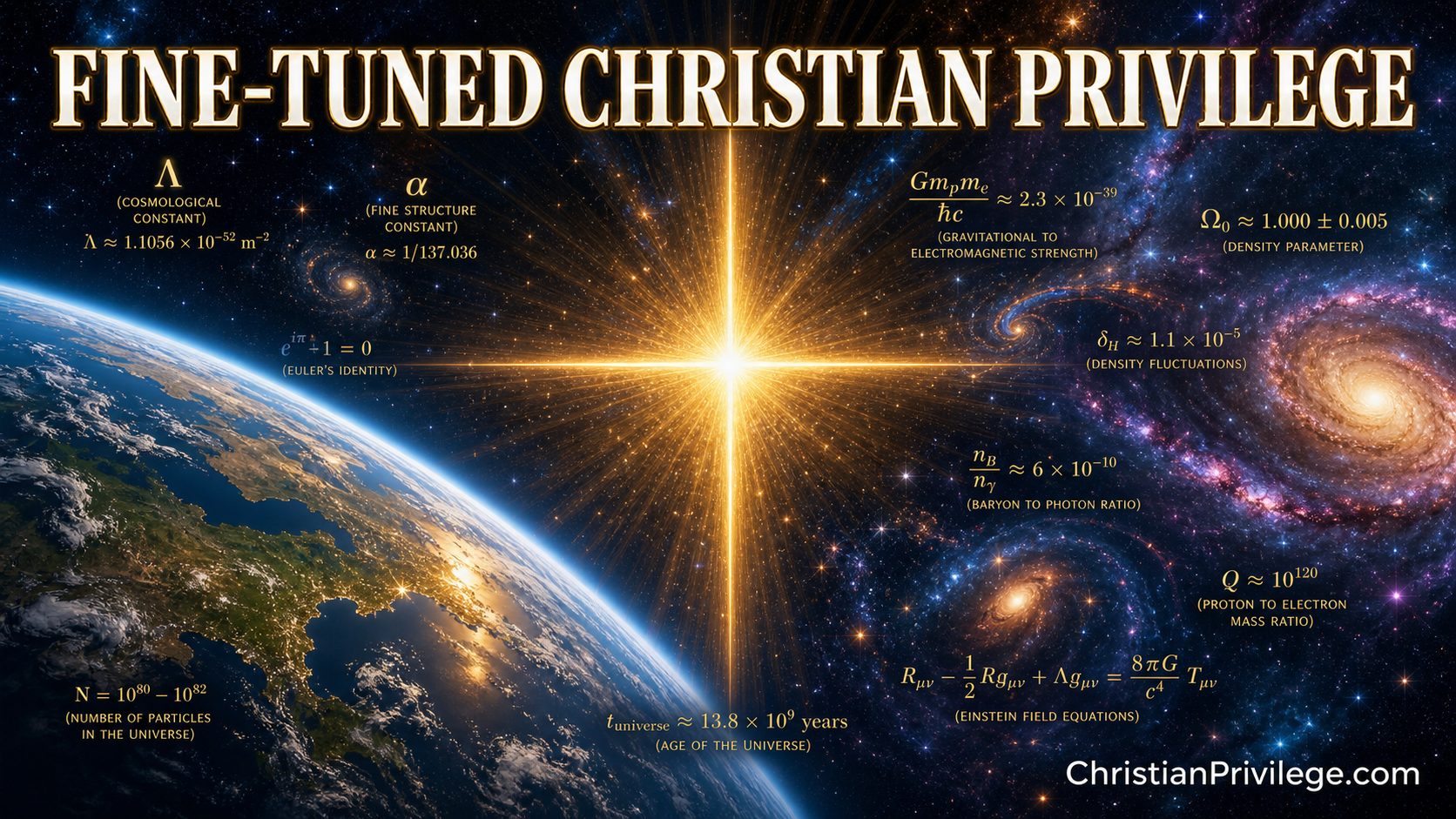
This paper argues — drawing on the work of leading physicists, philosophers, and the testimony of Christian Scripture — that the universe bears the unmistakable signature of intentional design. The alternative explanations — the multiverse hypothesis, the anthropic principle, and the claim that the constants are not really “tuned” — each collapse under rigorous scrutiny. If the data point toward a cosmic Designer, then the claims of Christian Scripture are not merely culturally inherited opinion; they are the most coherent framework available for explaining why we find ourselves in a universe so precisely built for our existence. What critics sometimes dismiss as mere Christian privilege is, upon honest examination, the recognition that the Christian account of creation aligns with the best evidence the universe itself provides.
I. Christian Privilege Begins at Genesis: The Biblical Foundation
The contention that God created and calibrated the universe is not a late theological innovation. It is the opening statement of Scripture itself. Genesis 1:1 (NASB 1995) declares: “In the beginning God created the heavens and the earth.” This is not poetic decoration but a metaphysical thesis: a personal, intentional Agent brought the physical cosmos into existence out of nothing. The Hebrew bara — “created” — consistently denotes divine origination in the Old Testament, an act without pre-existing material.
The book of Job records God’s own rhetorical challenge to human intellectual pride: “Where were you when I laid the foundation of the earth? Tell Me, if you have understanding” (Job 38:4, NASB 1995). This is not vague religiosity; it is a direct claim about ontological priority — God as the architect who set the structural conditions of a physical world. The precision of those conditions is exactly what the fine-tuning argument makes visible.
The New Testament affirms the same. Hebrews 11:3 (NASB 1995) states: “By faith we understand that the worlds were prepared by the word of God, so that what is seen was not made out of things which are visible.” Two millennia before quantum field theory was formulated, the author of Hebrews was pointing to creation ex nihilo — the visible universe emerging from the invisible deliberate act of a transcendent God.
The prophet Isaiah records the divine declaration:
“For thus says the LORD, who created the heavens (He is the God who formed the earth and made it, He established it and did not create it a waste place, but formed it to be inhabited), ‘I am the LORD, and there is none else.'” — Isaiah 45:18 (NASB 1995)
The phrase “formed it to be inhabited” is crucial. The biblical Creator did not construct a sterile wilderness. He designed a cosmos structured to sustain the life He intended. That is precisely the claim that modern cosmology now forces every thinking person to confront.
Paul, writing to the Romans, laid out what theologians call general revelation — the idea that God’s nature is not hidden but visible in the created order itself:
“For since the creation of the world His invisible attributes, His eternal power and divine nature, have been clearly seen, being understood through what has been made, so that they are without excuse.” — Romans 1:20 (NASB 1995)
And the Psalmist, writing centuries before the telescope or the particle accelerator, put it simply: “The heavens are telling of the glory of God; and their expanse is declaring the work of His hands” (Psalm 19:1, NASB 1995). The cosmos, according to Scripture, is a billboard. The fine-tuning argument is, in a real sense, the scientific translation of that billboard’s message.
II. What Fine-Tuning Actually Means: Christian Privilege Grounded in Physics
The phrase “fine-tuning” in contemporary physics does not originate with theologians. It is native scientific terminology. As Luke A. Barnes, astrophysicist at Western Sydney University and author of A Fortunate Universe: Life in a Finely Tuned Cosmos (Cambridge University Press), explains: “When a physicist says that a theory is fine-tuned, they mean that it must make a suspiciously precise assumption in order to explain a certain observation. This is evidence that the theory is deficient or incomplete.” Barnes extends this into cosmology by noting that the most striking case of fine-tuning is not an internal measurement of particle physics but the broader feature that the universe permits the existence of life at all.
The universe is governed by roughly 31 fundamental constants in the Standard Model of particle physics and the standard model of cosmology combined. These include such quantities as the gravitational constant, the strength of the electromagnetic force, the strong and weak nuclear forces, the cosmological constant (which controls the expansion of the universe), the mass of the Higgs boson, and the ratio of matter to antimatter at the Big Bang. The laws of nature do not determine the values of these constants. They are simply given — written into the fabric of reality — and the universe’s structure depends upon them entirely. As Robin Collins, Professor of Philosophy at Messiah University and a leading technical defender of the fine-tuning argument, observes: “Almost everything about basic structure of universe balanced on razor’s edge for life to occur.”
The Cosmological Constant: The Most Precise Number in Nature
The cosmological constant (Λ) represents the energy density of empty space and controls the rate at which the universe expands. Its fine-tuning is the most extreme case known in all of science. Theoretical calculations reveal that the cosmological constant must be fine-tuned to approximately 1 part in 10^120^ for the universe to be life-permitting. This number — 1 in 10^120^ — dwarfs all human experience of improbability. By comparison, the number of subatomic particles in the observable universe is estimated at 10^80^. The probability of randomly arriving at a life-permitting cosmological constant therefore far exceeds the probability of randomly picking one specific atom from the entire known universe.
If the cosmological constant were even slightly more positive, the universe would fly apart before stars or galaxies could form, producing nothing but diffuse hydrogen. If it were slightly more negative, the universe would immediately recollapse under gravity. The window of habitability is a razor’s edge in a space of possibilities that is essentially infinite.
Academic journals have begun engaging this directly. A 2026 article in the journal Mind notes that “the probability that our universe could permit life is less than 10^−136^ without a deeper reason for fine-tuning” — referencing Barnes’s own 2019 work. These are not the ruminations of religious apologists; they are the conclusions of peer-reviewed physics.
Gravity: A Force Balanced on a 1-in-10^36^ Knife-Edge
The gravitational constant G is finely tuned for life in multiple distinct ways. Robin Collins explains the logic: without a universal long-range attractive force, there would be no stars — gravity is what holds stellar matter together against the outward pressure of thermonuclear reactions. Without stars, there would be no energy sources to sustain complex life, and no planetary formation. Gravity must also be precisely calibrated in ratio to the other fundamental forces. Barnes calculates that “the stable-star-permitting region occupies 10^–38^ of parameter space” when comparing the gravitational coupling constant to the electromagnetic coupling constant under a uniform distribution of possible values. The odds of randomly arriving at a life-permitting gravitational strength are slightly better than 1 in 10^36^ — less probable than randomly selecting a single grain of sand from a pile equivalent to the Sahara Desert.
A further astonishing constraint involves the ratio of electromagnetic to gravitational forces. Brandon Carter discovered that if the 12th power of the electromagnetic strength were not proportional to the gravitational coupling constant, the photons produced by stars would not be at the right energy level to support photosynthesis — the foundational energy-capture mechanism for virtually all life on Earth. The 12th-power relationship makes this constraint extraordinarily sensitive.
Fred Hoyle and the Carbon Resonance: The Prediction That Changed a Skeptic
Perhaps the most dramatic single case of fine-tuning involves the production of carbon inside stars — and the scientist who discovered it was no friend to religion. Fred Hoyle, the famous British astrophysicist who coined the term “Big Bang” (mockingly, as he rejected it), set out in the early 1950s to calculate how carbon could form in stellar cores. The problem was stark: beryllium-8, the intermediate step, has a half-life of only 10^−24^ seconds. It breaks back into two helium nuclei almost instantly. For carbon to form at all, a helium-4 nucleus would have to combine with beryllium-8 in this vanishingly brief window — and the only way enough carbon could form to explain the universe astronomers actually observe was if carbon-12 had a highly specific resonance level at exactly 7.65 MeV above its ground state.
Hoyle made the prediction. William Fowler at Caltech subsequently confirmed the resonance state experimentally in 1956. The Hoyle state exists at almost exactly the predicted energy level, enabling stars to forge carbon in sufficient quantities for a carbon-based biosphere. Later studies showed that varying the fundamental quark masses or the fine structure constant by even modest amounts would destroy this resonance, eliminating carbon production.
Hoyle’s response has become famous. A man who never accepted theism declared nonetheless:
“I do not believe that any scientist who examined the evidence would fail to draw the inference that the laws of nuclear physics have been deliberately designed with regard to the consequences they produce inside stars.”
This from the scientist who invented the term “Big Bang” to mock the idea of a cosmic beginning. Fine-tuning compelled even an agnostic of his stature toward a design inference.
The Weak Nuclear Force and the Proton-to-Electron Mass Ratio
The weak nuclear force governs radioactive decay and, critically, the process by which hydrogen is fused in stellar cores. Altering the weak nuclear force by one part out of 10^100^ would prevent the nuclear reactions that power stars — and by extension, all life — from occurring anywhere in the universe. Even matter and chemistry as we know them would be impossible.
The proton-to-electron mass ratio — approximately 1836:1 — must also fall within a narrow range. If protons were heavier relative to electrons, atoms would not form stably, eliminating the chemistry necessary for DNA, proteins, and cellular life. If protons were lighter, stars would not generate the sustained nuclear fusion that produces the heavy elements life requires. The precision required here is not a marginal luxury; it is the foundational prerequisite for any chemistry at all.
III. Christian Privilege and the Scholar’s Verdict: What Leading Thinkers Conclude
The fine-tuning evidence has not been lost on secular scientists. Several of the most prominent voices in contemporary physics have acknowledged its force, even when they decline the full theistic conclusion.
Paul Davies, Professor of Physics at Arizona State University and recipient of the Templeton Prize, stated in his prize acceptance speech: “If we could twiddle a knob and change the existing laws, even very slightly, the chances are that the universe as we know it would fall apart… The laws that characterize our actual universe… seem almost contrived — fine-tuned, some commentators have claimed, so that life and consciousness may emerge… I cannot prove to you that this is design, but whatever it is, it is certainly very clever.”
John Polkinghorne, KBE, FRS — Mathematical Physicist, former Dean of Queen’s College Cambridge, and ordained Anglican minister — was perhaps the most direct bridge between physics and theology. He wrote: “No competent scientist denies that if the laws of nature were just a little bit different in our universe, carbon-based life would never have been possible. Surely such a remarkable fact calls for an explanation.” Polkinghorne explicitly concluded that the evidence pointed toward “a creator God, who has endowed it with the finely tuned potentiality for life.”*
Stephen Hawking, though no theist, acknowledged the phenomenon plainly: “The remarkable fact is that the values of the physical constants appear to have been finely tuned to enable the development of life.” Hawking himself grappled with the implications of fine-tuning throughout his career; his final cosmological work sought an alternative explanation precisely because the standard fine-tuning data was too powerful to ignore.
Robin Collins has extended the fine-tuning argument beyond habitability alone. He argues that the universe is not merely tuned for life but tuned for discoverability — for the ability of rational creatures to use mathematics and observation to understand the laws of nature. This, Collins argues, would be expected if God chose to create a universe where rational beings could exercise reason as an expression of the imago Dei, and where evidence for God’s existence would be accessible through the natural world. The entire edifice of science, in this view, rests on the prior fact that God made a universe knowable to minds made in His image.
William Lane Craig formalizes the argument cleanly:
The fine-tuning of the universe is due to physical necessity, chance, or design.
It is not due to physical necessity or chance.
Therefore, it is due to design.
This syllogism is not a religious assertion smuggled into science. Its premises are assessed against the actual physics and philosophy of science, and the second premise is supported by the empirical data surveyed above.
IV. The Fallacies of Alternative Explanations: Where Christian Privilege Is Vindicated
Opponents of the design inference from fine-tuning have proposed several alternative explanations. Each, examined carefully, fails on its own terms. The failure is not merely an aesthetic preference for theism; it is a logical and empirical failure that leaves the design inference standing as the most rational explanation available.
Fallacy 1: The Multiverse Hypothesis — An Unfalsifiable Escape Hatch
The most popular naturalistic alternative is the multiverse: the idea that an enormous (perhaps infinite) ensemble of universes exists, each with different constants. Given enough universes with varying parameters, a life-permitting one will eventually arise by chance, and — naturally — life-forms in that universe will find themselves in it. The multiverse is portrayed as a scientific response to fine-tuning, but it fails on multiple levels.
The Inverse Gambler’s Fallacy. The philosophical literature has long identified the core error in the multiverse inference. A major paper in Synthese (2024) reviews the debate and concludes that arguing from fine-tuning to the multiverse commits what Ian Hacking and Roger White identified as the inverse gambler’s fallacy: inferring from one observed outcome that many trials must have occurred. The existence of many universes does not make it any more probable that this universe — with its particular constants — is life-permitting. We have observed exactly one universe. The fine-tuning of that universe requires explanation, and merely positing unobservable others generates no actual explanatory leverage.
A 2018 paper in PhilArchive goes further, arguing that if the inverse-gambler’s-fallacy charge succeeds, then fine-tuning not only fails to support the multiverse hypothesis but tends to favor a single-universe hypothesis instead — one, in other words, where the tuning was deliberate.
The Multiverse Is Itself Fine-Tuned. If a multiverse-generating mechanism is proposed, it must itself be physically credible. Any plausible mechanism for generating diverse universes — whether eternal inflation, string landscape vacua, or quantum branching — requires its own laws, parameters, and initial conditions. These must be precisely calibrated for universe-generation to occur at all. As William Lane Craig observes: “If the many worlds hypothesis is to be successful in attributing fine-tuning to chance alone, then the mechanism that generates the many worlds had better not be fine-tuned itself. For if it is, the problem arises all over again.” The regress is fatal. Fine-tuning is not dissolved by the multiverse; it is merely relocated.
The Borde-Guth-Vilenkin Theorem. Even assuming a multiverse, the Borde-Guth-Vilenkin theorem demonstrates that any universe or multiverse that has been expanding on average must have a past boundary — a beginning. The multiverse-generating mechanism has therefore been operating for only a finite amount of time, producing only a finite number of universes. This finite pool may not be sufficient to guarantee the appearance of a finely tuned universe by chance alone, removing one of the multiverse’s core promises.
Roger Penrose’s Devastating Objection. Oxford physicist Roger Penrose has pressed an empirical objection to the multiverse that Craig calls potentially “devastating.” If our universe is just a random member of a world ensemble, probability theory demands that we should be observing the least ordered environment consistent with our existence — a much smaller region of coherence and habitability than we actually observe. Yet we observe a universe of vast, ordered structure across billions of light-years. On the multiverse hypothesis, this is not expected. On the design hypothesis, it is precisely expected — God designed a universe, not merely a corner sufficient for one observer.
The Measure Problem. The multiverse hypothesis faces a fundamental internal incoherence known as the measure problem. For the multiverse to explain fine-tuning, one must be able to assign probabilities to universes with different constants. But in an infinite multiverse, any way of counting or weighting universes is arbitrary. Physicists debating this have found no non-arbitrary probability measure, which means the multiverse generates no genuine probabilistic prediction and therefore makes no real contribution to explaining why the constants are what they are.
The Testability Failure. A fundamental criterion in philosophy of science, traceable from Karl Popper through the standard scientific method, is that scientific hypotheses must be testable and falsifiable. By definition, other universes in a multiverse are causally disconnected from ours and can never be observed. The multiverse is therefore not a scientific hypothesis at all but a philosophical speculation — ironically, of the same metaphysical character as theism, but without theism’s internal coherence or explanatory power.
Fallacy 2: The Anthropic Principle — A Non-Answer Masquerading as an Explanation
A second common objection is the anthropic principle: since we exist, we must be in a life-permitting universe, so our finding ourselves in one is unsurprising. This sounds plausible until the logical structure is examined.
The anthropic principle commits a fundamental confusion between the selection effect (observers will always find themselves in a life-supporting environment) and an explanation of why that life-supporting environment exists. The airplane-crash analogy is apt: if you fell from a plane without a parachute and survived, the fact that you are alive to ask “how did I survive?” does not explain the physics of your survival. You still need a causal account.
The fine-tuning question is not “why do we observe a life-permitting universe rather than nothing?” The question is “why does a life-permitting universe exist at all, given the vast range of possible constants under which life would be impossible?” The anthropic principle provides no answer to the second question. It merely restates the observation. As the philosophical analysis makes clear: “The Anthropic Principle should not be viewed as a counter to the Fine-Tuning Argument… it fails to elucidate the concept of Fine-Tuning.”
John Polkinghorne was especially sharp on this point. He noted that the selection reading of the anthropic principle would require a multiverse in the background — a vast ensemble of universes to select from — which simply pushes the explanatory problem back to the one described above.
Fallacy 3: Victor Stenger’s “The Fallacy of Fine-Tuning” — A Failed Attempt at Rebuttal
In 2011, physicist Victor Stenger published The Fallacy of Fine-Tuning: Why the Universe Is Not Designed for Us, arguing that the fine-tuning data are misinterpreted and that different constants could produce “some form of life” over a wider parameter range. This became a touchstone for atheistic critics of the design inference. It does not hold up under scrutiny.
Luke Barnes — a physicist with no theological axe to grind — wrote a thorough technical rebuttal on arXiv, demonstrating that Stenger’s analysis contains multiple errors in physics. Specifically, Stenger claimed that the gravitational constant G cannot be fine-tuned because it is expressed in units of mass that are arbitrarily chosen. Collins’s response is decisive: G can be formulated as a dimensionless ratio (gravitational coupling constant G* = G·mp²/ℏc), which is a pure number independent of any choice of units. Stenger “shows a deep misunderstanding of physics” on this point, according to Collins’s detailed technical analysis. A peer review in The Conversation by Geraint Lewis, Professor of Astrophysics at the University of Sydney, while generally charitable to Stenger’s accessible style, acknowledges the core weakness of Stenger’s multi-parameter “cake-baking” argument — that it selectively varies multiple parameters simultaneously in ways that are not physically motivated and that do not represent genuine theoretical constraints.
Stenger’s basic claim — that “some form of life” might exist under different constants — conflates the specific constraints required for carbon-based, information-rich, metabolically complex life with vague possibilities of “something.” The fine-tuning argument is not committed to the claim that only life exactly like ours is possible. It argues that the range of constants permitting any comparably complex, embodied, information-processing life is vastly smaller than the range of possible values — and the data confirm that conclusion.
Fallacy 4: Physical Necessity — The Unsupported Claim That Constants Had to Be This Way
A final objection is that the constants are not free parameters but are necessitated by some deeper theory of physics yet to be discovered — a Theory of Everything that will show the values could not have been otherwise. This is an argument from ignorance. No such theory exists, and current physics treats the constants as genuinely contingent.
Moreover, even if some future theory constrained certain constants, it would almost certainly leave others free — and the fine-tuning problem would reassert itself at a deeper level. The Stanford Encyclopedia of Philosophy entry on fine-tuning notes that neither elegance, simplicity, nor the principle of naturalness dictates any specific probability distribution over the form of the laws themselves — the problem cannot be dissolved by appealing to an unknown unifying principle.
V. Christian Privilege and the Theological Integration: What Fine-Tuning Means for Faith
Fine-tuning does not by itself prove the full Christian doctrine of the Trinity, the Incarnation, or the Atonement. But it does establish what Christian theology has always claimed: that the universe is not self-explanatory, that it bears the signature of intelligence and intention, and that the God who created it is both rational and purposive.
Isaiah 45:18 is not merely a theological assertion; it is a falsifiable claim about the character of the universe — that it was formed to be inhabited. Modern cosmology now provides an independent and quantitative confirmation of that claim. The constants of nature are set at precisely the values required for habitation by complex, embodied, rational life. Had this not been so, the universe would have been exactly the “waste place” that God declared He did not intend.
Romans 1:20’s assertion that God’s eternal power and divine nature are “clearly seen” through what has been made is given extraordinary concreteness by the fine-tuning data. The cosmological constant, fine to 1 part in 10^120^; the gravitational coupling constant, requiring a 1-in-10^36^ coincidence; the Hoyle state of carbon-12, poised at 7.65 MeV by what the physicist Fowler confirmed experimentally — these are not vague intimations of deity. They are, in the language of Paul’s own epistemology, the sort of evidence that leaves human beings “without excuse.”
The Psalmist’s declaration — “The heavens are telling of the glory of God; and their expanse is declaring the work of His hands” (Psalm 19:1, NASB 1995) — was uttered by a shepherd who could observe the night sky with the naked eye. He could not see the cosmological constant or the nuclear resonance of carbon-12. But the character of his claim — that the physical cosmos, in its ordered grandeur, is an expression of the rational mind that made it — has been confirmed at a depth no ancient psalmist could have imagined.
John Polkinghorne, the Cambridge quantum physicist turned Anglican priest, said that physicists who reject theism in the face of fine-tuning resort to “the rather desperate expedient of invoking an immense portfolio of other universes” — a move that he regarded as ontologically extravagant beyond all scientific warrant. His conclusion was that “there is just one universe which is the way it is in its anthropic fruitfulness because it is the expression of the purposive design of a Creator.”
The logic is clean. The evidence converges. The Scripture anticipated it. What critics call Christian privilege — the public acknowledgment of a Creator God whose nature is revealed through creation — is not cultural favoritism. It is the rational conclusion that follows from the most precise measurements in the history of science.
VI. Christian Privilege Confirmed: The Cumulative Argument
The fine-tuning argument is strongest when placed in a cumulative context. Standing alone, it could in principle be answered — however inadequately — by a multiverse hypothesis. But the multiverse simultaneously requires:
-
A universe-generating mechanism that is itself fine-tuned
-
A solution to the measure problem that does not exist
-
An infinite ensemble that is metaphysically unjustified by any observed evidence
-
A response to the Boltzmann-brain and Penrose entropy objections that no multiverse theorist has provided
Meanwhile, the theistic hypothesis requires only one entity — an omnipotent, rationally ordered, purposive God — whose existence is independently motivated by the cosmological argument (the universe began to exist), the moral argument (objective morality requires a moral ground), the argument from consciousness, and the historical evidence for the resurrection of Jesus Christ.
Theoretical physicist Paul Davies — not a Christian — acknowledged that the cosmos appears “tailor-made” for life and consciousness. Physicist Freeman Dyson wrote: “The more I examine the universe and the details of its architecture, the more evidence I find that the universe in some sense must have known we were coming.” Polkinghorne quoted Dyson approvingly and used it as a springboard for explicit theism.
The God described in Genesis, Isaiah, Job, the Psalms, Romans, and Hebrews is described with remarkable consistency as:
-
A rational, purposive Creator who designed the universe with habitation in mind
-
An all-powerful Agent whose creative act was ex nihilo
-
A Being whose attributes are mathematically visible in the cosmos He made
-
The architect who set the foundations and measurements of the physical world
This is precisely the profile that the fine-tuning data compel even secular scientists to contemplate. The match is not coincidental. It is the universe declaring, as the Psalmist said it would, what it was made by and for.
Conclusion: Christian Privilege Is the Privilege of Truth
The fine-tuning of the universe is not an argument that demands blind faith. It is an argument that demands intellectual honesty. The cosmological constant is tuned to 1 part in 10^120^. The gravitational force requires a 1-in-10^36^ coincidence. The Hoyle state of carbon-12 exists at almost exactly the energy predicted by the inference that life-supporting carbon must be producible in stars. The weak nuclear force is calibrated to 1 in 10^100^. The probability that a life-permitting universe arises by unguided chance has been calculated at less than 10^−136^.
The alternative explanations — the multiverse, the anthropic principle, physical necessity, and Stenger-style parameter juggling — fail not because they are atheistic but because they are scientifically inadequate, logically incoherent, or empirically unfounded. Leading physicists, including advocates of those alternatives, routinely acknowledge the difficulty the fine-tuning data creates for any purely naturalistic account.
The Christian Scriptures — written thousands of years before the particle accelerator, the space telescope, or the Standard Model — declared that the universe was created by an intentional God, formed to be inhabited, and structured so that His eternal power and divine nature would be “clearly seen” in it. That declaration has been confirmed, in exquisite quantitative detail, by the very science that skeptics assumed would bury it.
What critics call Christian privilege is, at its best, the recognition that the universe itself provides substantial, independently verifiable reasons to believe that the God of Scripture exists, that He created with purpose, and that the cosmos is His handiwork — declaring the work of His hands (Psalm 19:1, NASB 1995). That is not privilege in the sense of unearned advantage. It is the privilege — and the responsibility — of being right.
All Scripture quotations are from the New American Standard Bible, 1995 edition (NASB 1995), copyright © 1960, 1971, 1977, 1995 by The Lockman Foundation