One of the most powerful and personally resonant arguments for the truth of Christian theism is the argument from moral reality. When human beings argue, protest injustice, celebrate heroism, condemn cruelty, or insist that some things are just plain wrong, they are presupposing something deeply important: that moral reality exists outside of individual preference or cultural convention. The question the Christian apologist presses is simply this — why should that be so in a purely material universe? If the cosmos is nothing more than matter in motion, particles interacting across time by impersonal physical laws, there is no mechanism by which moral obligation enters the picture. Yet the deepest moral instincts of humanity insist that it does. Christianity offers a coherent, grounded explanation for that moral reality. Materialism does not.
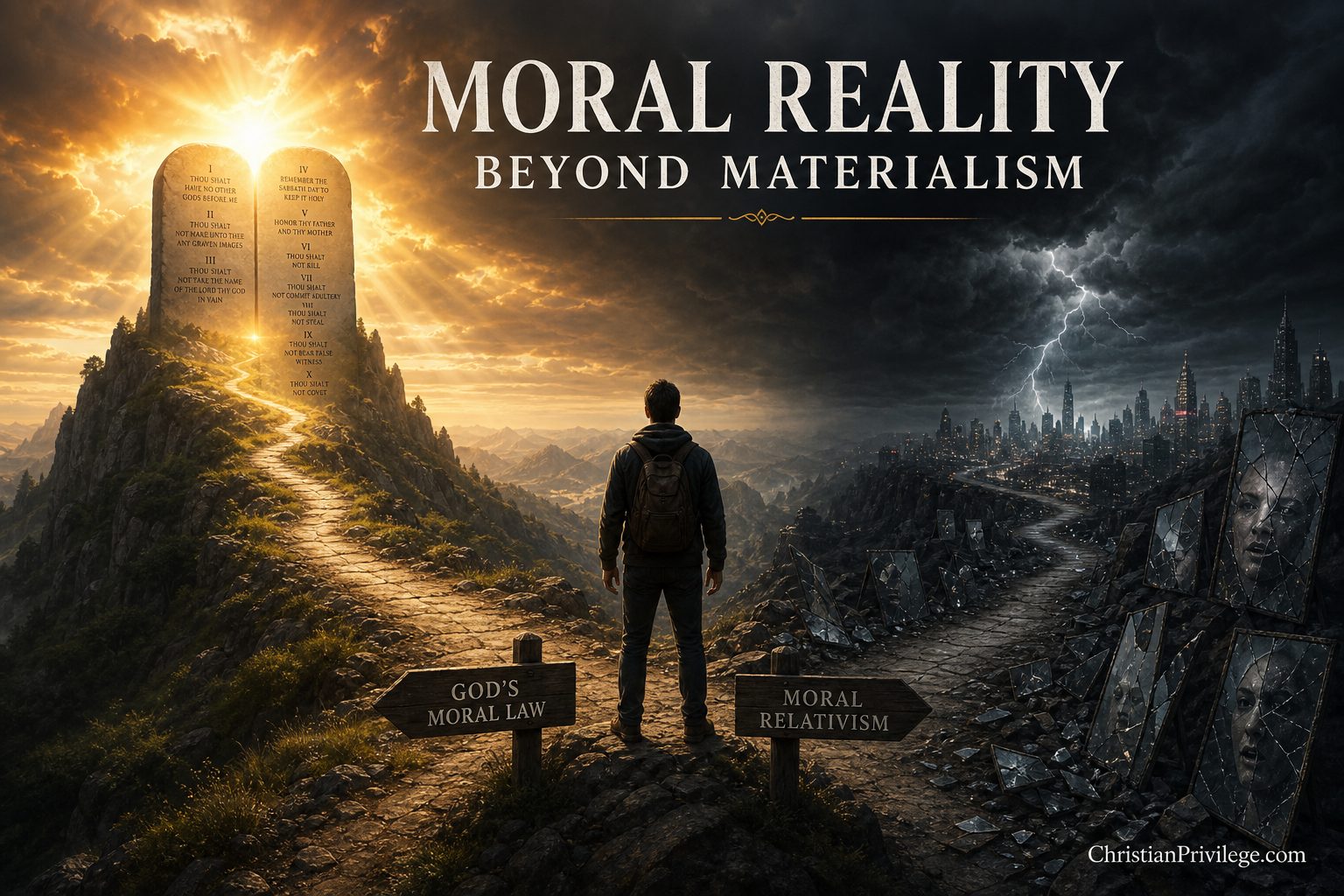
The Christian Privilege of a Fixed Moral Standard
The moral argument for Christian theism has been stated in its clearest modern form by philosopher and theologian William Lane Craig:
-
If God does not exist, objective moral values and duties do not exist.
-
Objective moral values and duties do exist.
-
Therefore, God exists.
The force of this argument rests on the second premise, which Craig insists is intuitively obvious to virtually all people. He writes that to say the Holocaust was objectively wrong is to say it would still have been wrong even if the Nazis had won World War II and succeeded in exterminating or brainwashing everybody who disagreed with them. This is not a merely emotional conviction. It is a recognition of a moral fact that stands independently of what any majority, culture, or ideology decides. The only question is: what grounds that fact?
Christianity answers that question directly. Moral reality is grounded in the character and nature of God — not arbitrarily handed down as commands, but flowing necessarily from a being who is perfectly and unchangingly good. As Stand to Reason’s analysis explains, God’s commands flow from His objective, morally perfect nature. He does not arbitrarily declare things good or evil according to His changing whims because God does not change. He is not simply a subject who prefers certain things; He is the ground of being and the objective standard of goodness by which all other goods are measured. This resolves the ancient Euthyphro dilemma by recognizing that God’s nature is itself the standard — He does not command things because they are good (as if goodness stands above Him), nor are they good merely because He commands them (as if His commands are arbitrary). Rather, His commands express what He is.
The Law Written on Every Heart: Christian Privilege in Universal Moral Experience
One of Scripture’s most remarkable claims is that this moral reality is not hidden from humanity — it is inscribed into human nature itself. The Apostle Paul writes in Romans 2:14–15 (NASB 1995):
“For when Gentiles who do not have the Law do instinctively the things of the Law, these, not having the Law, are a law to themselves, in that they show the work of the Law written in their hearts, their conscience bearing witness and their thoughts alternately accusing or else defending them.”
Paul’s point is stunning in its reach: even people who have never received the Mosaic Law — people from every culture, tribe, and nation across history — still demonstrate an internal awareness of moral principles. They know it is wrong to murder, steal, betray, or oppress. They may violate these norms, but they cannot permanently silence the conscience that tells them they have done wrong. As GotQuestions.org summarizes: “God’s moral law is manifest to everyone — both Jew and Gentile.”
This is also what Romans 1:20 (NASB 1995) affirms about God’s general revelation in creation:
“For since the creation of the world His invisible attributes, His eternal power and divine nature, have been clearly seen, being understood through what has been made, so that they are without excuse.”
The universality of moral conscience — the cross-cultural, cross-historical human sense that some things are genuinely right or wrong — is precisely what the Bible predicts. And it is precisely what a purely materialist worldview struggles to explain.
The Imago Dei: The Christian Foundation for Human Dignity
Central to the Christian understanding of moral reality is the doctrine of the Imago Dei — that human beings are created in the image of God (Genesis 1:26–27). This doctrine is not a peripheral theological nicety; it is the bedrock of every serious account of human dignity, rights, and moral responsibility.
Genesis 1:26 (NASB 1995) records God’s intention:
“Then God said, ‘Let Us make man in Our image, according to Our likeness; and let them rule over the fish of the sea and over the birds of the sky and over the cattle and over all the earth, and over every creeping thing that creeps on the earth.'”
As the Ethics and Religious Liberty Commission explains, the Imago Dei means that human value is not contingent on capacity, utility, beauty, or productivity. Every human being — from embryo to grave — possesses inherent dignity and moral accountability because God created them that way, not because of anything they have accomplished. This doctrine grounds human rights in a way that no secular anthropology can match. If humans are merely the products of blind evolutionary processes, there is no non-arbitrary reason to insist that human beings have rights rather than simply interests, or that those rights apply equally to the powerful and the powerless alike.
Why Materialism Cannot Ground Moral Obligation: The Fatal Christian Privilege of Asking “Why?”
This is where the Christian apologist presses the knife into the wound of materialist ethics. The materialist can describe moral feelings, preferences, and social agreements — but can it justify moral obligation? The distinction is critical. A purely physical account of human beings can tell us what we do feel when we witness cruelty; it cannot tell us what we ought to feel, or why we must refrain from cruelty when it is personally advantageous.
William Lane Craig makes the point precisely: without God, morality can only be a “human convention” — which is to say, morality is subjective and non-binding. Philosopher Jean-Paul Sartre, himself an atheist, admitted the problem with uncomfortable honesty. In Existentialism Is a Humanism, he wrote: “There can no longer be any good a priori, since there is no infinite and perfect consciousness to think it. It is nowhere written that ‘the good’ exists, that one must be honest or must not lie.” Sartre acknowledged that without God, there is no standard beyond human invention — and he found that fact extremely embarrassing rather than liberating.
Similarly, evolutionary accounts of morality do not solve the problem — they deepen it. Michael Ruse and E.O. Wilson famously argued that morality is simply an adaptation: an illusion fobbed off on us by our genes to get us to cooperate. But if morality is only an evolutionary adaptation — a useful fiction that helped our ancestors survive — then moral obligations carry no more binding force than our preference for sweet foods. They are not truths about the world; they are contingent products of our evolutionary history that could have been entirely different had our ancestors faced different selection pressures. As Charles Taliaferro argues, an evolutionary account of morality cannot escape presupposing the very objective moral facts (about harm and benefit) it claims to explain.
The Untenable Case of Individual Moral Autonomy: Christian Privilege in Exposing the Trap
The most culturally popular form of moral subjectivism today is not crude nihilism but rather individual moral autonomy — the idea that each person is the ultimate author of their own moral code, that right and wrong are defined by the individual for themselves. This is the implicit moral framework of much of modern Western culture. It is also, upon examination, completely untenable — and the Christian worldview uniquely exposes why.
Problem One: It Is Logically Self-Refuting
If morality is purely individual — if “right” means only “right for me” — then the statement “You should not impose your morality on me” is itself a moral imposition. It claims that there is something objectively wrong with moral imposition, which is precisely the kind of objective moral claim the relativist denies exists. As Stand to Reason notes: “When people say you shouldn’t push your morality on them, you can ask, ‘Why not?’ When someone says it’s wrong to judge you, ask them, ‘Why are you judging me?'” The moral relativist is caught: to advocate for relativism is to make an objective moral claim that relativism itself forbids.
As philosopher and apologist Greg Koukl catalogues, the moral relativist cannot coherently:
-
Accuse others of wrongdoing
-
Complain about the problem of evil
-
Place blame or accept praise
-
Claim anything is unfair or unjust
-
Improve their morality (since there is no standard to improve toward)
-
Hold meaningful moral discussions
-
Promote the obligation of tolerance
Every single one of those actions requires a standard that stands above individual preference. Without God, no such standard exists.
Problem Two: It Collapses into the Law of Power
When individuals are each their own moral authority, the inevitable result in any conflict is not peaceful coexistence — it is the triumph of whoever is strongest. If my moral code says I should take what I want, and your moral code says I should not, there is no neutral arbiter. There is only force. As Dr. Jake Thibault observed in a 2026 lecture on moral relativism, quoting then-Cardinal Joseph Ratzinger (Pope Benedict XVI): “We are building a dictatorship of relativism that does not recognize anything definitively and whose ultimate goal consists solely of one’s own ego and desires.” When objective moral truth is rejected, power becomes the only remaining foundation of law. What begins as liberation ends as tyranny.
History bears this out. The ideological totalitarianisms of the twentieth century — Nazism, Stalinism, Maoism — were not built on Christian moral foundations but on ideologies that explicitly rejected transcendent moral constraints. They operated on the frank principle that power determines right. The lesson is one that Dostoevsky foresaw with prophetic clarity.
Problem Three: The Karamazov Principle — “Everything Is Permitted”
Fyodor Dostoevsky dramatized the logical end of godless morality through the characters of The Brothers Karamazov. Though the famous formulation “If God does not exist, everything is permitted” was articulated in those precise words by Sartre, it captures Dostoevsky’s own thesis. Dmitri Karamazov understands that “if God doesn’t exist, man is the master of the earth; there are no moral laws other than what each man chooses for himself, as there is no moral lawgiver above man.”
His brother Ivan Karamazov concurs, recognizing that on purely naturalistic terms, “there is no law in nature that man should love mankind.” On the contrary, self-interest is the law of nature. If man is highest, and self-interest is the natural order, then “everything would be permitted.” This is not a caricature of atheism. It is what atheism’s own most honest advocates — from Sartre to Nietzsche to Richard Dawkins (who has acknowledged there is no good or evil in a universe of blind physical forces) — have themselves concluded. Christianity does not merely assert this; it points to the works of the secular tradition’s own most penetrating minds.
As an analysis in An Unexpected Journal explains, the “Karamazov principle” shows that if moral authority does not descend from a source above man, then each man becomes the source — and there is ultimately no authority capable of saying “Oh, but this is actually and really wrong.” Every appeal to human rights, human dignity, justice, equality, and fairness hangs in mid-air with no foundation beneath it. It is a magnificent structure built over a void.
Problem Four: Moral Progress Becomes Meaningless
Individual moral autonomy also abolishes the possibility of moral progress. If slavery was “right for” the slaveholders of 1850 and is “wrong for us” now, we have not made moral progress — we have merely changed preferences, the way fashion changes. On subjectivist grounds, we cannot say that the abolitionists were right and the slaveholders were wrong, only that we prefer the abolitionist view. This is philosophically intolerable because it renders the entire project of moral reform — including the reforms the relativist most cherishes — incoherent.
Peter Kreeft states the point memorably: “No culture in history has ever embraced moral relativism and survived.” And further: “Morality is always dreadfully complicated to a man who has lost all his principles.” Without moral absolutes, there are no principles — only shifting preferences that cannot be distinguished from the next man’s shifting preferences, including preferences for genocide.
The Atheist Who Borrows Capital from God: The Christian Privilege of Moral Coherence
One of the most revealing features of the secular moral landscape is that its most cherished commitments are borrowed wholesale from the Christian tradition it claims to have outgrown. The non-Christian critic who condemns Christian privilege as unjust, who appeals to equality, dignity, rights, and oppression, is using categories that Christianity placed in Western culture. As Randy Alcorn notes, atheists who live ethically do so largely because “they live in a culture influenced by a historic belief in God and the morality revealed in Scripture,” providing them a residual moral capital that their own worldview cannot generate.
This is what the moral argument reveals: the materialist worldview is not a coherent alternative moral system. It is a parasitic structure that draws on inherited Christian moral capital — human dignity, justice, equality, compassion — while undermining the only metaphysical foundation on which those commitments can be justified. Remove God, and you do not get a secular humanist utopia. You get, as Dostoevsky and Sartre both acknowledged, a world where man is his own god and where power is the only arbiter.
C.S. Lewis: The Moral Argument in Plain Sight
No treatment of the moral argument for Christian theism is complete without C.S. Lewis, whose presentation in Mere Christianity has been called “the most widely-convincing apologetic argument of the twentieth century.” Lewis begins with the simple observation that when people quarrel, they do not merely express displeasure — they appeal to a standard: “How’d you like it if anyone did the same to you?” or “Come on, you promised.”
These appeals presuppose that there is a standard of fair behavior that both parties recognize and to which appeals can be made — a standard that neither party invented. Lewis argues that this Law of Human Nature is not a product of social convention (you do not argue with convention the way you argue about right and wrong) nor of animal instinct (instincts pull in opposing directions; the moral law tells us which instinct to follow). It points, Lewis concludes, to Something behind the universe that communicates itself to us in the form of moral obligation.
As Lewis himself wrote in his own critique of atheism: “Thus in the very act of trying to prove that God did not exist… I found I was forced to assume that one part of reality — namely my idea of justice — was full of sense. Consequently, atheism turns out to be too simple.” The atheist who objects to anything as unjust has already conceded more than they realize.
The Christian Worldview: Privilege Grounded in Moral Truth
The great Christian privilege in the domain of moral reality is precisely this: Christianity makes sense of the moral world we actually live in. It explains:
-
Why cruelty is not merely disliked but wrong — because it violates the image of God in the victim and the nature of God in whose character goodness is grounded.
-
Why moral obligations feel binding — because they are commands of a Person who has authority over us, not merely social suggestions.
-
Why conscience speaks even when it is inconvenient — because God has written the work of His law on every human heart (Romans 2:15).
-
Why moral progress is real — because there is an objective standard toward which progress can be measured.
-
Why evil is genuinely evil, not merely statistically unusual or personally dispreferred — because God’s nature defines goodness, and violations of it are real transgressions, not just deviations from a majority preference.
Proverbs 14:34 (NASB 1995) frames the social stakes: “Righteousness exalts a nation, but sin is a disgrace to any people.” The moral health of a civilization cannot be decoupled from the metaphysical grounding of its moral commitments. A society that abandons the transcendent source of morality does not become neutral; it becomes rudderless. When every individual is their own moral authority, the result is not liberation but fragmentation — and ultimately, as both history and philosophy confirm, the domination of the many by the powerful few who have embraced their freedom from moral constraint most completely.
The Christian is not privileged because Christianity is the majority cultural tradition. The Christian is privileged because, in the domain of moral reality, Christianity is true — and truth has consequences that no amount of cultural revision can permanently erase.