The history of life on Earth, far from undermining the biblical account of creation, delivers one of the most powerful scientific arguments for the existence of an intelligent, purposive Creator. The central exhibit is what scientists themselves call the “Cambrian explosion” — a geologically instantaneous eruption of fully formed, morphologically complex animal body plans in the fossil record, beginning approximately 538–541 million years ago, without gradual precursors and without a Darwinian explanation that has stood up to scrutiny. When placed alongside its predecessor, the Avalon explosion, and subsequent biological “big bangs” throughout life’s history, the pattern is unmistakable: life does not creep gradually from simplicity to complexity, it arrives in quantum leaps of specified biological information that point inescapably to a Mind behind the matter.
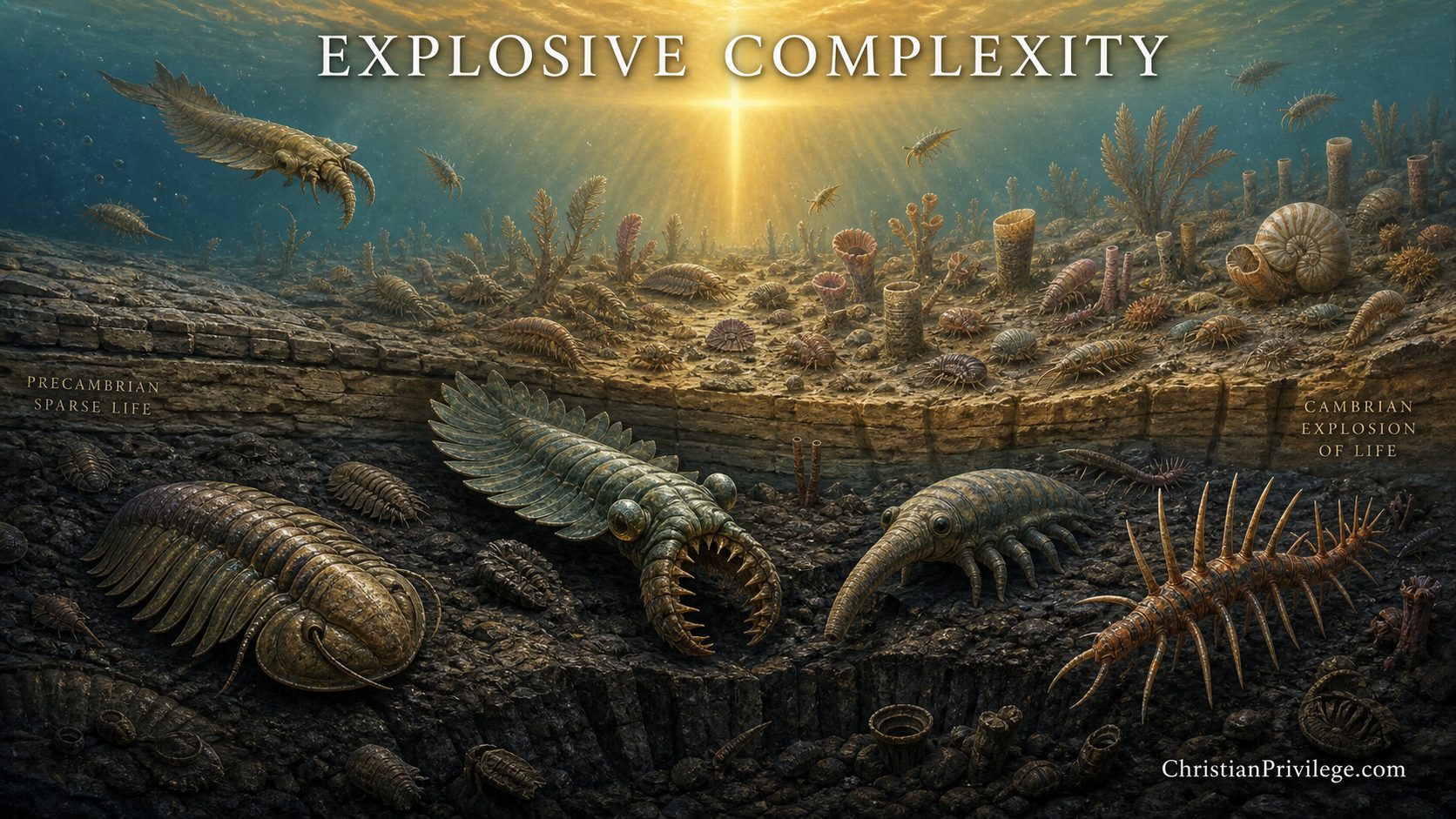
Scripture anticipated this pattern long before paleontology confirmed it. In Genesis 1:20–21 (NASB 1995), God commands: “Let the waters teem with swarms of living creatures” — and the text records: “God created the great sea monsters and every living creature that moves, with which the waters swarmed after their kind, and every winged bird after its kind; and God saw that it was good.” The Hebrew word bara — “created” — signals a sovereign, originating act. The phrase “after their kind” implies discrete, coherent categories of life, not an unbroken continuum of gradual transformation. The fossil record, especially the Cambrian period, looks exactly like what Genesis describes: distinct kinds appearing suddenly, fully formed, complex, and functionally integrated.
The Apostle Paul, writing in Romans 1:20 (NASB 1995), declared: “For since the creation of the world His invisible attributes, His eternal power and divine nature, have been clearly seen, being understood through what has been made, so that they are without excuse.” The Cambrian explosion is precisely this kind of general revelation — a signal in the deep time of Earth’s history that cannot be plausibly explained by naturalistic mechanisms alone, yet fits perfectly into a framework of divine creative intelligence.
Christian Privilege and the Question of Origins
Critics of Christian privilege often argue that the biblical worldview imposes an ancient, pre-scientific mythology upon a culture that should be guided by secular science. But this objection carries force only if evolutionary materialism has actually solved the problem of life’s origin and diversification. It has not. As leading paleontologists and developmental biologists have been forced to acknowledge, the sudden appearance of complex animal body plans in the Cambrian remains, in the words of a Philosophical Transactions of the Royal Society B paper, “one of the fulcrum points in the history of life, yet its origins and causes remain deeply controversial.”
If secular science cannot explain the data it owns — the fossil record, the information content of developmental gene regulatory networks, the protein folds required for new animal architectures — then the claim that Christian theism is scientifically defeated is premature. What the data actually shows is a pattern consistent with what Christians already believe: that life is the product of divine intelligence acting with creative power across the history of the Earth. In that case, the social and institutional recognition of the Christian worldview is not an irrational imposition of fable upon fact. It may be the acknowledgment of what is actually true — and those who hold that privilege are not unfairly advantaged but simply aligned with reality.
The psalmist captured it with perfect economy in Psalm 139:14 (NASB 1995): “I will give thanks to You, for I am fearfully and wonderfully made; Wonderful are Your works, And my soul knows it very well.” The Cambrian explosion provides the geological and biological scaffolding that undergirds this ancient doxology.
The Explosive Reality: What the Fossil Record Actually Shows
Christian Privilege in Recognizing the Pattern
The Cambrian explosion is not a marginal curiosity; it is the defining event in the history of animal life. Approximately 538–541 million years ago, over a geological window that paleontologists variously estimate at roughly 13–25 million years — brief by any measure of deep time — virtually all the major animal phyla represented in the modern world appeared simultaneously in the fossil record. These are not minor variations within existing body architectures. They are the fundamental plans of animal life: arthropods, chordates, mollusks, annelids, echinoderms, cnidarians, brachiopods, nematodes, and other categories — appearing abruptly, without clear ancestors in the rocks below them, and in many cases displaying levels of morphological sophistication not surpassed in the billions of years since.
Analysis from design-friendly paleontologists summarizes the magnitude in stark statistical terms: at the phylum and subphylum levels, the Cambrian strata document the abrupt appearance of the large majority of animal body plans that have ever existed on Earth. Richard Dawkins himself, no friend of creationism, acknowledged that the Cambrian animals “looked as if they were just planted there without any evolutionary history.” This is not a statement from a biblical literalist. It is a concession from the world’s most famous atheist evolutionary biologist. Even those most committed to a naturalistic account of life’s origin cannot escape the explosive, top-down character of what the rocks record.
Darwin’s Own Confession
Charles Darwin knew about this problem when he wrote On the Origin of Species in 1859. He encountered the abrupt appearance of complex animal forms — particularly trilobites — in the Cambrian rocks of northeastern Wales, and he was unable to account for them. In Chapter 9 of The Origin of Species, Darwin wrote with unusual candor: “To the question of why we do not find rich fossiliferous deposits belonging to these assumed earliest periods prior to the Cambrian system, I can give no satisfactory answer… The case at present must remain inexplicable; and may truly be urged as a valid argument against the views here entertained.”
Darwin’s solution was to appeal to the incompleteness of the fossil record. He predicted that with more time and more digging, the evolutionary ancestors of the Cambrian animals would eventually be found, filling the gap and vindicating his theory. But 160 years later, that prediction has failed. Rather than finding gradual transitions, paleontologists have found more Cambrian deposits, more detailed preservation, and an even more abrupt and information-rich explosion than Darwin ever knew. A widely cited analysis noted decades ago that “the metazoan explosion is real; it is too big to be masked by flaws in the fossil record,” and that the pattern “creates the impression that metazoan evolution has by and large proceeded from the ‘top down’.”
The Top-Down Pattern: A Devastating Reversal of Darwinian Expectations
Darwin’s theory predicts a “bottom-up” pattern in the fossil record. Evolutionary theory expects that life diversifies gradually from a common ancestor, with small-scale differences accumulating over time until larger and larger groupings diverge. On Darwin’s view, species-level diversity should precede order-level diversity, which should precede class-level diversity, which should precede phylum-level diversity. The broad categories of life should be the last to emerge, not the first.
The Cambrian explosion inverts this expectation completely. Phylum-level body plans — the broadest, most information-rich, most architecturally complex categories of animal life — appear first. They arrive fully formed, functionally integrated, and morphologically discrete. The lower levels of classification fill in only afterward. In the language of Meyer and others, “disparity precedes diversity”: the greatest differences (between phyla) appear before the smaller differences (between species) within a phylum.
This top-down pattern fits a model of intelligent, intentional creative action far better than it fits Darwinian gradualism. A Mind designing distinct categories of life would be expected to work top-down, setting the architectures first and then filling in variation within them. An undirected, bottom-up process of random mutation and natural selection would be expected to build up complexity incrementally, leaving a rich trail of transitional forms between the major groups. The fossil record shows the former and not the latter.
The Information Problem: Christian Privilege in Confronting What Materialism Cannot Explain
The Quantum Jump in Specified Biological Information
The Cambrian explosion is not merely a pattern in the timing of fossil appearances. It represents “a dramatic discontinuous or ‘quantum’ increase in the information content (or specified complexity) of the biological world,” in the assessment of intelligent design advocates summarizing the evidence. For roughly three billion years — about five-sixths of the entire history of life — organisms consisted largely of single-celled entities or simple multicellular colonies. Then, in the space of a geological blink, the Cambrian animals appeared with dozens of distinct cell types, each requiring new proteins and new genetic information encoded in DNA.
The simplest Cambrian animals required not only new body plans but entirely new protein architectures to build them. Molecular biologist Douglas Axe, in work discussed by Stephen Meyer, estimated that to build a single new functional protein fold by random mutation and selection, one essentially has to search through an astronomically vast space of possibilities — far beyond what realistic population sizes and timescales can traverse. Meyer uses this to illustrate that finding even one new fold is like a blind search for a marked atom in the galaxy; building a new Cambrian body plan would require coordinating many such new folds at once.
The Gene Regulatory Network Problem: The Fallacy of “More Time”
When confronted with the information problem, Darwinian defenders frequently argue that with enough time, random mutation and selection can build anything. But this retreat to time fails at the level of developmental gene regulatory networks (dGRNs) — and this is not the testimony of intelligent design theorists alone. It comes from Eric Davidson of Caltech, one of the most distinguished developmental biologists of the 20th century.
Davidson and his colleague Douglas Erwin, writing in Science and related venues, showed that animal body plans are controlled by large hierarchical gene regulatory networks, and that these networks contain core “kernels” — deeply integrated regulatory circuits — that are “conserved and hard to change” because of their central role in development. Subsequent work confirmed that mutations in the early-acting, body-plan-level portions of these regulatory networks do not produce new body plans. They tend to produce nonviable embryos or severe developmental defects.
As Meyer summarizes, drawing on Davidson’s research, mutations that act early in development either have no effect or are harmful, and the earlier and more extensive their effects, the more harmful they tend to be. The very genes that would need to be rewritten to generate a new body plan are precisely the genes that cannot be perturbed without lethal consequences. More time, in this context, is not the solution; more time simply provides more opportunities to destroy organisms by disrupting carefully tuned dGRN kernels.
Epigenetic Information: The Dimension Darwinism Does Not Address
A further problem for naturalistic explanations of the Cambrian explosion is that building new body plans requires not only new genetic information but new epigenetic information — patterns of three-dimensional spatial organization in the egg cell and in the developing embryo that are not fully encoded in DNA and cannot be generated by DNA mutation alone. The three-dimensional structure of cell membranes, the cytoskeleton, and the spatial organization of the cytoplasm all play roles in determining how an embryo develops — and these are inherited through physical structure, not through genetic code.
Neo-Darwinian theory, which focuses primarily on genetic mutations as the raw material of evolutionary change, has no detailed mechanism for generating new epigenetic information of this sort. This means that even if the protein-fold problem were solved, and even if the gene regulatory network problem were solved, there would still remain a layer of biological organization — the epigenetic architecture of the developing embryo — that unguided physical processes have not been shown to produce. The gap between Darwinian theory and the actual requirements of Cambrian body plan construction is not one problem but multiple layered problems: genetic information, regulatory network architecture, and epigenetic spatial organization.
The Secular Alternatives and Their Failure to Account for Explosive Complexity
The Artifact Hypothesis: Wishful Thinking in the Face of Evidence
The most common Darwinian response to the Cambrian explosion has been the “artifact hypothesis” — the claim, originally proposed by Charles Walcott after his discovery of the Burgess Shale in 1909, that the precursors to the Cambrian animals did exist but simply were not preserved because they lacked hard parts, or because the relevant rocks have been destroyed or not yet found. This was Darwin’s own preferred explanation, and it remained academically fashionable for decades.
The artifact hypothesis is now scientifically untenable. Soft-bodied organisms are preserved in the Precambrian record. The Ediacaran biota (c. 635–538.8 million years ago) preserve numerous soft-bodied forms in exquisite detail, demonstrating that the absence of Cambrian-type bilaterian precursors is not merely an artifact of preservation. Analyses of the Ediacaran–Cambrian transition show a real ecological and morphological turnover, not just a preservational artifact. If Darwin’s predicted ancestral forms existed in abundance, many should have been found in these lagerstätten; they have not.
Paleontologist Günter Bechly, who began his career as an atheist and later became a proponent of intelligent design after reexamining the fossil evidence, has argued that the general absence of fossil bilaterian animals from the Ediacaran era is “an inconvenient truth” because it leaves the appearance of complex animal phyla during the Cambrian explosion disturbingly unexplained. On this reading, the artifact hypothesis functions more as a protective strategy for shielding Darwinian theory from contrary evidence than as an explanation of that evidence.
The Oxygen Hypothesis: A Circular Retreat
Another secular explanation invokes a rise in atmospheric and oceanic oxygen as the creative force behind the Cambrian explosion. The reasoning is that complex, metabolically active animal life requires oxygen, and when oxygen levels rose sufficiently, the explosion became possible. But this explanation confuses a prerequisite with a cause, and it faces empirical questions.
Douglas Erwin and colleagues, in a widely discussed paper on the “Cambrian conundrum,” recognized that oxygen levels in the late Proterozoic may have constrained animal metabolism, but they also emphasized that ecological and developmental innovations played critical roles and that no single factor, including oxygen, can fully account for the timing and pattern of the explosion. Other work on oceanic redox states has complicated the simple narrative that a monotonic rise in oxygen directly triggered the Cambrian radiation.
Even if oxygen were abundant, however, it would not write the genetic information needed for new protein folds. It would not assemble the epigenetic architecture needed for new developmental programs. It would not specify the integrated, functionally coordinated body plans that appear in the Cambrian. Oxygen is a metabolic enabler, not a designer.
Evo-Devo and the Extended Synthesis: Promising but Still Inadequate
The most sophisticated naturalistic attempt to address the Cambrian explosion is evolutionary developmental biology (evo-devo), which focuses on the role of changes in gene regulatory networks in producing new body forms. Evo-devo proponents argue that small changes in the timing, location, or intensity of regulatory gene expression can produce large morphological changes, and that this mechanism can in principle generate new body plans.
Yet evo-devo has not closed the explanatory gap. The problem is not merely that detailed evo-devo pathways for particular Cambrian body plans are lacking. The deeper problem is structural: the very regulatory networks that control body plan development — Davidson’s dGRN kernels — are among the most resistant parts of the genome to evolutionary modification. As Davidson stressed, alterations to these kernels tend to be lethal or highly disruptive, not creative.
Evo-devo can explain variation within existing body plans — limb length, segment number, coloration patterns, and other modifications. It has not demonstrated the capacity to explain the origination of new body plans from scratch, which is what the Cambrian explosion requires. The leading developmental biologists’ own research has highlighted the constraints on body plan evolution as much as, or more than, its possibilities.
Beyond the Cambrian: A Pattern of Repeated Explosions
Christian Privilege in Seeing the Larger Story
One of the most significant developments in paleontology over the past two decades is the recognition that the Cambrian explosion is not a unique event. It is one of multiple sudden eruptions of biological complexity across the history of life — a pattern that compounds the challenge to Darwinian gradualism and reinforces the inference to creative intelligence.
The Avalon Explosion (c. 575 million years ago). Before the Cambrian explosion, researchers have identified what is now called the “Avalon explosion” — a sudden diversification of the Ediacaran biota approximately 575 million years ago, some 30-plus million years before the Cambrian. A study in Science by Virginia Tech paleontologists found that the morphological diversity of Ediacaran organisms appeared quickly and without clear precursors, in a pattern described as “abrupt” diversification within tens of millions of years. The organisms resemble fronds and quilted forms and appear across multiple morphologies nearly simultaneously.
The Great Ordovician Biodiversification Event (GOBE). After the Cambrian, the Ordovician period saw another major diversification of marine life, sometimes described as a second explosion, with new body plans and ecological roles appearing relatively rapidly. Other radiations — including the origin of flowering plants (angiosperms), which Darwin called an “abominable mystery,” and the diversification of placental mammals — also show relatively sudden appearances of new organizational forms in the fossil record.
Bechly and other design-friendly paleontologists argue that this cumulative pattern — repeated, abrupt increases in morphological disparity and ecological complexity — is difficult to reconcile with a strictly gradualist, bottom-up paradigm. From a Christian vantage point, however, it is exactly what one would expect if the Creator chose to introduce major innovations in life’s history at distinct intervals rather than through a single initial act followed by blind unfolding.
Simon Conway Morris: Convergence as Cosmic Inevitability
Even scientists who are not proponents of intelligent design have been driven toward conclusions that resonate with the Christian framework. Simon Conway Morris, the Cambridge palaeontologist and Fellow of the Royal Society who played a central role in interpreting the Burgess Shale fauna, has argued extensively for the reality and significance of convergent evolution.
In his book Life’s Solution: Inevitable Humans in a Lonely Universe (Cambridge University Press), Conway Morris marshals case after case in which evolutionary pathways converge on similar solutions — camera eyes, echolocation, complex sociality, and many others — across widely separated lineages. He concludes that the number of viable biological solutions is surprisingly limited, and that if evolution were “re-run,” it would likely produce something very much like humans again.
Conway Morris draws theological implications from this pattern, suggesting that convergence points to a deeper order and directionality in the cosmos. He speaks of a “theology of evolution” and has been explicit that, in his view, the universe shows evidence of being set up with particular outcomes in mind. Although he does not align with the intelligent design movement in its contemporary political form, his work supports a vision of life as ordered toward intelligible ends — a vision that dovetails with the Christian conviction that creation is governed by the divine Logos.
The Biblical Framework Confirmed: From Genesis to Colossians
Christian Privilege in What the Scriptures Already Declared
The biblical account of creation does not describe a gradual, continuous, bottom-up emergence of complexity. It describes the sudden, sovereign, categories-first appearance of distinct forms of life, each “after its kind,” by the direct creative act of God. This is precisely the pattern the fossil record displays at the level of body plans.
Genesis 1:24–25 (NASB 1995) records: “Then God said, ‘Let the earth bring forth living creatures after their kind: cattle and creeping things and beasts of the earth after their kind’; and it was so. God made the beasts of the earth after their kind, and the cattle after their kind, and everything that creeps on the ground after its kind; and God saw that it was good.” The repeated phrase “after their kind” emphasizes the discreteness and categorial integrity of what God creates — not a blur of transitions, but distinct, coherent biological architectures that appear by God’s sovereign command.
Colossians 1:16 (NASB 1995) gives the New Testament’s cosmic amplification of this: “For by Him all things were created, both in the heavens and on earth, visible and invisible, whether thrones or dominions or rulers or authorities — all things have been created through Him and for Him.” The Greek verb here indicates a decisive act of bringing into being. Paul does not describe a process by which things emerged from prior natural causes alone. He describes a Creator through whom “all things” — including the sudden, information-rich architectures of Cambrian animal life — came into existence by intentional act.
God’s own words to Job in Job 38:4 (NASB 1995) capture the epistemological challenge to any world-picture that tries to make creation self-explanatory: “Where were you when I laid the foundation of the earth? Tell Me, if you have understanding.” The sudden appearance of body plan complexity that neither Darwin nor his successors have been able to explain was not mysterious to its Author. It was precisely what He intended, and what He did.
The Fallacies in the Secular Explanations: A Summary
Those who argue that the Cambrian explosion is fully consistent with Darwinian theory typically rely on several claims that do not withstand scrutiny.
Fallacy 1: “The fossil record is still incomplete.” This was Darwin’s original escape hatch, and it has been undercut by more than a century of further discovery. Soft-bodied preservation in the Ediacaran (e.g., Mistaken Point), the Burgess Shale, the Chengjiang fauna in China, and other lagerstätten demonstrates that the absence of many expected bilaterian precursors is real, not merely apparent. The artifact hypothesis cannot simply be assumed; it must be demonstrated, and the evidence points the other way.
Fallacy 2: “Molecular clocks show the animal phyla diverged long before the Cambrian.” Molecular clock studies often attempt to push the divergence of animal phyla deep into the Precambrian, thereby reconciling the fossil record with Darwinian gradualism by moving the key events out of the observable geological window. But reconciling some of these estimates with a genuine Cambrian explosion would require rates of molecular evolution at the base of the animal radiation many times higher than those inferred for later periods — an ad hoc modification that raises as many questions as it answers. The tension between fossil and molecular data remains unresolved, and the fossil pattern of abrupt morphological disparity cannot be dismissed on the basis of adjustable molecular models.
Fallacy 3: “Given enough time, natural selection can produce anything.” This argument fails at both the mathematical and developmental levels. The combinatorial search space for new protein folds is enormous, and experimental and theoretical work suggests that functional sequences occupy a tiny fraction of that space. At the same time, the developmental gene regulatory networks that control body plan formation are precisely the parts of the genome least amenable to creative tinkering; mutations in these early-acting circuits generally produce nonviable embryos, not new architectures. More time does not solve a problem where the mechanism lacks the power to traverse the relevant search spaces without destroying the systems it must modify.
Fallacy 4: “Evo-devo and the extended synthesis have solved the problem.” They have not. Evo-devo has provided valuable insights into how existing body plans can be modulated, but it has not provided empirically demonstrated mechanisms by which entirely new body plans arise from scratch. The same developmental studies that expanded the evolutionary toolkit have also foregrounded the robustness and conservation of core developmental circuits — the dGRN kernels — which are difficult to reconcile with scenarios of repeated radical rewiring.
Conclusion: Christian Privilege and the Weight of the Evidence
The history of life, examined honestly and in depth, does not support the narrative that scientific discovery has displaced the biblical account of creation. On the contrary, the Cambrian explosion — and the broader pattern of repeated biological explosions throughout Earth’s history — constitutes a standing challenge to strictly naturalistic mechanisms proposed to explain the sudden appearance of complex, information-rich biological architecture. The leading scholars who have studied this data most carefully — Darwin, Dawkins, Davidson, Erwin, Conway Morris, and others — have each, in their own way, acknowledged the magnitude of the problem. None has provided a fully satisfying naturalistic solution.
The Christian worldview, anchored in the declaration of Genesis 1:1 (NASB 1995) — “In the beginning God created the heavens and the earth” — and illuminated by Romans 1:20 (NASB 1995)‘s insistence that God’s “eternal power and divine nature, have been clearly seen, being understood through what has been made” — fits the actual pattern of life’s history with a coherence that materialistic alternatives cannot match. The fossil record’s explosive complexity is not embarrassing evidence that Christianity must explain away. It is general revelation in stone — the kind of evidence that, as Paul wrote, leaves the atheist “without excuse.”
In this light, the charge that Christian privilege represents an irrational imposition of private religious belief upon a neutral public order fails at its scientific foundation. The biological history of this planet speaks the language of creation. The living God who spoke living creatures into existence “after their kind” is the same God whose Son holds “all things” together, as Colossians 1:16–17 (NASB 1995) proclaims. To give public honor to that God is not irrational favoritism. It is alignment with what the rocks of the earth, the architecture of the cell, and the mathematics of protein folding all, in their several ways, declare.