The existence of human consciousness and rational thought is among the most profound and persistent puzzles in all of philosophy. Why does subjective experience exist at all? Why can human minds perceive truth, construct logical arguments, and engage in abstract reasoning? Materialist naturalism — the dominant secular framework — struggles profoundly to answer these questions. The Christian worldview, by contrast, offers an elegant, coherent, and scripturally grounded answer: minds exist because there is a supreme Mind behind the universe, and human rationality is derivative of divine rationality. As the Apostle Paul declares in Colossians 2:2–3, all knowledge is ultimately rooted in Christ: “in whom are hidden all the treasures of wisdom and knowledge”. This is the mind-first world — and consciousness and reason fit it perfectly.
The Hard Problem of Consciousness: Materialism’s Achilles’ Heel
What Is the Hard Problem?
Philosopher David Chalmers famously articulated what he called the “hard problem of consciousness” — the challenge of explaining not merely the functional properties of the brain, but why any physical state is accompanied by subjective experience at all. The “easy problems” of consciousness — explaining how we react to stimuli, how we integrate information, how we report mental states — can in principle be handled by neuroscience. But the hard problem asks: why is there something it is like to be you? Why does seeing red feel like anything at all?
This distinction is crucial. Even a complete specification of a creature in purely physical terms, Chalmers argues, leaves entirely unanswered the question of whether or not that creature is conscious. It is conceptually coherent to imagine a “philosophical zombie” — a being physically identical to a human in every way, including all brain activity, but utterly lacking inner experience. If such a being is conceivable, physicalism — the doctrine that everything is ultimately physical — faces a catastrophic challenge: how can matter alone generate the felt quality of inner life?
The hard problem is not a fringe concern. It is recognized even by secular philosophers as one of the most pressing unsolved problems in all of science and philosophy. And the very fact that it remains unsolved after decades of vigorous inquiry by some of the world’s best minds is itself revealing.
The Fallacy of Materialist “Solutions”
Daniel Dennett: Consciousness Explained Away
Among the most prominent materialist responses is that of philosopher Daniel Dennett, whose book Consciousness Explained (1991) attempts to dissolve rather than solve the problem. Dennett argues that qualia — the subjective, qualitative character of experience — are an illusion generated by what he calls the “Multiple Drafts” model of cognition. His critics have pointed out the obvious: Dennett does not so much explain consciousness as deny that there is anything to explain. By refusing to acknowledge qualia as genuine metaphysical data, Dennett essentially argues that the hard problem is a pseudo-problem born of confused intuitions.
But as philosopher Thomas Nagel — himself no theist — observed, “the mind-body problem is not just a local problem, having to do with the relation between mind, brain, and behavior in living animal organisms, but that it invades our understanding of the entire cosmos.” Dennett’s strategy of dismissing qualia does not solve the hard problem — it merely sidesteps it. His critics rightly note that he “continually ignores subjective experience and refers only to consciousness from an objective, external point of view.” This is precisely the failure of eliminativism: it explains away the very data that requires explanation.
Paul Churchland’s Eliminative Materialism: Eliminating the Explainer
Philosophers Paul and Patricia Churchland take the materialist position even further with their doctrine of eliminative materialism. Their claim is that folk psychological concepts — beliefs, desires, experiences, pain — are simply false, that they will eventually be replaced entirely by descriptions of neural activation patterns. In their view, “the physical brain and not the imaginary mind gives us our sense of selves.”
The self-refuting nature of this position deserves emphasis. If beliefs do not exist, then the belief that eliminative materialism is true does not exist. If there are no subjective mental states, then Churchland’s own conviction about neuroscience is not a conviction at all, but merely neurons firing — with no truth-value whatsoever. The “Qualia Problem” exposes this circular logic: eliminativists use judgment and reasoning to argue that judgment and reasoning are illusions. As critic Frank Jackson demonstrated with the famous “Mary the color scientist” thought experiment, there are facts about subjective experience that cannot be captured by any amount of physical description — proving that the phenomenal is not reducible to the physical.
Thomas Nagel’s Admission: Materialism Is “Almost Certainly False”
Even outside Christian circles, the failures of reductive materialism are being publicly acknowledged. NYU philosopher Thomas Nagel — a committed atheist — published Mind and Cosmos: Why the Materialist Neo-Darwinian Conception of Nature Is Almost Certainly False (Oxford University Press, 2012), arguing that “if materialism cannot accommodate consciousness and other mind-related aspects of reality, then we must abandon a purely materialist understanding of nature in general.” Nagel argues that an adequate conception of nature “would have to explain the appearance in the universe of materially irreducible conscious minds, as such,” and that “no such explanation is available.”
This is a stunning concession from one of the English-speaking world’s most respected secular philosophers. Nagel is not a Christian apologist. He is not invoking intelligent design. He is simply following the evidence where it leads — and it leads away from materialism.
The Argument From Reason: Christian Privilege in a Mind-First Universe
C.S. Lewis’s Powerful Challenge to Naturalism
The most famous formulation of the argument from reason was developed by C.S. Lewis in his 1947 book Miracles: A Preliminary Study. Lewis argued that under naturalism, human beings evolved purely by natural selection, for survival alone. If all mental processes are ultimately nothing but neurochemical events caused by nonrational physical forces, there is no warrant for trusting that any of those mental processes actually tracks truth. Lewis himself stated it compellingly: “If my mental processes are determined wholly by the motions of atoms in my brain, I have no reason to suppose that my beliefs are true.”
The logic is airtight. Under naturalism, the goal of evolution is not truth — it is survival. Natural selection would favor beliefs that produce adaptive behavior, regardless of whether those beliefs are actually true. As philosopher Patricia Churchland herself admitted: “Truth, whatever that is, definitely takes the hindmost.” But if our reasoning faculties were shaped by blind processes that have no concern for truth, then naturalism itself — as a conclusion reached by reasoning — is undercut. Naturalism cannot trust reason while simultaneously claiming that reason is the product of nonrational causes.
Victor Reppert, Professor of Philosophy at Glendale Community College, expanded Lewis’s argument into a full-length philosophical defense in his book C.S. Lewis’s Dangerous Idea: In Defense of the Argument from Reason (InterVarsity Press, 2003). Reppert argues that Lewis’s argument remains philosophically devastating and that “the basic thrust of Lewis’s argument from reason can bear up under the weight of the most serious philosophical attacks.” The IVP publication represents careful, peer-reviewed philosophical scholarship — not popular apologetics.
The Anscombe Objection and Its Limits
Critics often cite philosopher Elizabeth Anscombe’s 1948 debate with Lewis at the Oxford Socratic Club as having “refuted” the argument from reason. Anscombe argued that Lewis had conflated the causal explanation of beliefs with the logical grounds that justify them. Lewis himself revised his argument in response. But the revision, as Reppert demonstrates, did not abandon the core insight — it refined it. The central challenge remains: if all mental events, including rational inferences, are “efficiently caused by non-rational cause-to-effect natural processes,” then ground-to-consequent reasoning — the backbone of all scientific and logical inquiry — is not genuinely possible.
The critics’ objection, in other words, at best moves the problem one step back. Even granting that causal and inferential sequences can be aligned in a physical system (as they are in a computer), the question remains why we should trust that the content of those physical states accurately represents reality, rather than merely producing adaptive behavior. A computer does not know anything — it processes.
Alvin Plantinga and the Evolutionary Argument Against Naturalism
The Self-Defeating Nature of Naturalism + Evolution
Princeton and Notre Dame philosopher Alvin Plantinga — winner of the 2017 Templeton Prize — developed what is now called the Evolutionary Argument Against Naturalism (EAAN), a rigorous philosophical argument demonstrating that the conjunction of naturalism and evolutionary theory is logically self-defeating.
Plantinga’s argument runs as follows. If naturalism is true, then human cognitive faculties arose through purely natural selection — a blind process concerned with survival, not truth. The probability that such faculties would reliably produce true beliefs, rather than merely adaptive ones, is therefore low or inscrutable. But if the reliability of our cognitive faculties is in doubt, then every belief formed by those faculties — including the belief in naturalism and evolution — is in doubt. The naturalist therefore has a “defeater” for all her beliefs, including her belief in naturalism.
As the University of Notre Dame’s Center for Philosophy of Religion summarizes: “Alvin Plantinga believes it is a mistake to accept both naturalism and evolution together… combining belief in evolutionary theory with belief in naturalism leaves one in a pretty tough spot, for when those beliefs work together, they should yield the further belief that we don’t know much of anything about ourselves or the world.”
Karl Popper’s attempt to rescue naturalism by arguing that surviving creatures must have mostly true beliefs fails, as Plantinga demonstrates. Beliefs need not be true to be adaptive. A prehistoric hominid who believes that avoiding tigers is a good way to honor the spirits — a false belief — may survive just as well as one who correctly understands tiger danger. The behavioral output can be identical regardless of whether the underlying belief is true.
Theism’s Decisive Advantage
Under theism, by contrast, the reliability of human reason is precisely what we would expect. God, as a wholly rational being who created human minds in His own image, would have designed cognitive faculties that reliably track truth. The Christian worldview therefore provides a principled foundation for trust in reason that naturalism cannot. This is not a minor point — it is the precondition for all knowledge, including scientific knowledge. Science itself presupposes that human minds can reliably apprehend reality. Christianity explains why.
J.P. Moreland and the Argument From Consciousness
Five Properties That Resist Physical Reduction
Philosopher J.P. Moreland of Biola University, one of the foremost Christian philosophers of mind, argues in his book Consciousness and the Existence of God (2008) that the existence of conscious beings in the universe is powerful evidence for the existence of God. Moreland identifies several properties of consciousness that are “permanently unsusceptible of psychophysical reduction” and that are entirely at home in theism.
These properties include:
-
Qualia — The raw, felt quality of sensory experience (the redness of red, the painfulness of pain), which simply cannot be captured in any purely objective, third-person physical description
-
Intentionality — The “aboutness” of mental states; the fact that thoughts are about things in a way that mere physical states are not
-
Subjectivity — The irreducibly first-person character of experience, the fact that there is someone who is having the experience
-
Rational insight — The capacity to grasp logical necessities, mathematical truths, and abstract entities that have no physical location
-
Unified selfhood — The experience of being a continuous, unified self persisting through time, which has no clear physical correlate
Moreland frames the central question as philosopher Colin McGinn posed it: “How can mere matter originate consciousness?” On naturalism, “finite mental entities (‘minds’) seem inexplicable.” On theism, their existence is entirely expected: a universe created by a supreme Mind would naturally produce beings that share in that Mind’s rational nature.
As Moreland states in his interview with Biola University: “The reason consciousness exists is because we started with a rabbit… [God]. The best explanation for why there is consciousness is because we are made in the image of a conscious, rational God.”
The Biblical Foundation: Christian Privilege and the Rational God
The Logos: Divine Reason Incarnate
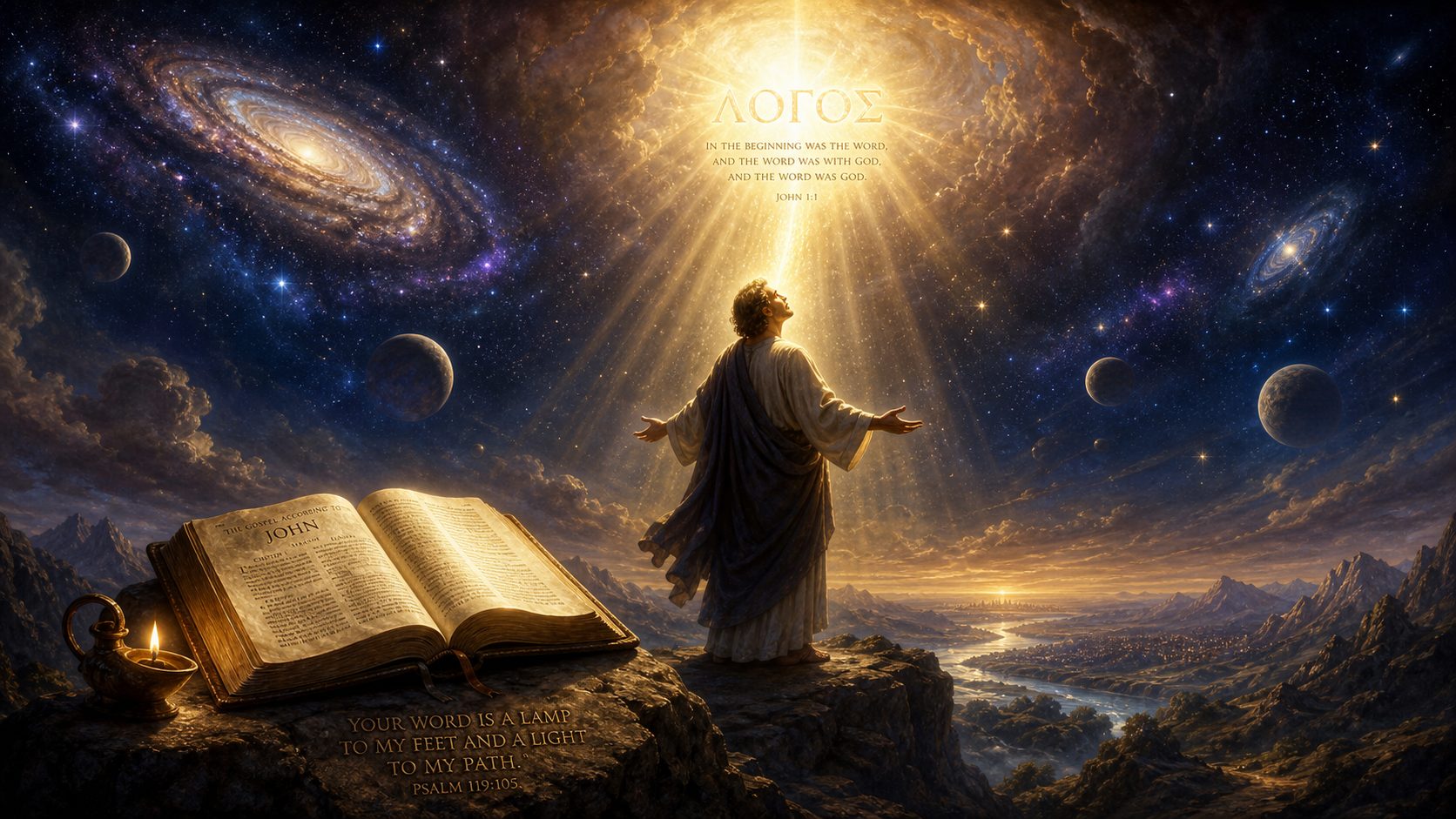
The biblical case for a mind-first universe begins not with philosophy but with the opening of the Gospel of John: “In the beginning was the Word [Logos], and the Word was with God, and the Word was God” (John 1:1, NASB 1995). The Greek term logos was not chosen arbitrarily. In first-century Greek philosophy, logos referred to the rational principle underlying the cosmos — the intelligible structure that makes the universe comprehensible. In Jewish thought, it referred to God’s wisdom and creative expression. John’s Gospel deliberately appropriates both meanings to declare that the rational structure of the universe is not impersonal — it is personal. It is not a force; it is a Person.
John 1:3 declares: “All things came into being through Him, and apart from Him nothing came into being that has come into being.” This means that every mind, every capacity for rational thought, every instance of consciousness in the universe traces back to the divine Logos. Matter did not produce mind; Mind produced matter.
This is the ultimate foundation of Christian privilege in epistemology: we live in a universe that was thought into existence by an infinite Mind, and we are creatures endowed with minds capable of knowing both the creation and, through revelation, the Creator.
Imago Dei: The Image of a Rational God
The Genesis account provides the anthropological basis for this argument. When God declares, “Let Us make man in Our image, according to Our likeness” (Genesis 1:26, NASB 1995), He is describing a creature that uniquely reflects divine rationality. As GotQuestions.org summarizes the theological consensus: “Mentally, humanity was created as a rational, volitional agent. In other words, human beings can reason and choose. This is a reflection of God’s intellect and freedom.”
The imago Dei (image of God) explains what naturalism cannot: why human reason has genuine truth-tracking power. Human minds are not accidental byproducts of blind processes — they are reflections of the divine Mind. Their capacity for logic, mathematics, language, artistic creativity, and moral reasoning is intelligible precisely because they are derivative of a God who is Himself the source of all rationality.
Proverbs 2:6 — The Lord as Source of Wisdom
The Wisdom literature of the Old Testament reinforces this point: “For the LORD gives wisdom; From His mouth come knowledge and understanding” (Proverbs 2:6, NASB 1995). Wisdom is not a human achievement extracted from raw experience; it is a divine gift flowing from the mouth of the God who created the rational order of the cosmos. This is why the fear of the Lord is described as “the beginning of wisdom” (Proverbs 9:10) — not its obstacle, but its very foundation.
Colossians 2:3 — All Knowledge Hidden in Christ
Paul’s declaration in Colossians 2:3 (NASB 1995) provides the Christological apex of this argument: “in whom are hidden all the treasures of wisdom and knowledge.” The “whom” is Christ — the incarnate Logos. Paul is not merely making a spiritual point about personal devotion; he is making an epistemological claim. All wisdom, all genuine knowledge, is ultimately rooted in and derived from the divine Mind that became flesh in Jesus Christ. This is not mysticism — it is the metaphysical claim that rationality itself has a personal source, and that source is Christ.
1 Corinthians 2:14-16 — The Mind of Christ
Paul’s description in 1 Corinthians 2:14-16 (NASB 1995) adds a further dimension: “But a natural person does not accept the things of the Spirit of God, for they are foolishness to him; and he cannot understand them, because they are spiritually discerned… But we have the mind of Christ.” This passage reveals that full rational and spiritual apprehension of reality — including ultimate truths about the nature of God, humanity, and the cosmos — requires not merely natural cognitive capacity, but the illuminating work of the Holy Spirit. The unregenerate mind, though capable of remarkable natural achievements, is darkened with respect to ultimate reality (Romans 1:21). It is the renewing work of the Spirit that restores the mind to its full truth-tracking function.
Romans 12:2 — The Transformed Mind
Paul’s exhortation in Romans 12:2 (NASB 1995) captures the practical implication: “And do not be conformed to this world, but be transformed by the renewing of your mind, so that you may prove what the will of God is, that which is good and acceptable and perfect.” The renewing of the mind is not merely moralistic self-improvement — it is the restoration of the imago Dei in its epistemic dimension. A mind aligned with its divine source can discern truth; a mind conformed to worldly frameworks — including materialist naturalism — is epistemically compromised.
The Cumulative Case: Why Consciousness Fits Theism, Not Naturalism
What the Evidence Demands
The argument from consciousness and reason does not rest on any single consideration but on a convergence of multiple independent lines of evidence. Each supports the same conclusion: consciousness and rationality fit a mind-first universe and are deeply anomalous in a matter-first universe.
The Self-Defeat of Naturalism
A particularly striking feature of this argument is the self-referential instability of materialist naturalism when applied to itself. If all thoughts are nothing more than neurochemical events produced by nonrational causes, then the thought “all thoughts are nothing more than neurochemical events” is itself nothing more than a neurochemical event — and has no claim to be true. Naturalism, if consistently applied, devours the epistemic ladder it used to climb.
This is not a minor technical problem. It is a fundamental incoherence at the heart of materialist metaphysics. As Lewis observed: “Unless I believe in God, I can’t believe in thought. So I can never use thought to disbelieve in God.” The rational reliability that makes science, philosophy, and everyday reasoning possible is inexplicable on naturalist terms — and entirely expected on Christian terms.
Thomas Nagel’s Reluctant Witness
The testimony of Thomas Nagel is particularly significant because he comes to his conclusion without any theistic commitment. His frank admission that “physics cannot be the theory of everything” and that reductive materialism cannot account for “consciousness, cognition, and value” represents an acknowledgment from within secular philosophy that naturalism has failed its most basic explanatory task. Nagel does not accept theism as the answer — but his argument clears the intellectual ground for it. He has identified the problem; Christianity has the solution.
Addressing the Fallacies in Alternative Explanations
Fallacy 1: Science Will Eventually Explain Consciousness
A common materialist response to the hard problem is “promissory materialism” — the claim that even if we cannot explain consciousness now, science will eventually solve the problem. This objection fails on multiple levels. First, as Lewis noted, any future scientific explanation will itself need to be reasoned through by human minds — and it is precisely the reliability of those minds that is in question. Second, no amount of increasingly detailed functional description brings us one step closer to explaining why there is something it is like to be that system. The explanatory gap is not a gap of information — it is a gap of ontology.
Fallacy 2: The Zombie Argument Is Incoherent
Some materialists argue that philosophical zombies are not genuinely conceivable, and that conceivability does not entail possibility. But as Chalmers responds, the concept of a zombie is logically coherent — no contradiction can be derived from it using the laws of logic alone. And if zombies are coherent, then consciousness is not logically entailed by physical structure — which means physicalism is false as a necessary truth.
Fallacy 3: Emergent Consciousness Is Naturalistic
Some thinkers propose that consciousness emerges from sufficiently complex physical systems in the way that wetness emerges from H₂O molecules. But this comparison fails. Wetness is itself a physical property explicable in terms of how water molecules interact with other physical systems. Subjectivity — the felt quality of experience — is not a physical property at all. It is categorically different from any third-person description, no matter how complex. Emergence accounts merely push the mystery back one level; they do not resolve it.
Conclusion: The Mind-First Universe and Christian Privilege
The convergent case from consciousness and reason is powerful and multi-pronged. David Chalmers has shown that the hard problem of consciousness is genuine and irreducible to physics. Thomas Nagel has admitted that materialist neo-Darwinism is “almost certainly false” as a complete worldview. Daniel Dennett’s dismissal of qualia fails on its own terms by eliminating the very data it should explain. Paul Churchland’s eliminative materialism is self-refuting, using the reasoning it seeks to eliminate in order to argue for its elimination. Alvin Plantinga has demonstrated that naturalism combined with evolution is self-defeating as an epistemological foundation. Victor Reppert has shown that Lewis’s argument from reason survives the best philosophical attacks.
Christian theism, by contrast, provides a principled explanation for all of these phenomena. Human minds reliably track truth because they are made in the image of the God who is Truth (John 14:6). Consciousness exists because the universe was spoken into existence by a personal, conscious God whose Logos is the rational structure of all reality (John 1:1-3). Wisdom is available to human beings because “the LORD gives wisdom; from His mouth come knowledge and understanding” (Proverbs 2:6, NASB 1995). All the treasures of wisdom and knowledge are hidden in Christ (Colossians 2:3), not in matter and motion.
The phrase “Christian privilege” takes on a wholly different character in light of this argument. If the universe is indeed mind-first — if consciousness and rationality are not accidents of blind chemistry but gifts of the divine Mind — then Christianity does not merely assert a preference. It names reality. And recognizing reality is not privilege; it is simply thinking clearly.
As Paul wrote in Romans 12:2 (NASB 1995): “And do not be conformed to this world, but be transformed by the renewing of your mind, so that you may prove what the will of God is, that which is good and acceptable and perfect.” The renewed, theistically grounded mind is the mind most fully equipped to know truth — because it is aligned with the Mind from which all truth flows.