Christian Privilege and the Rebranding of Religious Liberty
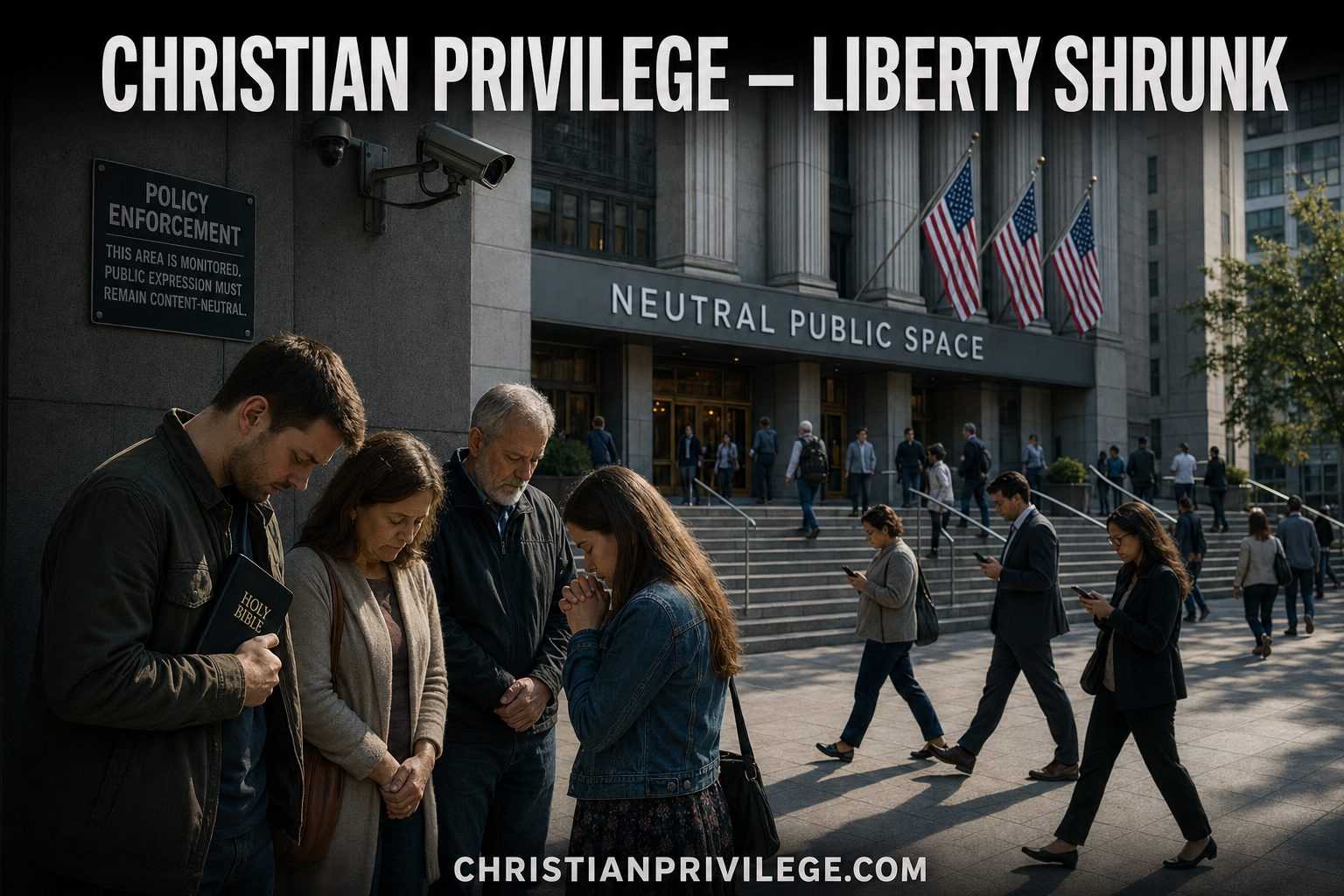 The most politically effective criticism of Christian Privilege does not usually demand the abolition of religion outright. It does something subtler and more dangerous. It redefines visible Christian participation in public life as a constitutional problem rather than a constitutional right. Once that reframing succeeds, the Free Exercise Clause is no longer understood as protection for believers living publicly according to conviction. It becomes little more than permission to believe privately and discreetly.
That is a radical downgrade of American liberty. The First Amendment does not merely prevent Congress from establishing a national church; it also forbids government from “prohibiting the free exercise” of religion. The Constitution Annotated describes the Religion Clauses together as protections for “individual freedom of religion and separation of church and state.” Those words matter because they reveal what the anti-Christian Privilege framework tries to hide: American constitutionalism was designed to secure religious liberty, not to manage religion into civic irrelevance.
Yet that is precisely where the rhetoric of Christian Privilege tends to lead. Christianity may be tolerated, but only if it stays in the realm of private comfort. It may console the grieving, inspire personal kindness, and decorate family rituals. But if it speaks into education, politics, law, institutional life, or national meaning, it is no longer treated as free exercise. It is treated as suspicious influence.
Christian Privilege and the Shrinking Public Square
Once Christian Privilege becomes the controlling lens, the public square begins to shrink—but only for Christians. The square still exists for activists, bureaucrats, media institutions, universities, ideological movements, and every other moral tribe. They are free to speak in the full vocabulary of their convictions. They can invoke justice, equality, identity, dignity, liberation, autonomy, or historical reckoning without apology. Their worldviews are regarded as substantive but legitimate.
Christians, however, are increasingly told that bringing explicitly Christian reasoning into public debate constitutes a form of unfair advantage. Their faith is not treated as one worldview among others in democratic competition. It is treated as an illegitimate residue of cultural dominance. The result is a rigged neutrality in which everyone may argue from first principles except those whose first principles are too recognizably Christian.
That is not pluralism. It is ideological zoning. Christianity is allowed to exist in the private residence but not open a storefront in the civic center. It can light candles behind drawn curtains, but it must not shape the architecture of common life. What critics call the end of Christian Privilege is often just the removal of Christianity from the list of convictions permitted to matter publicly.
Christian Privilege and the Founding Meaning of Free Exercise
The American tradition did not invent religious liberty in order to create a nation of politely silent believers. The language of the First Amendment reflects a deeper conviction: human beings have obligations of conscience that government is not competent to control. The United States Courts explains that the Free Exercise Clause protects citizens’ right to practice religion, subject only to compelling state interests in particular circumstances. It does not say believers are free only so long as nobody notices their beliefs.
History makes this even clearer. Roger Williams, often invoked as an architect of separation, argued for a “high wall” between church and state in order to protect the church from corruption and conscience from coercion. The National Park Service notes that Williams wanted Providence to be a “refuge for persons distressed of conscience.” He did not imagine a neutral society in which religion vanished from public consequence. He imagined a society in which civil authorities stopped pretending they could rule the soul.
That distinction is essential. The anti-Christian Privilege reading of church-state separation treats the wall as a device for keeping Christianity out of public relevance. The older American reading treated it as a barrier against government overreach. One protects conscience. The other domesticates it.
Christian Privilege and the Conversion of Rights into Permissions
This is where the rhetoric surrounding Christian Privilege becomes so destructive. It slowly converts rights into permissions. Rights belong to citizens by constitutional guarantee. Permissions are granted conditionally by institutions that can always revise them. Under the old American model, Christians had the right to participate in public life as Christians, subject to ordinary legal limits shared by everyone else. Under the new anti-Christian Privilege model, Christians are permitted to participate only after translating, muting, or disguising the convictions that animate them.
That is a profound difference. A Christian teacher may privately pray, but publicly visible faith is deemed risky. A Christian nonprofit may serve the poor, but its doctrinal identity is treated as a reputational problem. A Christian elected official may hold convictions, but those convictions must be rendered into bloodless secular language before they are considered admissible. In each case, religion is not prohibited outright. It is simply subjected to conditions that make serious public exercise increasingly costly.
In effect, Christians are told: you may believe whatever you like, provided your beliefs do not shape your public conduct too clearly. That is not free exercise. It is licensed exercise.
Christian Privilege and the “No One Can Feel Uncomfortable” Standard
One of the most corrosive intellectual habits in the attack on Christian Privilege is the assumption that public expressions of Christianity are constitutionally suspect if they make outsiders feel excluded or uncomfortable. That standard sounds humane, but it is impossible to administer without eliminating robust religious expression from common spaces.
As one legal critique summarized by AEI put it, some Establishment Clause reasoning drifted toward treating discomfort itself as a kind of coercion, effectively protecting “the right not to feel uncomfortable” in the presence of others’ religious expression. However one evaluates that line of cases, the broader danger is obvious. If the public visibility of religion becomes problematic whenever someone feels like an outsider, then any serious expression of conviction can be recast as harm.
That logic does not stay confined to formal state ceremonies. It spills outward into schools, workplaces, charities, local government, and civic culture. Christian speech is no longer evaluated by whether it coerces anyone. It is evaluated by whether it creates atmospherics that critics dislike. Once that happens, Christian Privilege becomes the master accusation used to convert ordinary public faith into a social injury.
A free society cannot survive on that basis. Democratic life inevitably exposes people to convictions they reject. The answer to disagreement is counterargument, not constitutional quarantine.
Christian Privilege and the New Theory of Public Contamination
The deeper problem with the anti-Christian Privilege framework is that it treats Christianity not simply as one moral tradition among others, but as a kind of contaminant in public life. It may be permissible in strictly private use, but once it enters law, education, institutional mission, or political rhetoric, it is presumed to distort fairness.
That is a remarkable shift in moral burden. Christians are no longer asked merely to obey the law and respect pluralism. They are expected to prove that their participation does not leave too obvious a Christian trace. Their arguments are not addressed as arguments; they are pathologized as products of excess cultural power. Their institutions are not judged solely by performance or legality; they are judged by whether their identity reproduces the wrong symbolic order.
This is how Christian Privilege kills free exercise without ever formally repealing it. It establishes a new social doctrine in which public Christianity is tolerated only when sufficiently diluted. Believers remain technically free, but only after they have learned the art of self-erasure. They are citizens, but citizens under atmospheric probation.
Christian Privilege and the Return of Informal Religious Tests
The Constitution prohibits religious tests for public office, and the American order has long aspired to reject state sorting of citizens by creed. Yet the strongest anti-Christian Privilege logic recreates those tests in softer form. It no longer asks whether an officeholder belongs to the wrong denomination. It asks whether the officeholder’s Christianity is too consequential.
Can a judge reason from moral premises shaped by Christian belief without being suspected of bias? Can a legislator cite Scripture without being accused of imposing faith? Can a school leader openly identify Christian commitments without triggering claims of exclusion? Once Christian Privilege becomes the governing category, the practical answer is often yes—but only at a price.
That price is self-neutralization. To remain publicly acceptable, Christians must continually prove that their faith will not exercise too much influence over their decisions, priorities, language, or institutional leadership. In effect, the public test becomes this: how little does your Christianity matter when real decisions are made? The more the answer is “very little,” the more respectable you become.
That is not equal citizenship. It is a velvet-rope version of exclusion.
Christian Privilege and the Disaster of Consistent Implementation
If the critique of Christian Privilege were implemented consistently, the resulting public order would be both impossible and disastrous. It would be impossible because Christianity is woven too deeply into American memory, language, philanthropy, education, and civic activism to be removed cleanly. And it would be disastrous because the attempt to remove it would require constant discrimination against religious expression in the name of preventing favoritism.
This is the paradox critics rarely confront. A system meant to prevent Christians from enjoying too much social comfort would have to make Christianity uniquely uncomfortable in public. Schools would treat Christian visibility as a risk factor. Employers would manage Christian speech more nervously than parallel secular speech. Courts and agencies would analyze public expressions of faith through a suspicion lens unavailable to other moral viewpoints.
That is not neutrality. It is negative establishment—the tacit establishment of a secular orthodoxy that grants full public dignity to every worldview except the one accused of historical overrepresentation. The result would not be fairness but a new civic hierarchy in which Christians must pay a visibility tax for exercising rights others may use without apology.
Christian Privilege and the American Alternative
The wiser American alternative is already embedded in the constitutional tradition. Government may not establish religion, and it may not prohibit its free exercise. That framework does not promise an empty public square. It promises a contested one—a place where citizens argue, persuade, disagree, organize, worship, and build institutions without the state deciding which convictions are too metaphysically assertive to count as legitimate.
That arrangement is harder than the anti-Christian Privilege model because it requires maturity. Citizens must tolerate speech they dislike. Institutions must coexist with rivals whose visions they reject. Public life must remain open to religious as well as secular argument. But that difficulty is the price of liberty, and it is far preferable to the fake peace produced by managed silence.
The best answer to past favoritism is not the shrinking of free exercise into private sentiment. It is equal freedom under law. Christians do not need the state to crown them. But neither should they be asked to disappear into the wallpaper of national life so others can call the room neutral.
That is why the social criticism of Christian Privilege is not merely shallow. It is constitutionally corrosive. It begins by claiming to oppose favoritism and ends by teaching the country to treat public Christianity as a problem to be contained. Once that lesson is fully learned, free exercise still exists on paper—but in practice it has already died.