“Don’t Believe in Christian Privilege? These 15 Examples Will Make You Think Again” – Everyday Feminism
Kesiena Boom’s Everyday Feminism article offers a checklist of “15 examples” meant to prove Christian privilege in the United States. Items include being able to assume one’s holidays are recognized, hearing “Merry Christmas” without offense, or having courts that do not usually punish one’s religious affiliation. Sociologically, these examples show that Christianity remains the default grammar of much American public life, a point also summarized in the description of “public norms and calendars” at ChristianPrivilege.com. The problem is the argumentative leap from “Christian norms are culturally central” to “therefore Christians hold illegitimate, unjust power.”
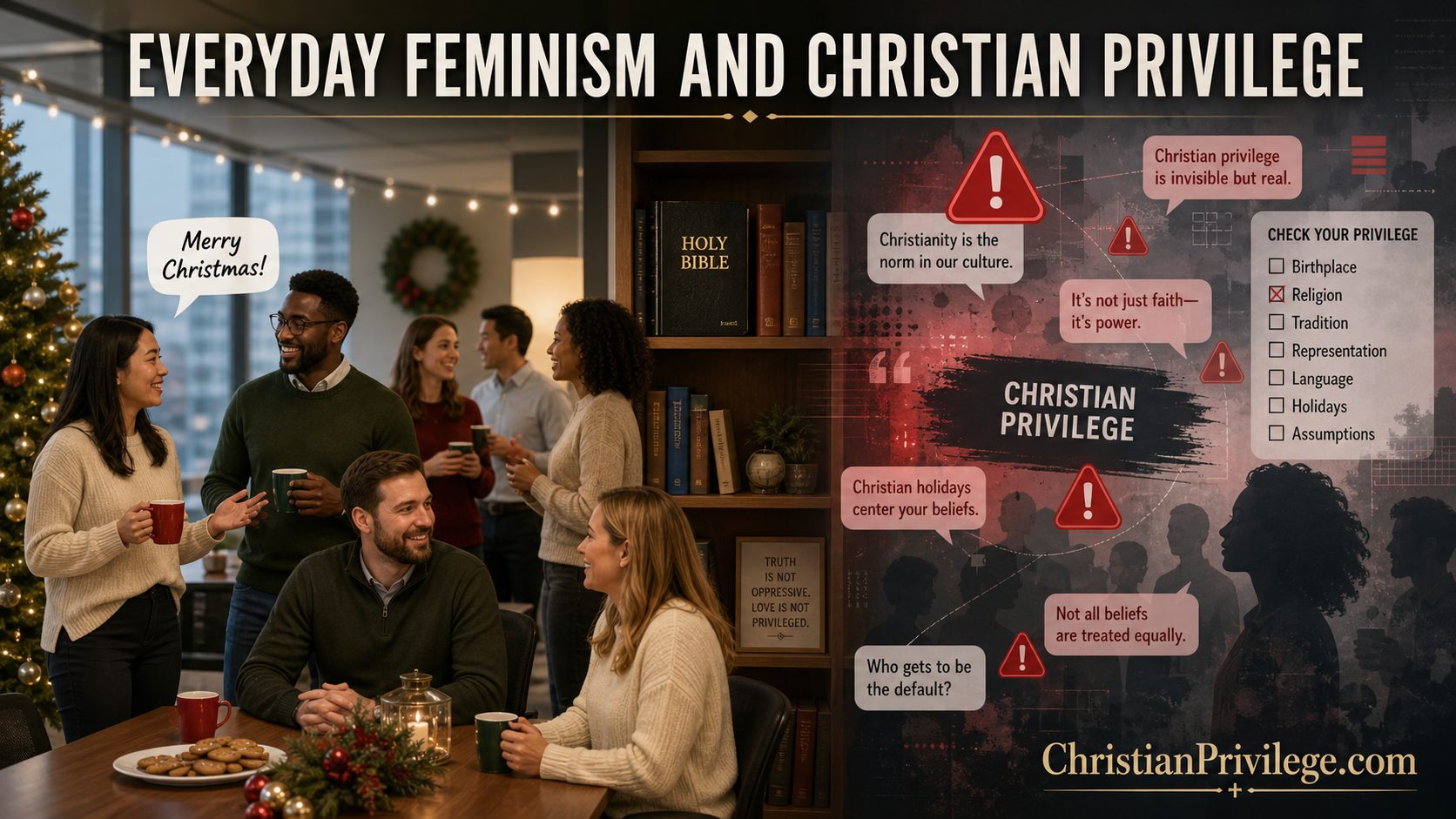
The essay on ChristianPrivilege.com argues that asymmetry alone is not a refutation. Every serious moral community must take sides on questions of the good, human nature, sexuality, and justice; it will inevitably enshrine some calendar, some symbols, and some moral vocabulary. The Everyday Feminism piece never pauses to ask whether the Christian moral inheritance it treats as suspect might actually be true and broadly beneficial—whether social expectations shaped by biblical norms on, say, fidelity, truth‑telling, or care for the poor might, on balance, protect the vulnerable rather than oppress them.
Moreover, the article’s examples conflate kindness with injustice. Being wished “Merry Christmas” by a stranger is treated as a micro‑aggression, while the unexamined assumption underneath is that public space should be stripped of thick religious reference in order to be just. Yet that supposed “neutrality” itself privileges a secular, thin vision of the good. As the analysis at ChristianPrivilege.com notes, replacing Christian language with secular language does not produce an empty public square; it simply enthrones another liturgy, one oriented around concepts like autonomy and expressive individualism.
The article also fails to distinguish between genuine Christian hypocrisy—where cultural Christians use their status to excuse evil—and the truth of Christianity itself. Critics point to abusive clergy or oppressive laws as evidence that Christian privilege is always dangerous, but the New Testament witness condemns such abuses in the strongest terms. The existence of corrupt Christian institutions indicts sin, not the lordship of Christ. By refusing to grapple with Christian claims about creation, sin, redemption, and judgment—claims defended in the cumulative case at ChristianPrivilege.com, including arguments from cosmology, morality, and the resurrection—the article operates as if Christianity were merely a lifestyle label.
In sum, the Everyday Feminism checklist sharpens awareness of majority comfort but offers no serious account of truth, no comparison with the “privilege” of secular frameworks, and no willingness to ask whether honoring Christianity in public might, if Christianity is true, be a reasonable and even loving posture toward reality.