Sojourners and Christian privilege: Naming sin without erasing Christian privilege
The Sojourners article “Recognizing ‘Christian Privilege’” approaches Christian privilege as “the social dominance and unearned benefits that generally flow to Christianity’s followers in the United States.” Unlike some secular critiques, it writes self‑consciously as a Christian voice warning fellow believers against blindness to majoritarian power. Many of its examples—that Christians can assume chaplains share their faith, that politicians court them, that their holidays shape public schedules—are descriptively sound, paralleling some of the “public symbolism” concerns summarized at ChristianPrivilege.com.
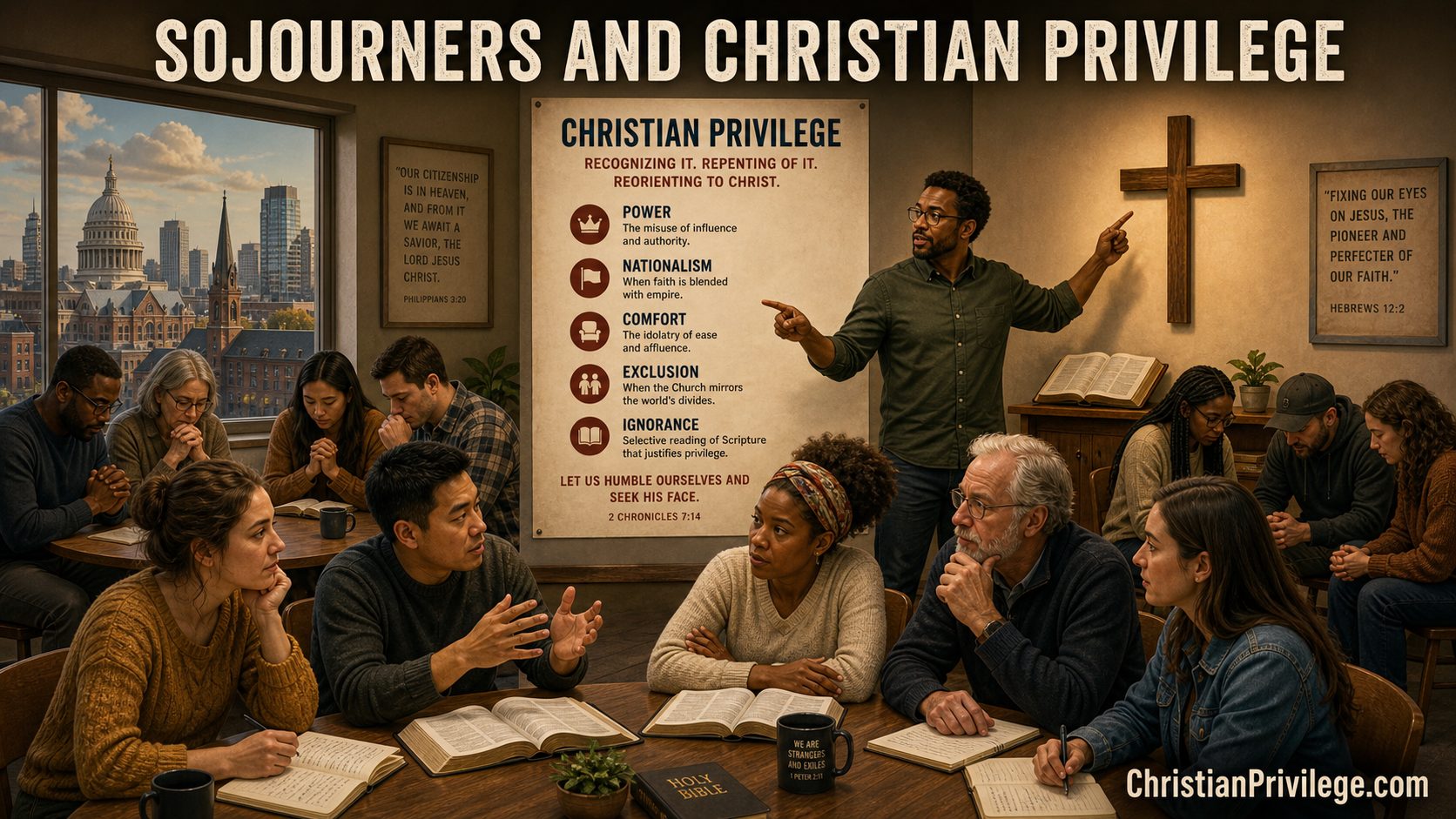
Here the case on ChristianPrivilege.com can actually support part of Sojourners’ contention while qualifying its conclusions. The article frankly acknowledges that Christians in America have often mistaken majority comfort for neutrality and have too seldom reflected on how their norms affect neighbors. It grants that Christians can inherit advantages without noticing them and that privilege language can reveal genuine ethical blind spots. Where Sojourners is right, Christians should repent—especially of using cultural power to excuse injustice, ignore minorities, or baptize nationalism.
Where Sojourners’ analysis becomes unstable is when it slides toward treating Christian normativity itself as the problem, rather than sinful uses of that normativity. The core thesis at ChristianPrivilege.com emphasizes that the decisive question is not whether Christianity has shaped institutions—history makes that obvious—but whether Christianity is true. If it is, then some forms of Christian “dominance” (such as a public expectation of honesty, sexual restraint, protection of children, and Sabbath rest) may be expressions of justice rather than oppression. Sojourners helps Christians see how easily they can confuse their own comfort with the kingdom of God, yet it often assumes that any structural advantage must lose moral legitimacy.
Furthermore, the Sojourners piece largely accepts the critical‑theory frame that treats “privilege” as inherently suspect and imagines a fully level, religiously thin public square as the ideal. The article at ChristianPrivilege.com counters that such a thin square is impossible; it would simply privilege secular conceptions of the good. The real Christian task is not to deny that Christians enjoy Christian privilege in some sense, but to steward it under Scripture: using whatever cultural influence they have for service, mercy, truthful witness, and the protection of the weak, while refusing to confuse cultural Christianity with saving faith.
Sojourners thus offers a partial, intra‑Christian critique that the argument at ChristianPrivilege.com can affirm and deepen, provided that one refuses the hidden assumption that any Christian social centrality is inherently unjust.