Christian Privilege and the Convenient Rewrite of American History
The criticism of Christian Privilege often presents itself as morally brave because it claims to expose a hidden structure of favoritism long ignored by polite society. But in practice, the sharpest versions of that critique do not illuminate history so much as flatten it. They take a long, tangled, contradictory American story and force it into a simple script: Christianity equals dominance, public Christianity equals exclusion, and the more Christian a society appears, the less free it must be.
That is not serious history. It is ideological editing.
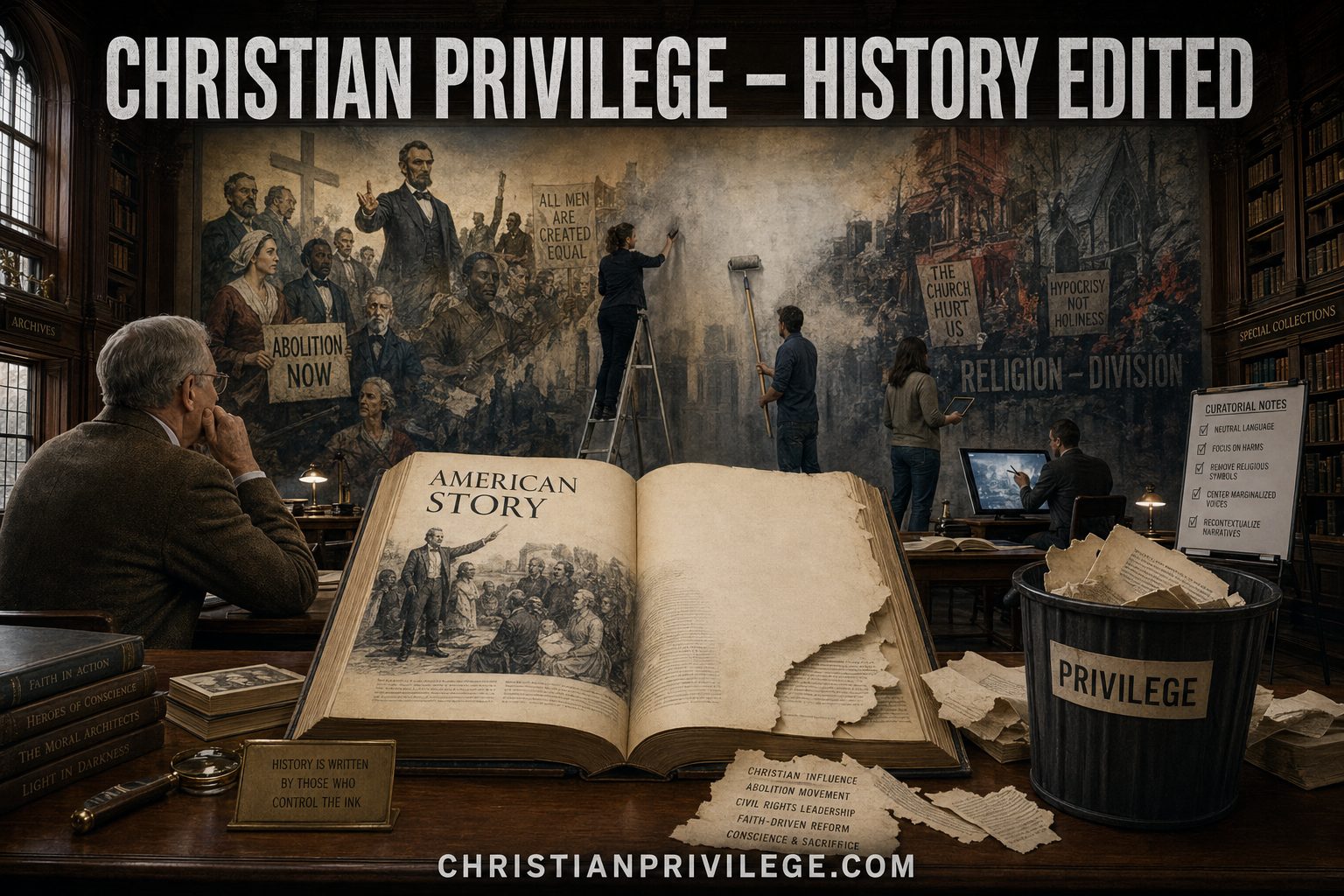
The real American story is far messier. As the Smithsonian put it, America’s religious past is an “often awkward, frequently embarrassing and occasionally bloody tale.” That line is worth dwelling on because it cuts against sentimental myths on both sides. It refutes the fantasy that America was always a harmonious Christian nation, but it also refutes the anti-Christian Privilege fantasy that Christian public presence can be treated as a single, stable form of oppression.
History was bloodier than the triumphalists admit and more complex than the critics can tolerate.
Christian Privilege and the Erasure of Christian-on-Christian Conflict
One reason the Christian Privilege narrative is so shallow is that it often speaks of Christianity as though it were a single, coordinated power bloc. American history says otherwise. From the colonial period onward, the fiercest religious conflicts in America were often not between Christians and secularists, but between Christians and other Christians.
The Smithsonian recounts “pitched battles between various Protestant sects” and even more explosive conflicts between Protestants and Catholics. That fact matters because it destroys the simplistic image of a monolithic Christian machine uniformly distributing privilege to all believers. In reality, the public status of “Christianity” in America often concealed bitter fights over which Christians counted, which doctrines were respectable, and which communities could safely be marginalized.
This does not disprove that some Christians enjoyed cultural advantages. It proves something more important: the phrase Christian Privilege is often too crude to describe the actual historical landscape. It turns a civil war of denominations, sects, and consciences into a cartoon.
Christian Privilege and the Record of Real Religious Persecution
If the critics of Christian Privilege were serious about historical honesty, they would admit that America’s past includes genuine forms of religious coercion—some of them enacted in explicitly Christian terms. Blasphemy laws existed. Religious tests existed. State favoritism existed. Anti-Catholic violence existed. Mormons were persecuted. Dissenters were punished.
The Library of Congress notes that laws banning blasphemy “specifically related to Christianity” were prevalent in the states around the founding era. The Constitution’s rejection of federal religious tests also arose in a world where many state constitutions still imposed them or assumed them. In Massachusetts, a convent was burned by an anti-Catholic mob in 1834; in Philadelphia, the Bible Riots of 1844 destroyed churches and killed people. Missouri even issued an expulsion order targeting Mormons.
Those facts matter. They are ugly, and they should not be minimized. But the anti-Christian Privilege framework usually does something subtler than outright denial. It treats those episodes not as warnings against coercion in general, but as proof that Christianity in public is inherently suspect. That leap is the historical sleight of hand.
Christian Privilege and the Forgotten Birth of Liberty of Conscience
The same American history that records religious persecution also records the birth of some of the strongest arguments against it—and many of those arguments were advanced by Christians themselves. Roger Williams is the clearest example. He did not respond to persecution by demanding a naked public square purged of religion. He argued that religion “must not be subject to state regulation” and that conscience must remain free.
The National Park Service describes Rhode Island under Williams as a refuge for those “distressed of conscience.” Another historical summary of Williams explains that he fought for “individual conscience” at a time when most people believed religious freedom and civil order could not coexist. That is not the language of anti-religious cleansing. It is the language of principled limits on state power.
This is one of the most devastating facts for the Christian Privilege critique. Christianity was not only part of the coercive side of American history. Christianity was also part of the rebellion against coercion. A framework that cannot tell those two things apart is not morally discerning enough to guide a free society.
Christian Privilege and the Madison Problem
Roger Williams was not alone. James Madison’s opposition to state support for religion is another major historical obstacle to simplistic Christian Privilege narratives. Madison did not attack Christianity as a contaminant in public life. He attacked the competence of the state to sponsor religion without violating conscience and corrupting both church and government.
The Smithsonian notes that Madison’s “Memorial and Remonstrance Against Religious Assessments” became “a fundamental piece of American political philosophy.” That phrase matters because it reveals the true American remedy to religious favoritism. It was not to strip Christians of public voice. It was to deny government the authority to manage souls.
This distinction is everything. The anti-Christian Privilege framework frequently behaves as though the cure for past Christian favoritism is present Christian marginalization. Madison’s logic points the other way. The cure is institutional restraint—government kept from making theological judgments while citizens remain free to act, speak, persuade, worship, and organize according to conscience.
That older vision is harder because it does not flatter ideological tribes. It does not offer the drama of purging a dominant class. It simply limits the state and tolerates the noise of freedom.
Christian Privilege and the Category Error at the Heart of the Critique
The core error in the criticism of Christian Privilege is historical as well as conceptual. It confuses cultural inheritance with legal imposition and then confuses legal imposition with the mere public visibility of Christianity. That is how the argument moves so quickly from “America had Christian favoritism in parts of its history” to “Christianity in public life is itself a civic problem.”
But that conclusion does not follow. The existence of blasphemy laws does not prove that public Christian argument is illegitimate. The history of anti-Catholic bigotry does not prove that Christian schools or churches should now be treated as structurally suspect. The fact that state constitutions once imposed religious tests does not mean Christian voters, Christian charities, and Christian moral claims should now be managed as remnants of oppression.
This is the great category error. Past coercion becomes an excuse for present exclusion. Historical abuses are used not to defend liberty equally, but to justify new suspicion toward one religious tradition. The lesson drawn from old violations of conscience becomes: Christians should probably be quieter now. That is not moral seriousness. It is revenge disguised as balance.
Christian Privilege and the Dangerous Symmetry of Overcorrection
Every society that rediscovers a past injustice faces a temptation toward overcorrection. That temptation is especially strong when the injustice can be tied to a majority faith. In that setting, it becomes easy to imagine that fairness requires reversing the old status order entirely. If Christians once enjoyed favoritism, then Christians today must lose cultural standing. If public institutions once leaned Christian, then public institutions must now become allergic to Christianity.
That instinct is emotionally understandable and politically disastrous. It creates a perfect symmetry of error. The old model privileged Christianity by law or assumption; the new model would penalize Christianity by policy or atmosphere. One made dissenters second-class citizens. The other risks making Christians second-class citizens in the name of avoiding historical repetition.
This is why the critique of Christian Privilege is dangerous when taken literally. It imagines that the opposite of Christian favoritism is anti-Christian management. But freedom is not found at either extreme. A society does not cure historical domination by creating a new class of supervised participants. It cures domination by refusing to let the state privilege or punish conscience.
Christian Privilege and the Myth of the One-Way Story
The anti-Christian Privilege narrative survives by telling American religious history as a one-way story: Christians had power, Christians used power, Christians harmed outsiders, and therefore Christian influence in public life remains inherently suspect. But history is not one-way. It loops, fractures, contradicts itself, and often produces liberty through conflict.
The same culture that generated coercive laws also produced the arguments that dismantled them. The same nation that tolerated anti-Catholic bigotry also developed stronger norms of conscience and equal citizenship. The same religious energies that sometimes fueled exclusion also inspired abolition, reform, charity, and resistance to state overreach.
This does not make Christianity uniquely innocent. It makes history morally real. And moral reality is exactly what the Christian Privilege framework often cannot handle. It wants a prosecutorial narrative, not a truthful one. It wants a permanent defendant, not a civilization wrestling with the conditions of liberty.
Christian Privilege and the New Amnesia
The ultimate irony is that critics of Christian Privilege accuse others of forgetting history while practicing a more selective amnesia themselves. They remember Christian coercion but forget Christian arguments for liberty. They remember state favoritism but forget constitutional restraints built to prevent it. They remember anti-Catholicism and anti-Mormonism but rarely draw the obvious lesson that majority panic can turn against any visible religious minority—including Christians when the ideological climate shifts.
This new amnesia is socially destructive because it teaches citizens the wrong lesson from the past. Instead of learning that conscience must not be coerced, people learn that visible Christianity should always be treated with suspicion. Instead of learning that governments should not sort good and bad religions, people learn that state and institutional power should be used to manage Christianity’s cultural footprint.
In other words, the country forgets the very lesson its history paid for in blood.
Christian Privilege and the Lesson History Actually Teaches
The honest lesson of American history is not that Christian Privilege must be dismantled by pushing Christianity out of public life. The lesson is that every alliance of state power and religious sorting eventually becomes abusive, whether it favors Christians or disciplines them. The answer to that danger is not the privatization of conviction. It is liberty of conscience under a limited state.
That is the lesson Roger Williams saw before most of his contemporaries could bear it. That is the lesson Madison sharpened into constitutional argument. And that is the lesson the anti-Christian Privilege machine cannot afford to remember, because remembering it would force a devastating admission: the true American remedy to religious favoritism is not anti-Christian suspicion but principled freedom.
That is why the modern social criticism of Christian Privilege is so often shallow, dangerous, and impossible to implement. It is shallow because it flattens history into propaganda. It is dangerous because it invites overcorrection by institutions hungry to manage belief. And it is impossible to implement without forgetting the deepest truth American history teaches—that conscience must not be violated, urged, or constrained.