Christian Privilege and the Promise of Neutrality
The modern argument against Christian Privilege usually arrives dressed as a simple appeal to fairness. Christians, it says, have enjoyed too much cultural deference, too much moral influence, too much institutional familiarity, and too much access to the symbols and language of national life. The cure, we are told, is not persecution but neutrality.
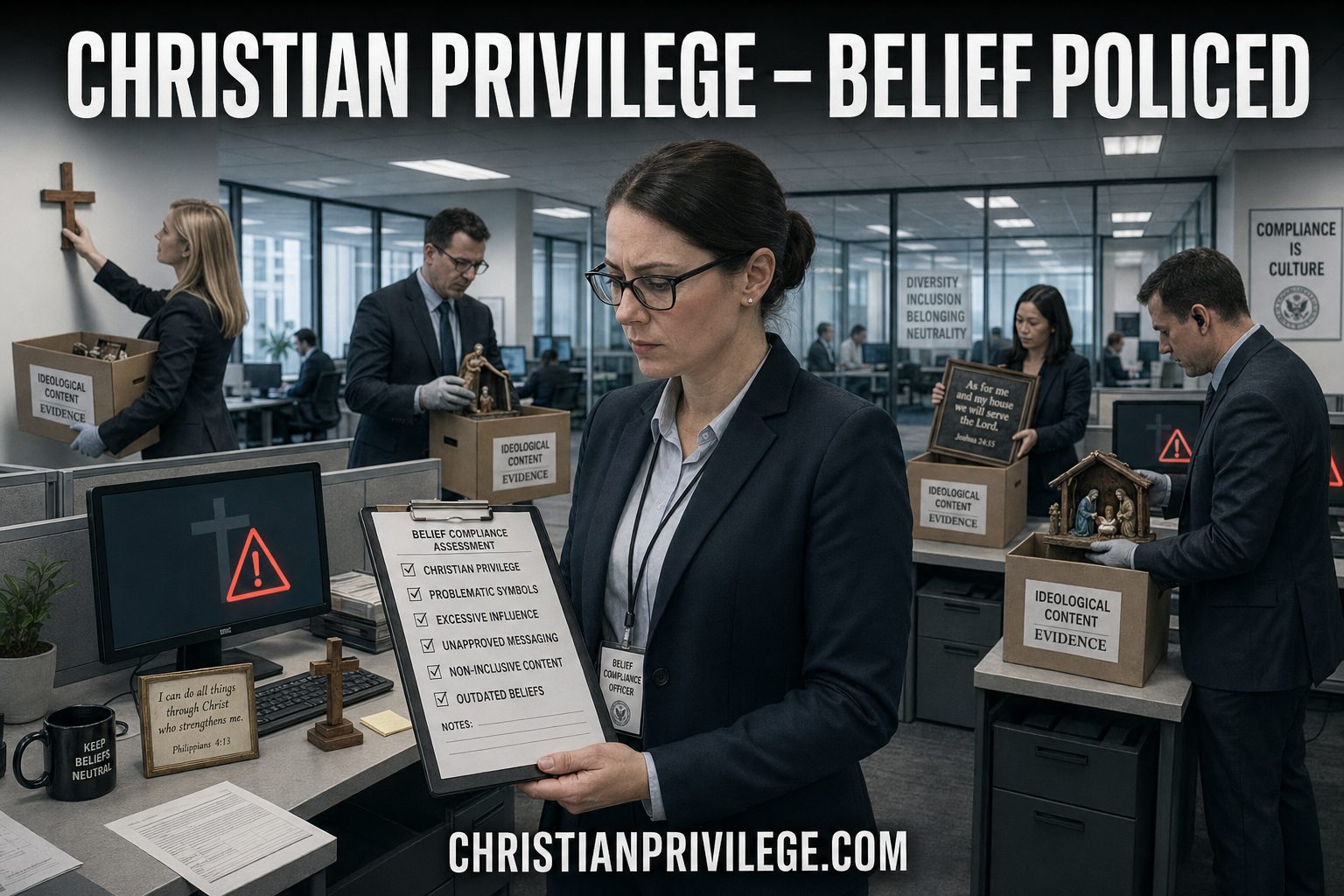
That word does enormous work. It sounds calm, procedural, civilized, almost antiseptic. But if the campaign against Christian Privilege were ever pursued seriously rather than rhetorically, neutrality would not remain neutral for long. It would require administrators, policies, standards, investigations, and enforcement mechanisms able to identify, measure, and reduce Christian influence wherever it appeared too visible, too normal, or too successful.
That is the dirty secret buried inside the critique of Christian Privilege: its proposed cure requires a society constantly monitored for religious imbalance. The project cannot succeed through goodwill alone. It needs inspectors.
Christian Privilege and the Machinery Required to Dismantle It
Critics of Christian Privilege often write as though the problem is self-evident. Christmas language in schools, Christian assumptions in civic speech, pastors shaping public opinion, churches operating institutions, Christian arguments in politics—these are treated not merely as features of a historically Christian-majority society but as evidence of structural unfairness. Once that framing is accepted, the obvious next question follows: who decides when Christian presence becomes too much?
That is where the theory becomes dangerous. If Christian Privilege is something society must actively reduce, then someone has to define it case by case. Someone has to review school policies, public symbols, workplace practices, nonprofit partnerships, government meetings, curriculum materials, grant standards, and speech norms. Someone has to determine whether a Christian teacher’s comment is protected expression or illicit influence, whether a faith-based charity’s hiring standards are identity or discrimination, whether a public reference to Scripture is democratic speech or a subtle assertion of dominance.
A system built on those distinctions does not resemble liberty. It resembles a licensing regime for conscience. The old village may have had a priest listening for heresy; the new republic of anti-Christian Privilege would have a compliance office doing the same work in business-casual clothes.
Christian Privilege and the Lesson of American History
American history offers a warning here, though not the one critics usually emphasize. It is true that the United States has known forms of legal favoritism toward Christianity. Blasphemy laws once existed in multiple states, and legal structures in earlier eras often protected Christian assumptions more readily than the rights of dissenters. But the lesson of that history is not that Christian influence must be rooted out. The lesson is that the state is a terrible manager of religious boundaries.
The Library of Congress notes that blasphemy laws “specifically related to Christianity” were widespread around the founding era, even where religious freedom protections existed on paper. That contradiction matters. It shows how quickly noble language about order and morality can become a mechanism for punishing disfavored belief or speech.
Now reverse the direction of the pressure. Imagine a regime no longer dedicated to defending Christianity from insult but to defending the public square from Christianity’s alleged “privilege.” The structure would be different, but the temptation would be the same. Officials would still sort acceptable and unacceptable religious expression. They would still decide whose conscience counts as normal participation and whose counts as civic contamination. A state that once punished blasphemy could easily become a state that polices “excessive” Christian presence. The theology changes; the administrative instinct survives.
Christian Privilege and the Collapse of the Influence-Coercion Distinction
At the center of the Christian Privilege critique is a fatal conceptual confusion: it collapses the distinction between influence and coercion. In a free society, influence is unavoidable. People vote, argue, persuade, organize, preach, publish, donate, and build institutions based on their convictions. Coercion, by contrast, occurs when the state compels belief, suppresses dissent, or imposes penalties for conscience.
That distinction is the backbone of American liberty. The First Amendment protects both against establishment and for free exercise. It does not require religious citizens to become silent or morally generic the moment they step into public life. As the United States Courts explains, the Free Exercise Clause protects the right to practice religion, subject to compelling public interests in limited cases. The point is not that religion must vanish when public consequences appear. The point is that government may not casually interfere with religious practice and expression.
But the rhetoric of Christian Privilege often treats ordinary Christian participation as if it were quasi-coercive by nature. A Christian argument in politics becomes “imposition.” A Christian-run institution becomes “exclusion.” A Christian moral vocabulary in civic speech becomes “dominance.” Once those categories blur, government and institutions are invited to manage not coercion but influence—and that is where the belief inspector state begins.
Christian Privilege and the Rise of Soft Authoritarianism
Not every authoritarian system arrives in boots. Some arrive in workshops, HR manuals, accreditation reviews, and policy updates. That is exactly why the anti-Christian Privilege project is so dangerous: it would likely operate through soft authoritarianism rather than open persecution.
Consider what implementation would require. Public schools would need guidelines on when Christian references are historically appropriate and when they are unacceptably normalizing. Universities would create procedures for addressing complaints about Christian organizations whose beliefs allegedly reproduce “privilege.” Employers would train managers to distinguish between harmless personal faith and disallowed public faith expression. Government offices would treat overtly Christian reasoning as a reputational risk requiring mitigation.
No single act in that system looks dramatic by itself. That is precisely the danger. Nobody has to ban Christianity outright. They simply build a culture in which Christians learn to edit themselves preemptively. Speech narrows. Institutions sanitize their identities. Public officials translate convictions into abstract jargon so as not to trip ideological alarms. The faith remains legal, but only after it has been socially declawed.
This is what a belief inspector state looks like in practice. It does not throw everyone in jail. It teaches them to whisper.
Christian Privilege and the New Religious Test
America has long rejected formal religious tests for public office, but a regime built to combat Christian Privilege would recreate them informally. The test would no longer ask whether a person belongs to the right church. It would ask whether a person can be trusted not to let Christian conviction matter too much in public.
That is a test all the same. It pressures believers to prove that their faith is personally comforting but publicly irrelevant. It rewards those who treat Christianity as private sentiment and punishes those who regard it as a total vision of reality with social implications. In effect, it divides Christians into acceptable and unacceptable kinds: ceremonial Christians may remain, but serious Christians become suspect.
This is not paranoia; it is simply the logic of implementation. If Christian Privilege names the problem, then any robust Christian presence will always be liable to charge. The more coherent the conviction, the more likely it is to be considered threatening. The more visible the institution, the more likely it is to be monitored. The more persuasive the public witness, the more likely it is to be framed as unequal power.
In the name of equality, the state and its allied institutions would end up grading souls by public harmlessness.
Christian Privilege and the Public School Laboratory
One place this logic becomes especially clear is the public school system. Schools are already battlegrounds for questions of religious expression, state neutrality, and the moral formation of children. A society serious about dismantling Christian Privilege would almost certainly make schools the front line.
Christian ideas in literature, moral reasoning rooted in biblical categories, holiday traditions, student religious expression, teacher speech, historical interpretation—none of these would remain simple educational matters. Each would become an occasion for ideological scrutiny. The question would no longer be, “Is this constitutionally permitted?” but “Does this reinforce Christian cultural dominance?”
That shift matters. The constitutional standard asks whether government is establishing religion or infringing free exercise. The Christian Privilege standard asks whether Christianity is too present, too familiar, or too influential. One protects liberty. The other polices atmosphere.
A classroom governed by the second standard would not be more open-minded. It would be more suspicious. Teachers would become curators of ideological balance rather than educators. Students would be taught not merely to understand Christianity’s role in history, but to regard its normal presence as inherently problematic. That is not education in pluralism. It is instruction in cultural distrust.
Christian Privilege and the Endless Expansion of Oversight
The deepest flaw in the anti-Christian Privilege project is that it has no limiting principle. Once Christian influence is recast as a social wrong rather than a normal fact of democratic participation, there is no stable stopping point. Every sphere becomes reviewable.
Churches that operate schools, hospitals, foster agencies, food banks, and counseling centers would face questions about whether their Christian identity gives them unfair latitude. Business owners acting from conscience would be examined not simply for compliance with law, but for whether their beliefs reproduce patterns of Christian favoritism. Public ceremonies, invocations, monuments, and civic vocabulary would be subjected to constant dispute because any remnant of Christian inheritance could be treated as continuing evidence of privilege.
This is how bureaucracies grow. They feed on abstractions that can never be fully satisfied. Because Christian Privilege is not a precise constitutional category but a floating cultural accusation, it guarantees perpetual enforcement. There will always be another phrase to examine, another tradition to audit, another institution to discipline, another symbol to reinterpret. The project cannot conclude because its object is not a concrete legal abuse but a civilization’s memory of itself.
Christian Privilege and the Cost to Democratic Trust
A society cannot remain free for long if large portions of its population come to believe that ordinary public participation will be treated as presumptively illegitimate. Yet that is exactly what would happen if the strongest critique of Christian Privilege were converted into policy and institutional culture.
Christians would learn that speaking from conviction in public life carries a professional and civic penalty. Non-Christians would be trained to interpret Christian visibility not as one feature of a pluralistic democracy but as a threat requiring management. Institutions would increasingly present themselves as neutral while applying ideological judgments behind the scenes. Everyone would become more litigious, more defensive, and more tribal because no one would trust the arbiters.
That is how democratic trust erodes. Not through one dramatic act, but through the repeated message that some citizens may participate only after their deepest motivations have been domesticated. A nation that tells believers, “You are free to have faith, but only in a form that never meaningfully shapes public life,” has not preserved pluralism. It has quietly replaced it.
Christian Privilege and the Better Alternative
The better American alternative is older, wiser, and far less grandiose. It does not deny history. It does not pretend Christians have never enjoyed cultural advantages. And it does not confuse every inherited Christian norm with perfect justice. But neither does it treat Christian visibility as a pathology demanding constant supervision.
The constitutional model is clearer: government may not establish religion, and it may not prohibit its free exercise. That framework leaves room for disagreement, persuasion, institutional diversity, and visible faith in public life. It is messy, but freedom always is. What it does not require is a nationwide corps of belief inspectors evaluating whether Christians are being too Christian in public.
That is why the social criticism of Christian Privilege is so dangerous when taken seriously. It sounds modest, but it cannot be implemented modestly. It begins with calls for fairness and ends with the quiet construction of a belief inspector state. Once that machine exists, no one should be confident it will stop with Christians.