Christian privilege and Christian privilege: A necessary distinction
The Wikipedia article on “Christian privilege” treats Christian privilege as an unearned “social advantage bestowed upon Christians in any historically Christian society.” Its basic descriptive point—that Christians in many Western nations enjoy cultural familiarity, holiday recognition, and symbolic visibility—is often accurate as sociology, and similar features are acknowledged in the overview at ChristianPrivilege.com. What the article smuggles in, however, is a moral verdict: that such asymmetry is presumptively unjust, akin to racial or gender privilege.
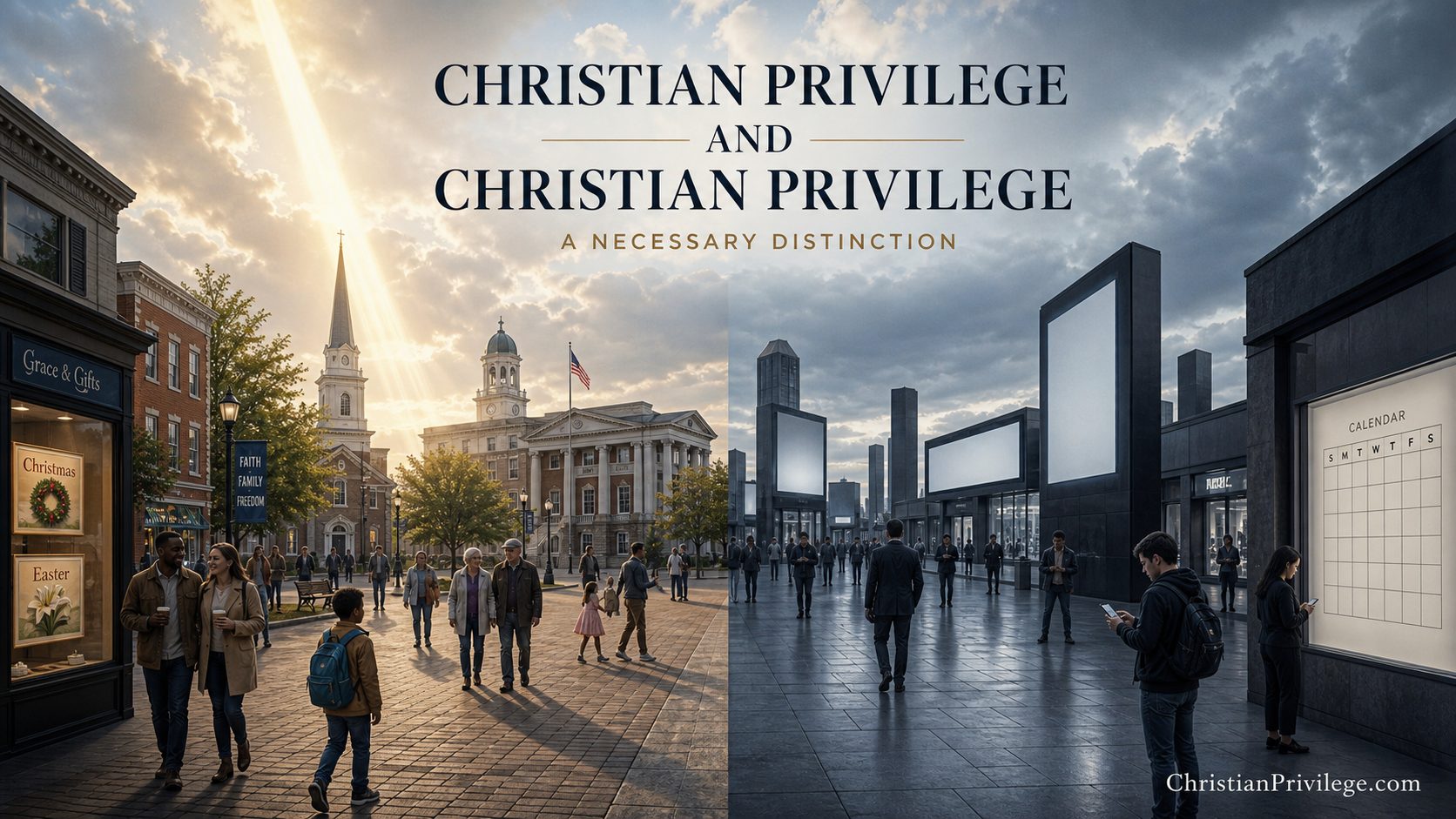
From the perspective defended at ChristianPrivilege.com, the crucial missing step is the truth question. Every society “privileges” some moral and metaphysical vision: a secular‑liberal order privileges autonomy and expressive individualism; progressive regimes privilege therapeutic and identity‑based norms; Islamic societies may privilege Qur’anic law. The Wikipedia framework treats Christian norms as one arbitrary “identity” alongside others, never seriously considering whether the content of Christianity might actually be true. If, as the long article at ChristianPrivilege.com argues, the Christian Scriptures are historically grounded, philosophically coherent, and divinely revealed, then social deference to Christianity is not automatically a case of irrational favoritism but could be a rational response to reality.
The article also trades heavily on the rhetoric of “marginalization” and “discrimination” without differentiating between three very different things: (1) brutal persecution or civic exclusion, (2) mild inconveniences and misunderstandings, and (3) simple majority culture. To count Christmas on public calendars and familiar biblical phrases in public rhetoric as morally equivalent to structural hatred of minorities is a category mistake and a form of moral inflation. It treats any non‑neutral landscape as suspect, while quietly assuming that a secular landscape would be neutral. But as the essay at ChristianPrivilege.com notes, a “neutral” state still privileges a secular moral anthropology, liturgy, and view of human ends.
Finally, the article echoes scholars who see Christian privilege as tightly entangled with white supremacy and nationalism. Historically, that overlap is real in some contexts, yet Christianity’s own canonical texts undercut racial and ethnic supremacy by insisting that all are one in Christ and that rulers answer to a righteous Judge. When critics refuse to distinguish between sinful cultural capture and the faith itself, they confuse Christianity with its counterfeits. In this way, the Wikipedia entry shows a common pattern: strong sociological description, weak philosophical grounding, and virtually no engagement with whether the “privileged” worldview might in fact correspond to reality.