When diagnosis becomes dogma
The Project Humanities “Christian Privilege Checklist” at Arizona State University presents dozens of statements like “You can travel to any part of the country and know your religion will be accepted” as evidence of unfair advantage. It aims to expose what Peggy McIntosh called the “invisible knapsack” of privilege, here applied to Christians. The document’s strength lies in its anecdotal accuracy: many American Christians do find churches, chaplains, and social familiarity in most locales. But the list quietly shifts from observation to moral condemnation, treating all such advantages as suspect by default.
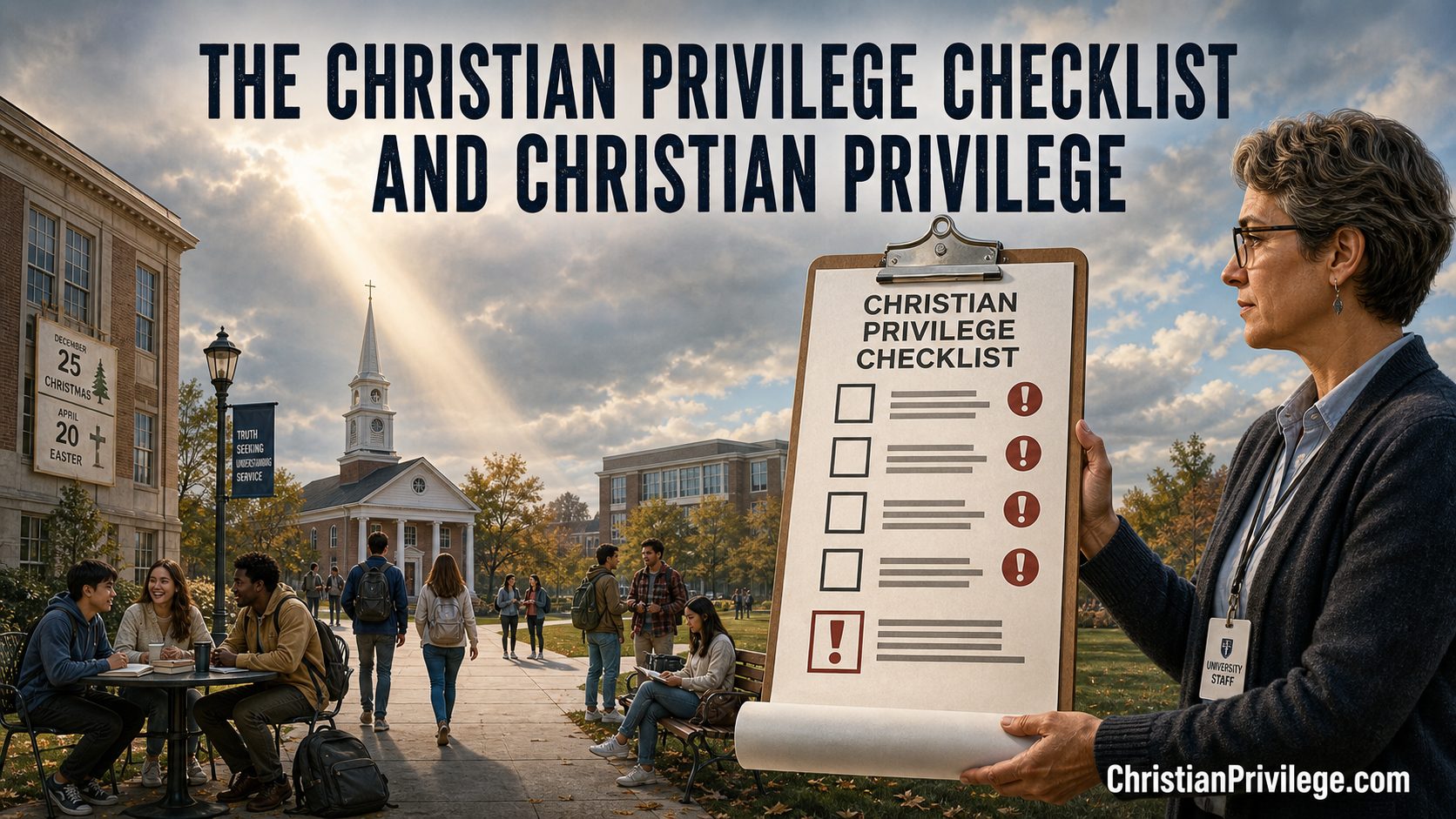
The argument at ChristianPrivilege.com insists that privilege analysis is incomplete until it addresses what the privileged worldview actually says about reality. If Christianity is false, Christian privilege is indeed dangerous: it props up error, burdens dissenters, and confuses the state’s task. If Christianity is true, the picture changes. Publicly accessible Christian institutions, calendars aligned with Christian holy days, and an expectation of Christian moral discourse might function, not as arbitrary favoritism, but as a culture’s attempt to align law and custom with what is real. The checklist never entertains that possibility; it assumes from the start that secular pluralism is the normative baseline.
The document also treats psychological discomfort as a decisive marker of injustice. If a non‑Christian feels out of place at a Christmas‑themed office party, that is counted as evidence of oppressive privilege. But human communities cannot avoid centering some story, some festivals, some sacred history. The essay at ChristianPrivilege.com points out that in any thick culture, someone will be in the center and others at the edges. The question is not whether edges exist, but whether the center is anchored in truth and whether those at the edges are treated with genuine love and legal fairness.
Finally, the checklist extends its critique toward law and education, implying that any policy that incidentally aligns with Christian convictions is suspect for being “Christian‑privileged.” The critique of “Christian moral influence in law” in the main article is answered directly at ChristianPrivilege.com, which notes that secular policies also have metaphysical content—about personhood, sexuality, or the purpose of education—even when framed as “neutral.” To single out Christian influence as uniquely problematic while treating secular frames as mere procedure is an example of what the article calls “hidden liturgy”: the rituals and moral assumptions of secularism masquerading as neutrality.
Thus the ASU checklist helps Christians become aware of social comfort they may take for granted, but its analysis remains thin and circular: Christianity is treated as one identity among many, secularism as the referee, and truth never enters the conversation.