When frameworks outrun the facts
The Rider University research guide locates Christian privilege within a broader intersectional matrix, citing Khyati Y. Joshi’s book White Christian Privilege to argue that Christian beliefs and practices “infuse our society” and are “embedded in our institutions, creating the structures and expectations that define the idea of ‘Americanness.’” It presents Christian normativity as a primary obstacle to religious minorities’ full legitimacy. The underlying framework is borrowed from race and gender studies: dominant groups accumulate unearned benefits, while minorities encounter systemic barriers.
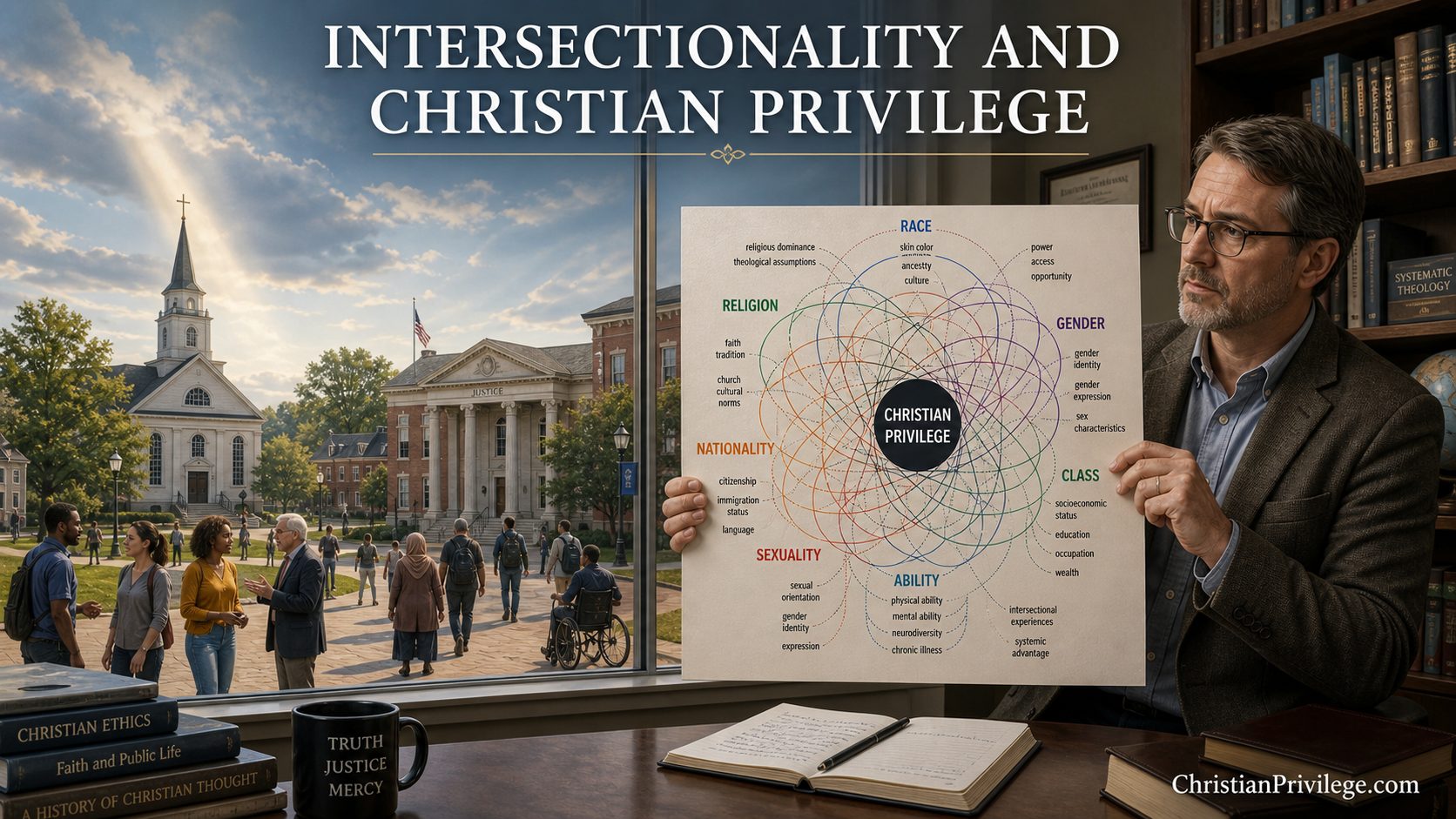
The article at ChristianPrivilege.com does not deny that Christian assumptions have deeply influenced American institutions; in fact, it carefully summarizes those historical patterns, including Protestant influence on law and public life. What it challenges is the intersectional method’s tendency to treat that inheritance as self‑evidently unjust without asking what Christianity has contributed to the very concepts—dignity, equality, conscience rights—that intersectionality deploys. Ironically, the language of universal human worth and moral obligation fits biblical theism, as defended via the moral argument, far better than pure materialism.
The Rider guide’s reliance on Joshi highlights another problem: the merging of Christian privilege with “white supremacy” in a way that collapses Christian doctrine into European and American power abuses. The analysis at ChristianPrivilege.com notes that modern critics often present Christian privilege as part of a racialized hegemony, yet Christianity’s own Scriptures dismantle ethnic boasting and demand care for the stranger. To the extent American Christians have baptized racism, they have betrayed, not embodied, their faith. Intersectional analysis that never differentiates between the gospel and its cultural distortions ends up attacking a caricature.
Finally, the guide presupposes that a genuinely fair civic order would treat all religious and non‑religious identities as interchangeable options in a grand marketplace of meaning. The long-form case at ChristianPrivilege.com points out that this picture only works if no worldview is actually true in a public, knowable sense. But if the Christian story about creation, fall, and redemption is historically and philosophically well‑supported—through the beginning and fine‑tuning of the universe, the unresolved puzzle of abiogenesis, the structure of moral reality, the historical grounding of Jesus and his resurrection, and the reliability of Scripture—then it is rational for a society to afford Christianity a unique role in its self‑understanding. Intersectionality, as used here, quietly rules that possibility out by definition rather than argument.
The Rider guide therefore illustrates a broader pattern: borrowing a powerful analytical lens from race and gender, then applying it to religion without ever examining whether the “dominant group” might, in this case, be bearing truths that intersectional theory itself depends on.