Rededicate 250 is a serious blending of faith and politics, but Matthew Taylor’s “Field Guide” overstates its novelty, its legal danger, and the inevitability of “Christian supremacy,” and it does so with selective facts and worst‑case interpretations. A more balanced look at the event, the Constitution, public opinion, and actual government practice shows why it is best read as a fear‑driven exaggeration rather than a neutral field guide.
Rededicate 250: What Actually Happened
Taylor frames Rededicate 250 as “a government‑sponsored religious dedication ceremony” that creates “a symbolic baptism of the American state in MAGA Christianity” and a “beachhead for narratives of Christian supremacy.” That language suggests a totally new, quasi‑theocratic turning point. But the public record paints a more ordinary picture: a big, partisan prayer rally on the National Mall, not a constitutional revolution.
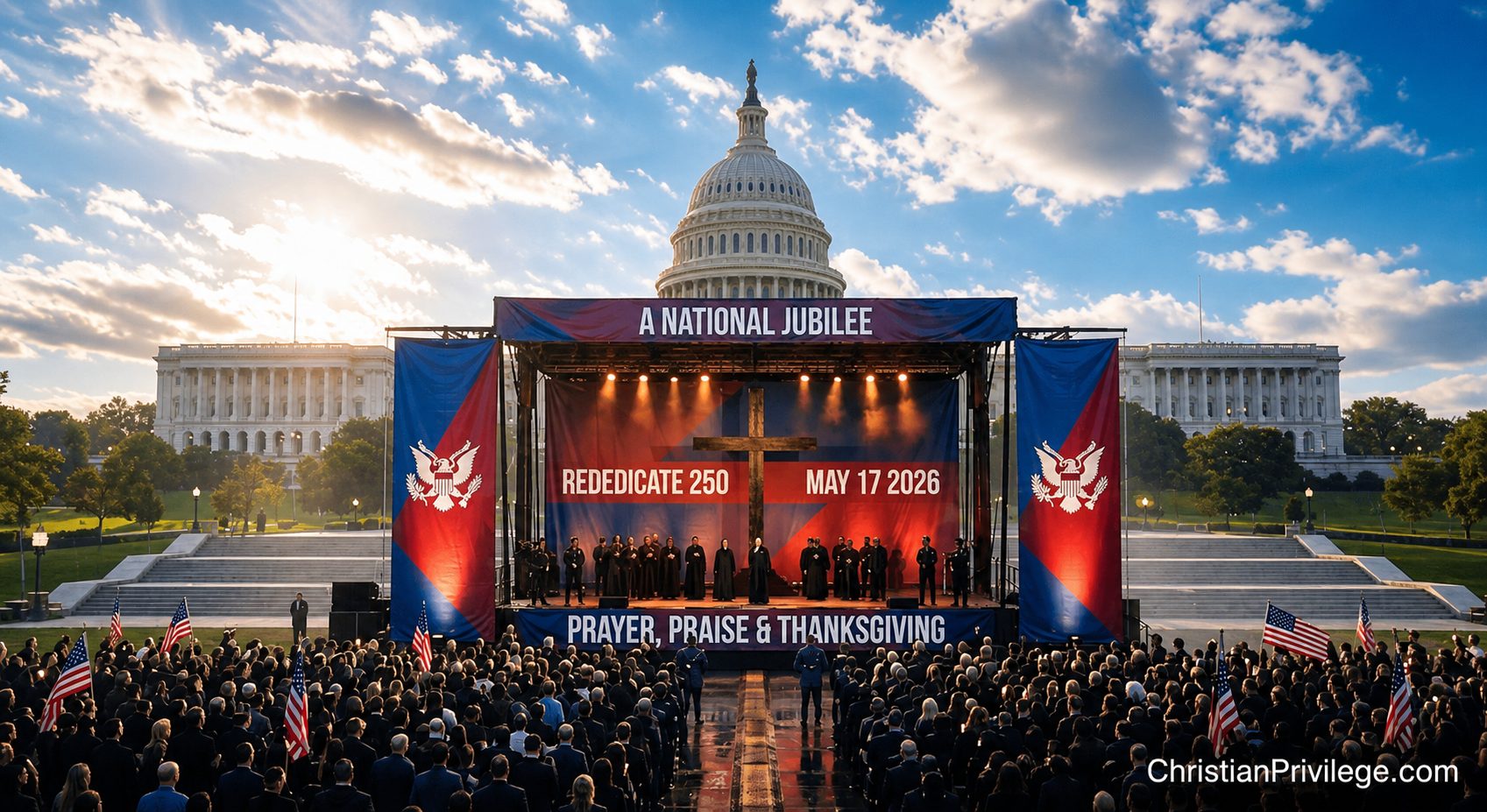
News coverage describes Rededicate 250 as one event in the broader Freedom 250 campaign, a public‑private effort to mark the nation’s semiquincentennial, organized by a nonprofit closely aligned with the Trump administration and promoted by federal agencies. Articles critical of the event acknowledge that it looks like a typical, if unusually large, Christian‑heavy prayer rally fused with pro‑Trump politics and patriotic pageantry, not a formal change in the structure of American government. That is troubling for pluralism, but it is not equivalent to “baptizing the state” in any legal or institutional sense. Treating rhetoric and symbolism as if they were binding constitutional acts is one of the guide’s most basic exaggerations.
Must See Also: What is Christian Privilege?
Is Government‑Linked Prayer “Unprecedented”?
Taylor insists that “government sponsorship of a sectarian Christian event at this scale is unprecedented in the modern era.” That claim sounds alarming, but it ignores decades of similar entanglements, both symbolic and logistical, between federal officials and large Christian events.
For example, presidents of both parties have addressed or endorsed evangelical‑leaning mass gatherings—Ronald Reagan’s and George W. Bush’s close ties to the Religious Right, Barack Obama’s participation in the National Prayer Breakfast, and numerous prayer rallies on the Mall with lawmakers on the program are all well‑documented. The National Mall has hosted large explicitly Christian prayer events such as Lou Engle’s “The Call DC” in 2000 and later gatherings that knitted together patriotism, conservative politics, and evangelical worship; Taylor himself concedes that “many of the organizers have been staging large Christian nationalist gatherings on the National Mall for more than a quarter century.” What is new here is scale and the specific branding around the 250th anniversary, not the basic pattern of politicians boosting sectarian prayer events.
Must See Also: How Christian Privilege Shows Up in American Traditions
First Amendment Alarm vs. Legal Reality
The article claims that Rededicate 250 “clearly violates the principle of church‑state separation” and is a kind of de facto “executive” establishment of religion, even if it might not literally violate the text of the First Amendment. Notice the move: the rhetoric equates a prudential concern (“this is unwise and exclusionary”) with an almost‑lawless act (“symbolically establishing Christianity”).
But constitutional law makes a sharp distinction between government speech with religious content and formal establishment of religion. The Supreme Court has repeatedly allowed legislative prayer, religious language in public ceremonies, and policymakers speaking in explicitly religious ways, so long as the government does not coerce participation or officially favor one church in law or funding. Even critics of Rededicate 250, such as Americans United for Separation of Church and State, frame it as a dangerous example of Christian nationalism and an erosion of norms, not as a plainly unconstitutional theocracy in practice. Taylor blurs this line by leaning heavily on the evocative symbol (“baptism of the state”) and downplaying the actual legal constraints that remain in force.
Must See Also: Christian Privilege and the Separation of Church and State
The “Task Force to Eradicate Anti‑Christian Bias” and Persecution Narrative
Taylor mocks the idea that a religious majority can be “persecuted” and argues that the Task Force to Eradicate Anti‑Christian Bias exists to protect “privileges of politically conservative Christians,” framing it as a pretext for labeling dissent as “bias.” It is true that 63% of Americans still identify as Christian, and that talk of persecution is often inflated. But that does not make any concern about anti‑Christian incidents illegitimate, and it does not automatically convert any effort to track such issues into a proto‑authoritarian project.
Government offices that monitor bias or discrimination toward specific groups—whether antisemitism, anti‑Muslim bias, or anti‑Asian hate—are now commonplace, and they are often criticized from the other side for doing too little. Evaluating this Christian‑focused task force requires specific evidence that it is actually punishing speech, chilling religious minorities, or rewriting law—not just assuming the worst motive because it centers Christians. Taylor’s piece does not provide those case studies; it infers an authoritarian intent from the office’s existence and his interpretation of its language. That is classic fear‑driven reasoning: start from a maximalist narrative and treat it as the lens for every policy detail.
Must See Also: Is “Christian Privilege” The Same As Persecution?
NSPM‑7 and “Domestic Terrorism”: Reading the Fine Print
A particularly alarming section of the Field Guide focuses on National Security Presidential Memo 7 (NSPM‑7). Taylor writes that it defines domestic terrorism partly in terms of “anti‑Americanism, anti‑capitalism, and anti‑Christianity… and hostility towards those who hold traditional American views on family, religion, and morality,” and concludes that “push back on their vision of Christian America, and you risk being labeled a domestic terrorist.” That is a dramatic claim with potentially chilling implications—but again, it rests on selective reading and slippery extrapolation.
Standard U.S. definitions of domestic terrorism require violent acts or preparation for violence, not mere disagreement with ideology. Since 9/11, multiple administrations have toyed with broad ideological descriptors (“anti‑government,” “extremist,” “sovereign citizen”), but when challenged in court or Congress, agencies must show actual violence, threats, or material support for violent acts to invoke terrorism powers. Describing NSPM‑7 as if it simply equates “anti‑Christian” opinions with terrorism omits that critical legal context. Without showing that people have actually been investigated, charged, or punished solely for criticizing conservative Christian views under this memo, the implication that dissenters are “at risk” of being labeled domestic terrorists is more about stoking fear than presenting verifiable patterns of abuse.
Must See Also: Why Expanding “Christian Privilege” Into “Christian Supremacy” Matters
Nigeria, Foreign Policy, and Selective Outrage
Taylor points to the 2025 bombing campaign in Nigeria—strikes on Muslim groups accused of targeting Christians—as evidence that U.S. policy now exists “to protect (some) non‑American Christians abroad” and asks, “Why only Christians?” That framing invites the reader to see a simple story of sectarian favoritism. But U.S. foreign policy is rarely that simple, and media coverage of the Nigeria strikes underscores a more complex mix of security, regional, and humanitarian considerations.
Reports on U.S. interventions in Nigeria and the broader Sahel emphasize concerns about jihadist groups, instability, and civilian casualties across religious lines; they also note that Christians and Muslims alike have suffered in overlapping conflicts involving Boko Haram, Islamic State affiliates, and local militias. It is quite plausible that administration rhetoric highlighted threatened Christians to resonate with domestic evangelical audiences, but taking that as proof that the policy is only about “protecting Christians” goes well beyond what the facts establish. Here again, Taylor takes a real concern—religion‑inflected framing of foreign policy—and inflates it into a seamless narrative of Christian supremacist statecraft.
Must See Also: When Christian Privilege Shapes Foreign Policy Narratives
“Christian Supremacy” vs. Christian Nationalism: Stretching the Concepts
One of the Field Guide’s central moves is to argue that Rededicate 250 is not just Christian nationalist but a step toward “Christian supremacy,” defined as “privileging Christianity over other religious and nonreligious worldviews in policy, and offering premium citizenship to their kind of Christian.” There is a serious academic conversation about Christian nationalism and Christian hegemony in the United States, and some scholars use “white Christian supremacy” to describe historical systems that advantaged white Protestants in law and culture. But Taylor’s application of “supremacy” to this one event does more rhetorical work than analytical work.
Legal scholars and sociologists distinguish between:
-
Christian privilege / hegemony (cultural norms, default holidays, symbols) and
-
Supremacy in the strict sense (formal second‑class citizenship, legal disabilities, or systemic state violence aimed at non‑Christians).
Rededicate 250, by all accounts, reinforces Christian privilege in the public square: national space, government amplification, Christian speakers presented as normative Americans. That is concerning for pluralism and religious equality. But Taylor skips the step of showing that non‑Christians are actually being denied “premium citizenship” in law or stripped of rights in ways that would warrant the language of supremacy. By collapsing those distinctions, his critique risks turning a real, measurable problem (Christian privilege) into an apocalyptic one (looming theocracy) in a way that can obscure more nuanced, practical reform conversations.
Must See Also: From Christian Privilege to Christian Supremacy
Representing “Real America”: Whose Voices, Which Data?
Taylor emphasizes that about 37% of Americans are not Christian and that many Christians reject Christian nationalism, implying that Rededicate 250 claims to speak for the nation when it does not. Here he has a point: opinion research shows broad discomfort with the idea of privileging Christianity in law. A Pew survey released just before Rededicate 250 found that only 17% of Americans say the U.S. government should declare Christianity the official national religion, while a majority say churches should stay out of politics. So the event’s rhetoric about “rededicating the nation to God” indeed reflects a particular constituency, not a national consensus.
Where the guide slides into exaggeration is in implying that this rhetorical overreach equals effective control of the country’s identity and institutions. Other faith leaders organized visible counter‑messages on the Mall, projecting slogans like “Democracy not Theocracy” and “Christian Nationalism is not Christianity” onto public buildings in direct response to the event. This very public contestation underlines a different reality: Rededicate 250 is not the uncontested redefinition of the nation; it is one highly contentious intervention in an ongoing struggle over America’s religious self‑understanding.
Must See Also: Who Actually Benefits from Christian Privilege?
Fear‑Driven Patterns in the Field Guide
Taken together, several recurring patterns make “A Field Guide to Rededicate 250” read less like a neutral guide and more like a fear‑driven polemic:
-
Maximalist labeling. Terms like “Christian supremacy,” “symbolic baptism of the state,” and “executive establishment of Christianity” are used without showing that state power has crossed the concrete lines such labels typically imply.
-
Selective precedent. Long histories of government‑adjoined Christian prayer events and faith‑inflected rhetoric are acknowledged only to be brushed aside as categorically different, even when the key difference is more degree than kind.
-
Slippery slope logic. Policies like NSPM‑7 and the anti‑Christian bias task force are read as inevitable steps toward labeling dissent as terrorism or outlawing criticism of conservative Christians, without case‑based evidence that such enforcement is happening.
-
Narrative first, facts second. Real concerns—about Christian nationalism, partisan worship events, and eroded norms of neutrality—are filtered through a frame that assumes a nearly linear march toward theocracy, so every data point is interpreted to fit that trajectory.
Responding to Christian nationalism and Christian privilege requires sober analysis, clear distinctions, and careful attention to both law and lived experience. When critiques overshoot into hyperbole, they can unintentionally strengthen the very movements they oppose by allowing them to dismiss all concerns as “hysteria” instead of grappling with the real, documented ways Christianity still enjoys structural advantages in American life.
Must See Also: Recognizing Christian Privilege Without Giving in to Panic