The phrase “check your privilege” has become a familiar slogan in modern Western culture. One of the clearest examples is the original “Check Your Christian Privilege” card. It places a calendar with a cross in the corner and the number 25—clearly evoking Christmas—next to a checklist of identity categories like race, sex, class, and ability. At the bottom, it quietly defines privilege as “unearned access to social power based on membership in a dominant social group.” The implication is simple: if your workplace or school recognizes your Christian holidays, you are part of an oppressive majority that owes the world an apology.
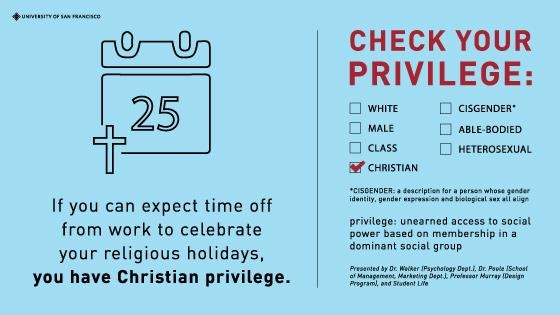
On the surface, this looks like a compassionate attempt to raise awareness for minorities. But underneath, it subtly disciples Christians into seeing God’s gifts as something to be embarrassed about rather than grateful for. It trains believers to view answered prayers, spiritual community, and even public recognition of holy days as markers of social guilt instead of reasons to praise God. The card does not invite reflection on Christ; it invites resentment toward anyone perceived as “advantaged.” It’s less about justice and more about a simmering frustration that others might be enjoying what the critic does not have.
In that sense, the first card exposes not so much “Christian privilege” as the frustration and entitlement of a culture that does not understand the gospel. When the focus is purely on social power—who gets recognition, who gets time off, whose holidays make the calendar—the conversation stays horizontal. It never asks whether there is a deeper spiritual problem beneath the complaints. It never asks why, even in societies where almost every category on the card has been challenged, people are still anxious, angry, lonely, and unsure of themselves. It stops at pointing fingers instead of probing hearts.
That’s where the second image—the “Non-Christian Privilege” card—does something the first one never does: it turns the spotlight inward. The palette is darker, the calendar date has changed, and the cross has been replaced by a hollow symbol. The checklist on this card doesn’t list social advantages; it lists burdens: no lasting hope for eternity, crushing guilt and regret, anxiety and uncertainty, fear of death and judgment, endless work to feel “good enough,” identity without true rest. Instead of accusing others of having too much, it invites the reader to notice what they themselves are carrying without Christ.
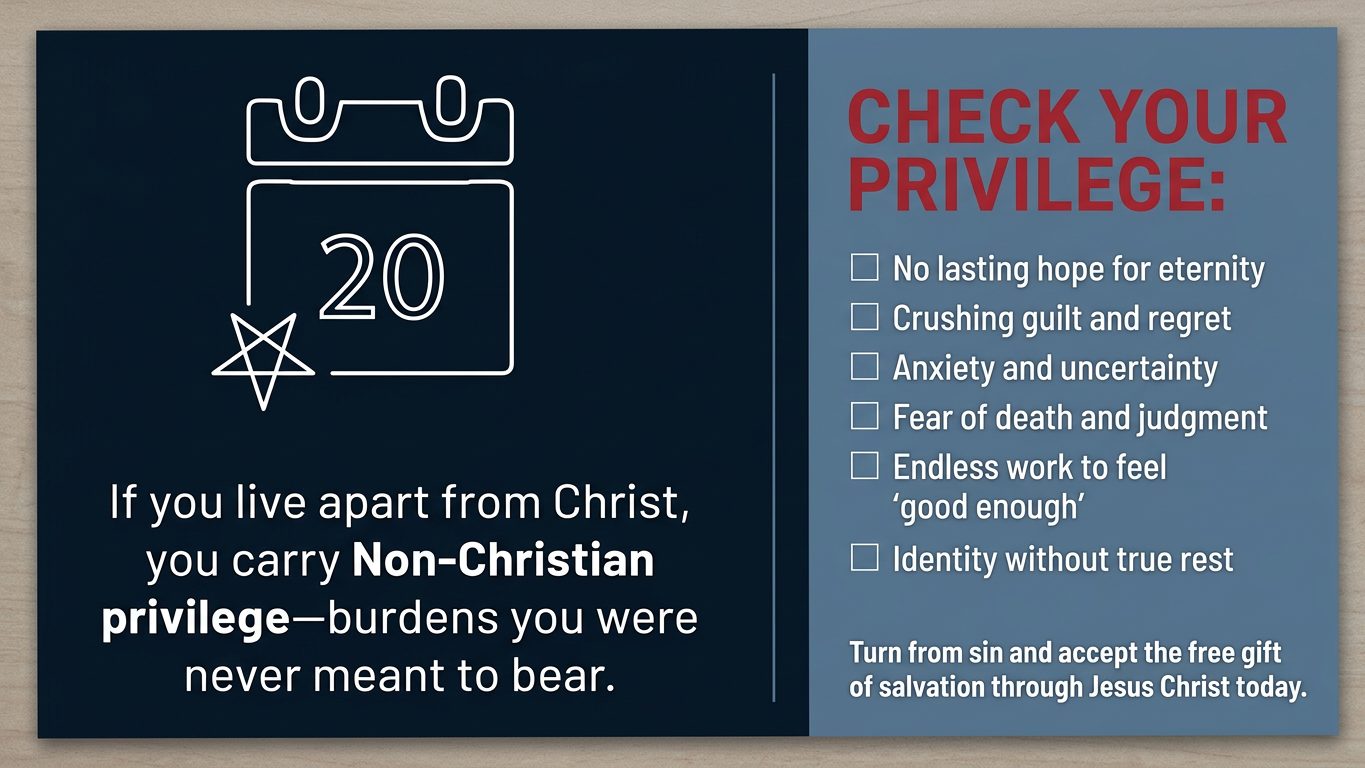
Here, “privilege” is turned upside down. Living apart from Jesus is portrayed not as a neutral option, but as its own kind of privilege—an unwanted one. It’s the “privilege” of bearing weights God never intended a human soul to bear alone. The privilege of trying to save yourself by performance. The privilege of building identity on shifting cultural sands. The privilege of facing death with no solid answer. When seen this way, the real problem with those who complain about Christians isn’t primarily social; it’s spiritual. Their anger at “Christian privilege” can be a symptom of a deeper ache: they feel the emptiness of being cut off from the very Giver who could relieve their burdens.
The second card therefore becomes a mirror. It does not mock. It diagnoses. It gently names what life looks like when Christ is kept at arm’s length: restless striving, gnawing guilt, constant uncertainty, nagging fear of what comes after the last heartbeat. And crucially, it does not end in despair. At the bottom, it extends an invitation: “Turn from sin and accept the free gift of salvation through Jesus Christ today.” The answer to Non-Christian privilege is not envy of Christians, but repentance and faith. The way out is not to pull Christians down, but to let Christ lift you up.
Only after seeing both the cultural complaint and the spiritual condition do we arrive at the third image: the “Embrace Your Christian Privilege” card. The colors brighten again, the cross returns, the date 25 reappears, and the headline invites believers not to hide but to rejoice: “Embrace your Christian privilege.” This card finally names the real privileges that matter—privileges no government can grant and no culture can cancel.
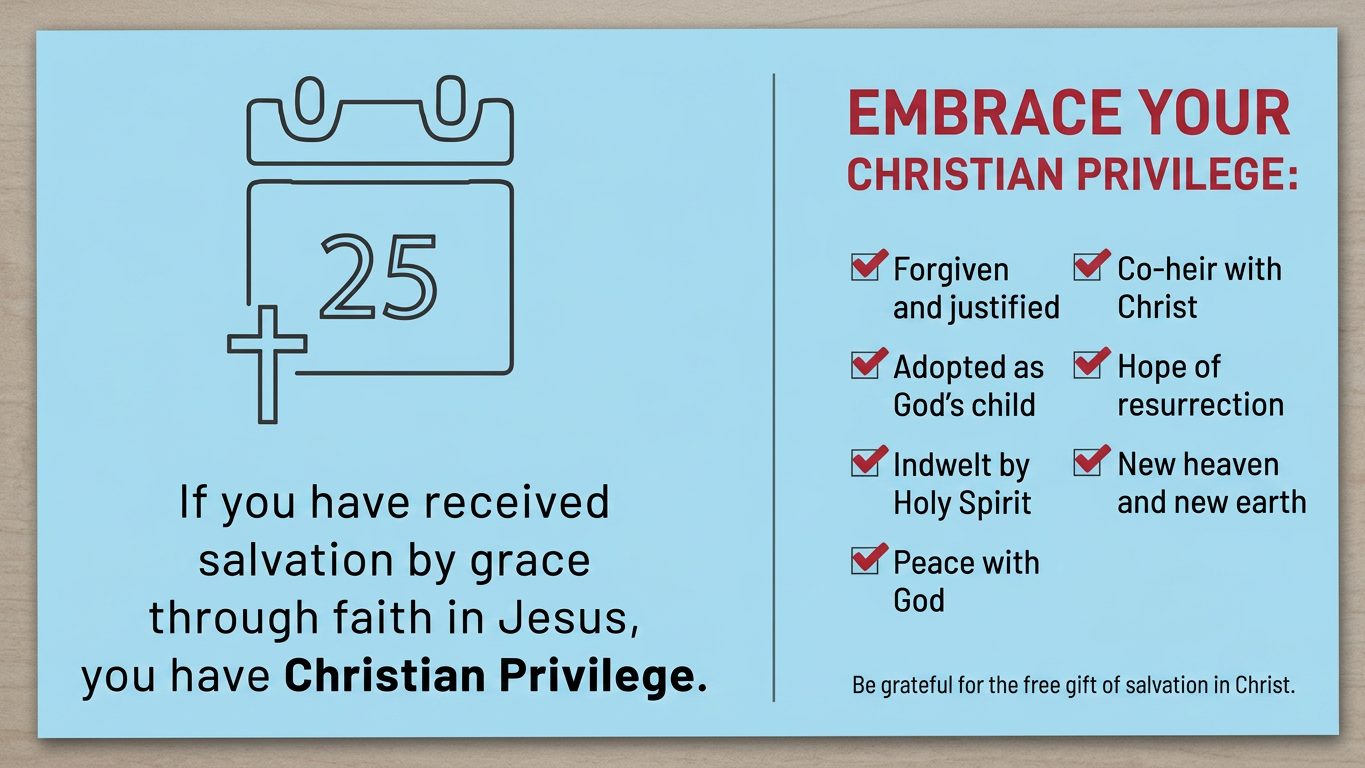
Instead of listing race or gender, the checkmarks run through the riches of the gospel: forgiven and justified, adopted as God’s child, indwelt by the Holy Spirit, peace with God, co-heir with Christ, hope of resurrection, new heaven and new earth. These are not social perks; they are eternal realities purchased by the blood of Jesus. They are not “unearned access to social power”; they are unearned access to God Himself. And unlike the privileges criticized on the first card, these blessings are not limited to any earthly majority. They are freely offered to anyone