Will Aliens Cause a Worldwide Emergency? A Biblical Lens on Modern Fear Narratives The question “Will Aliens Cause a Worldwide Emergency?” is increasingly moving from science fiction into mainstream conversation, fueled by government disclosures, media coverage, and cultural fascination. However, from a Christian worldview, the idea of interstellar alien visitors poses serious scientific and theological problems. The vast distances between stars—such as the nearest star system being over 4.2 light‑years away—make regular travel across galaxies practically impossible with known physics, as even light‑speed travel would take years, and no material object can achieve that velocity without infinite energy requirements. Scripture reinforces a human‑centered creation narrative, where Earth is uniquely designed for life and purpose. Passages like Genesis 1:1 emphasize God’s intentional creation of the heavens and the earth, not a…
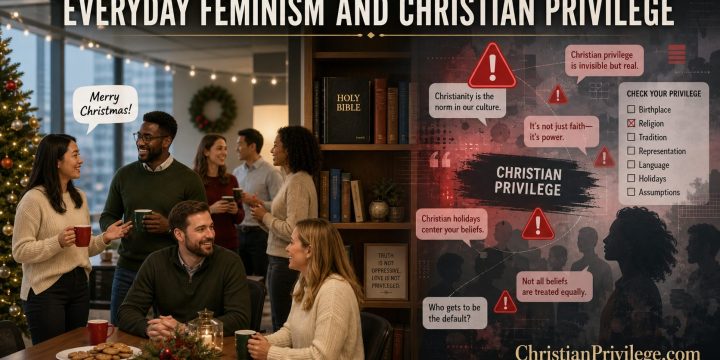
“Don’t Believe in Christian Privilege? These 15 Examples Will Make You Think Again” – Everyday Feminism Kesiena Boom’s Everyday Feminism article offers a checklist of “15 examples” meant to prove Christian privilege in the United States. Items include being able to assume one’s holidays are recognized, hearing “Merry Christmas” without offense, or having courts that do not usually punish one’s religious affiliation. Sociologically, these examples show that Christianity remains the default grammar of much American public life, a point also summarized in the description of “public norms and calendars” at ChristianPrivilege.com. The problem is the argumentative leap from “Christian norms are culturally central” to “therefore Christians hold illegitimate, unjust power.” The essay on ChristianPrivilege.com argues that asymmetry alone is not a refutation. Every serious moral community must take sides on questions of the good, human nature,…
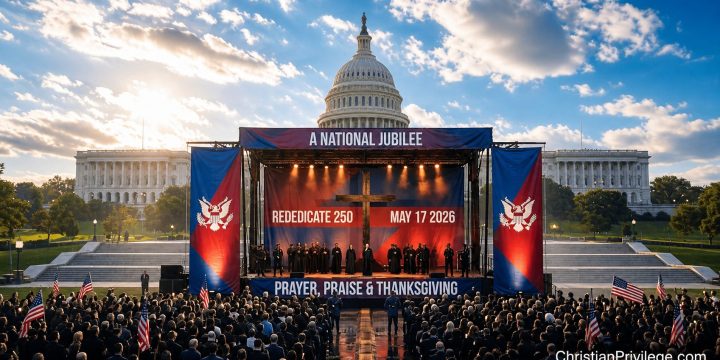
Rededicate 250 is a serious blending of faith and politics, but Matthew Taylor’s “Field Guide” overstates its novelty, its legal danger, and the inevitability of “Christian supremacy,” and it does so with selective facts and worst‑case interpretations. A more balanced look at the event, the Constitution, public opinion, and actual government practice shows why it is best read as a fear‑driven exaggeration rather than a neutral field guide. Rededicate 250: What Actually Happened Taylor frames Rededicate 250 as “a government‑sponsored religious dedication ceremony” that creates “a symbolic baptism of the American state in MAGA Christianity” and a “beachhead for narratives of Christian supremacy.” That language suggests a totally new, quasi‑theocratic turning point. But the public record paints a more ordinary picture: a big, partisan prayer rally on the National Mall,…
The existence of human consciousness and rational thought is among the most profound and persistent puzzles in all of philosophy. Why does subjective experience exist at all? Why can human minds perceive truth, construct logical arguments, and engage in abstract reasoning? Materialist naturalism — the dominant secular framework — struggles profoundly to answer these questions. The Christian worldview, by contrast, offers an elegant, coherent, and scripturally grounded answer: minds exist because there is a supreme Mind behind the universe, and human rationality is derivative of divine rationality. As the Apostle Paul declares in Colossians 2:2–3, all knowledge is ultimately rooted in Christ: "in whom are hidden all the treasures of wisdom and knowledge". This is the mind-first world — and consciousness and reason fit it perfectly. The Hard Problem of…
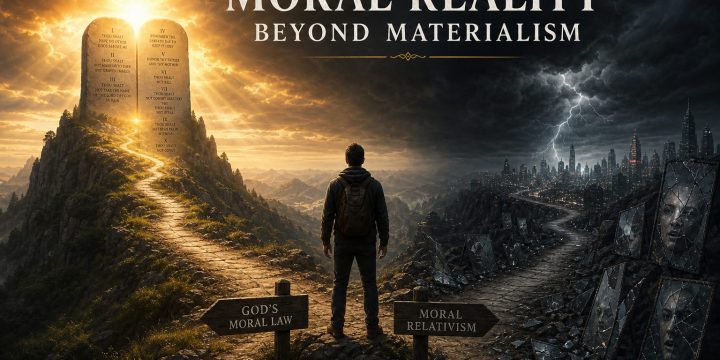
One of the most powerful and personally resonant arguments for the truth of Christian theism is the argument from moral reality. When human beings argue, protest injustice, celebrate heroism, condemn cruelty, or insist that some things are just plain wrong, they are presupposing something deeply important: that moral reality exists outside of individual preference or cultural convention. The question the Christian apologist presses is simply this — why should that be so in a purely material universe? If the cosmos is nothing more than matter in motion, particles interacting across time by impersonal physical laws, there is no mechanism by which moral obligation enters the picture. Yet the deepest moral instincts of humanity insist that it does. Christianity offers a coherent, grounded explanation for that moral reality. Materialism does not. The Christian Privilege of…
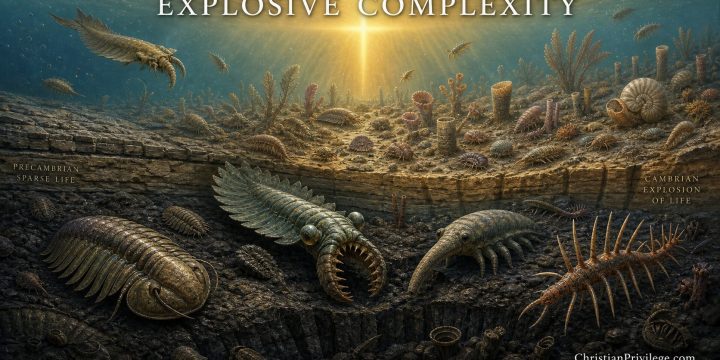
The history of life on Earth, far from undermining the biblical account of creation, delivers one of the most powerful scientific arguments for the existence of an intelligent, purposive Creator. The central exhibit is what scientists themselves call the "Cambrian explosion" — a geologically instantaneous eruption of fully formed, morphologically complex animal body plans in the fossil record, beginning approximately 538–541 million years ago, without gradual precursors and without a Darwinian explanation that has stood up to scrutiny. When placed alongside its predecessor, the Avalon explosion, and subsequent biological "big bangs" throughout life's history, the pattern is unmistakable: life does not creep gradually from simplicity to complexity, it arrives in quantum leaps of specified biological information that point inescapably to a Mind behind the matter. Scripture anticipated this pattern long…
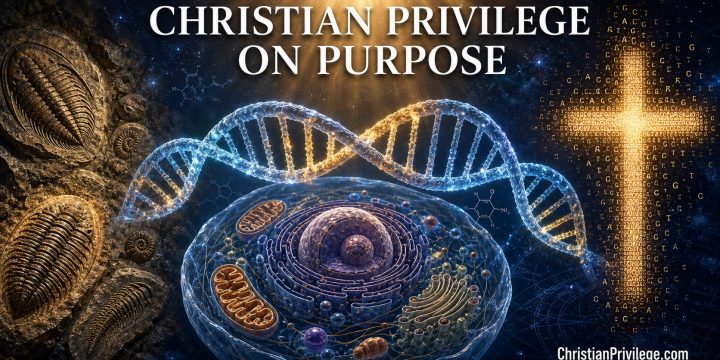
The living cell is not merely complicated — it is specified. It stores, reads, copies, and executes digital information encoded in a four-letter chemical alphabet with a precision that exceeds any technology humanity has yet devised. The Christian worldview has always taught that this is exactly what we should expect: a rational Creator made a world intelligible to rational creatures, and the deepest structures of life bear the signature of that intelligent authorship. Scripture anticipated what molecular biology would later confirm. As the psalmist wrote, "For You formed my inward parts; You wove me in my mother's womb. I will give thanks to You, for I am fearfully and wonderfully made; Wonderful are Your works, and my soul knows it very well" (Psalm 139:13–14, NASB 1995). The argument from biological information is not…
The Case for Divine Creation and the Failure of Naturalistic Origins The question of how life originated from non-life stands as one of the most consequential debates in the history of science and theology. At its core, the contention is simple: either life is the product of an unguided, purposeless chemical accident, or it is the deliberate act of an intelligent Creator. This paper argues — drawing from Scripture, credentialed scientists, philosophers, and the observable limits of modern chemistry — that the biblical account of God as the Author of life is not only coherent but is, in fact, the only explanation that accounts for all the evidence. The materialist alternatives, when subjected to honest scientific scrutiny, collapse under the weight of their own assumptions. Life, in its very nature,…
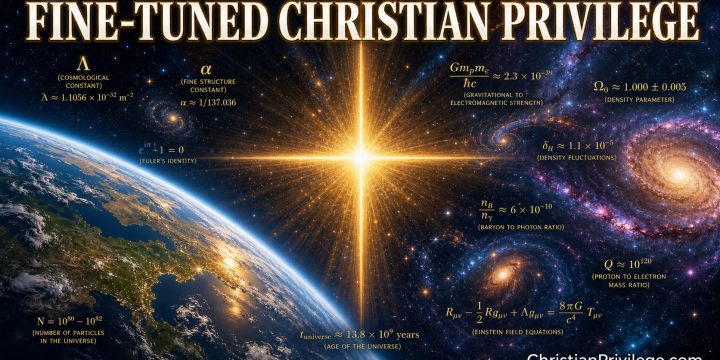
A Deep-Dive into Fine-Tuning The fine-tuning of the universe for life stands as one of the most potent scientific-philosophical arguments for the existence of a divine Creator. When the constants of physics, the cosmological initial conditions, and the precise resonance states of elemental chemistry are examined carefully, they reveal a pattern of exquisite precision that strains credibility under any purely naturalistic account. This paper argues — drawing on the work of leading physicists, philosophers, and the testimony of Christian Scripture — that the universe bears the unmistakable signature of intentional design. The alternative explanations — the multiverse hypothesis, the anthropic principle, and the claim that the constants are not really "tuned" — each collapse under rigorous scrutiny. If the data point toward a cosmic Designer, then the claims of Christian…
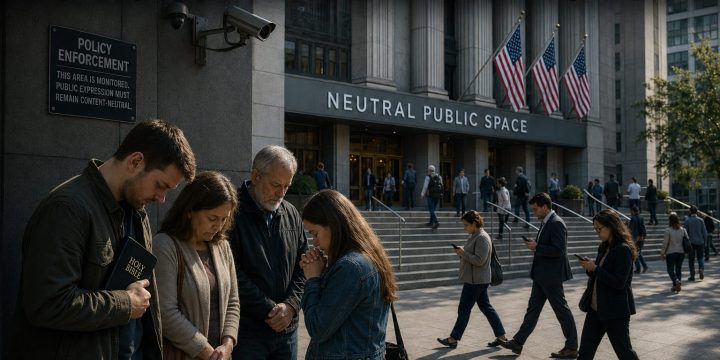
Christian Privilege and the Rebranding of Religious Liberty The most politically effective criticism of Christian Privilege does not usually demand the abolition of religion outright. It does something subtler and more dangerous. It redefines visible Christian participation in public life as a constitutional problem rather than a constitutional right. Once that reframing succeeds, the Free Exercise Clause is no longer understood as protection for believers living publicly according to conviction. It becomes little more than permission to believe privately and discreetly. That is a radical downgrade of American liberty. The First Amendment does not merely prevent Congress from establishing a national church; it also forbids government from “prohibiting the free exercise” of religion. The Constitution Annotated describes the Religion Clauses together as protections for “individual freedom of religion and separation of…
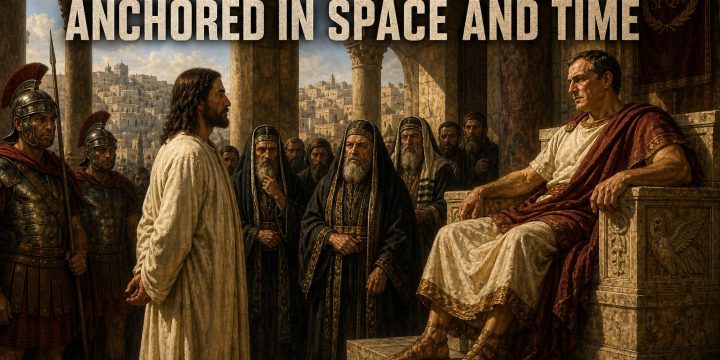
Christian Privilege and the Factual Foundation of the Gospel The Christian privilege debate ultimately hinges not on sociology but on truth. If the central figure of Christianity — Jesus of Nazareth — is a historical phantom invented by credulous followers, then Christians enjoy an advantage built on fabrication. If, however, Jesus lived, taught, was condemned by a Roman governor, and was crucified in first-century Judea, then the Christian claim rests on verifiable events in real time and space. This paper examines the robust and multi-layered historical evidence anchoring Jesus' life and death to first-century history, confronts the fringe theory that Jesus never existed, exposes the fallacies of the mythicist position, and demonstrates why the Gospels' portrait of Jesus belongs to the domain of history, not legend. As the Apostle Paul…
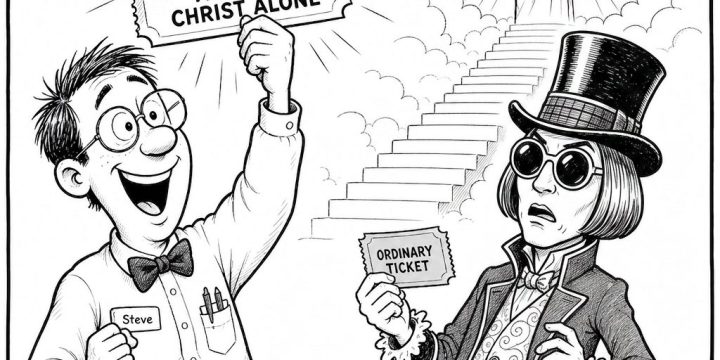
Christian Privilege Is Accepting the Real Golden Ticket When people talk about “privilege,” they usually mean advantages, status, or opportunities in this world. But there is a far greater privilege than any social, economic, or political advantage: the privilege of receiving the real golden ticket—salvation through Jesus Christ alone and the promise of eternal life. In the cartoon image, Steve realizes that what he’s holding is not a ticket to a factory or a fantasy, but to forgiveness, reconciliation with God, and everlasting joy in His presence. That picture is a powerful metaphor for what the Bible calls the gospel, the “good news” of Jesus Christ. The Golden Ticket We All Need The Bible says that every human being has the same basic problem: sin. Sin is not just “big” wrong things;…
If Christian Scriptures Are True, Don't Christians Deserve Privilege? The controlling thesis of this article is straightforward: if the Christian Scriptures are true, then the central moral and political objections to Christian privilege lose much of their force, because a society is not acting irrationally or unjustly when it gives public honor, legal deference, or cultural preference to what is in fact true and good. That claim does not settle every prudential or constitutional question, and it does not justify cruelty, coercion, hypocrisy, or civil disabilities for dissenters. It does mean, however, that the modern critique of “Christian privilege” usually depends on a prior assumption that Christianity is merely one identity option among many and not the true account of God, man, sin, redemption, and public morality. ... Read More Below…
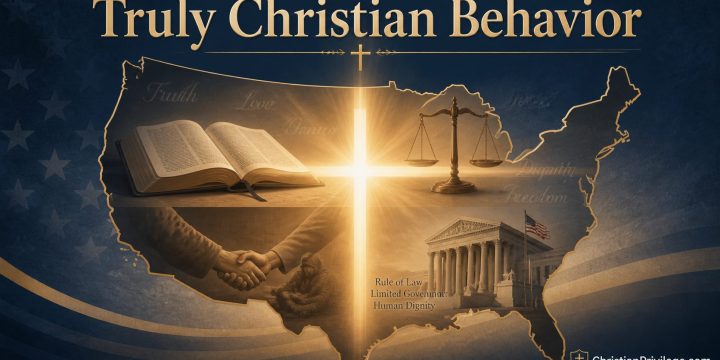
Christianity, at its core, is a faith system built on the twin commandments to love God with all one's heart and to love one's neighbor as oneself — a framework that has demonstrably shaped the most consequential nation in human history. The United States of America did not emerge from a vacuum. Its founding documents, its institutions, its culture of ordered liberty, and its eventual self-correction on historic moral failures all draw meaningfully from a Christian theological inheritance. To acknowledge this is not to claim the nation has been perfectly Christian — it has not — but rather to observe that its greatest achievements reflect Christian ideals applied faithfully, and its greatest failures reflect those same ideals abandoned or distorted. The modern critique of “Christian privilege” frames this legacy through…
There is a food court somewhere in the middle of America that has become, without anyone quite planning it, a perfect metaphor for the most contentious arguments in our national life. Walk past the entrance and the place you'll notice first — the one with the longest lines, the warmest bread smell drifting into the corridor, the quiet hum of satisfied conversation — is the Italian restaurant. It's been there the longest. It built the building. The tile work around the doorframe is hand-painted in green, white, and red. A chalkboard by the door announces the day's specials in Italian script. The menu is unapologetically Italian. Next door is a Mexican restaurant. Next to that, a Thai place. Down at the end of the hall, an Indian kitchen, a Greek…
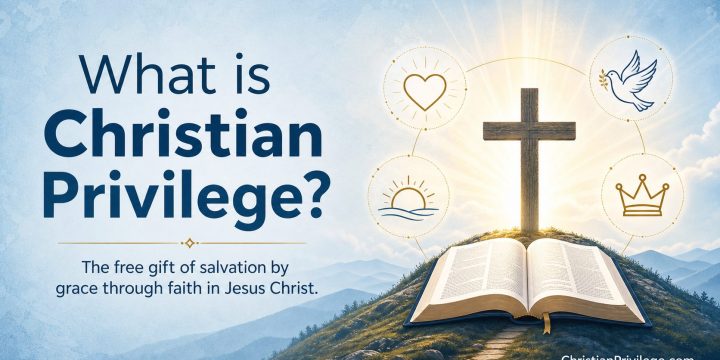
Christian Privilege, rightly understood through the lens of Scripture, is not a social construct or a cultural status symbol — it is a divine endowment. It is the extraordinary, unmerited standing granted to every believer in Jesus Christ by virtue of God's sovereign plan of salvation. This privilege originates not in human achievement, cultural dominance, or institutional power, but in the eternal will of God — a will that was set before the foundation of the world, progressively revealed through covenants and prophecy, definitively accomplished in the life, death, and resurrection of Jesus Christ, and now freely offered to every soul who believes. The pages that follow trace this great privilege from its primordial promise in the Garden of Eden through its prophetic unfolding in the Hebrew Scriptures, its magnificent…
CHRISTIANS HAVE THE PRIVILEGE OF EXPERIENCING AMAZING FREEDOM FROM GUILT AND REGRET. THEY SLEEP WELL. THEY SMILE. THEY ARE AT PEACE. HAVE HOPE - HAVE CHRISTIAN PRIVILEGE People say there is no freedom in a religion that restricts your behaviors, yet in their “freedom,” they have become slaves to guilt, regret and the consequences of their actions. They’ve hurt people with their selfishness and they know it’s wrong. They don’t sleep. They don’t have peace. They don’t have hope. There is a heaviness on their lives. But you can have hope. I was in the Mountain Phase of Ranger School when I prayed. I didn’t know God, but I knew I was at the end of my strength and God was the only place I could think to turn. Sitting…