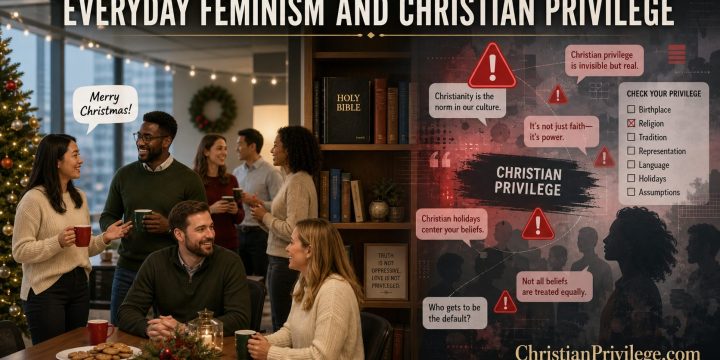
“Don’t Believe in Christian Privilege? These 15 Examples Will Make You Think Again” – Everyday Feminism Kesiena Boom’s Everyday Feminism article offers a checklist of “15 examples” meant to prove Christian privilege in the United States. Items include being able to assume one’s holidays are recognized, hearing “Merry Christmas” without offense, or having courts that do not usually punish one’s religious affiliation. Sociologically, these examples show that Christianity remains the default grammar of much American public life, a point also summarized in the description of “public norms and calendars” at ChristianPrivilege.com. The problem is the argumentative leap from “Christian norms are culturally central” to “therefore Christians hold illegitimate, unjust power.” The essay on ChristianPrivilege.com argues that asymmetry alone is not a refutation. Every serious moral community must take sides on questions of the good, human nature,…
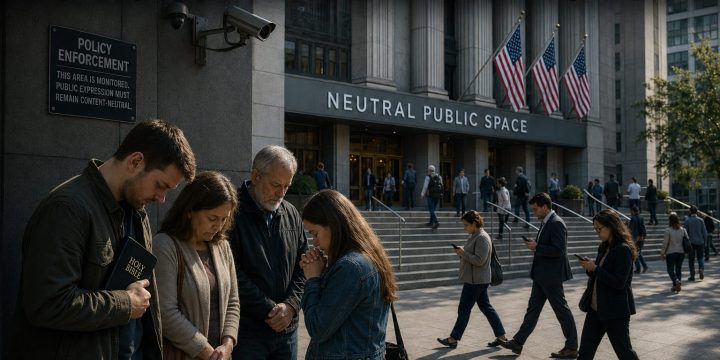
Christian Privilege and the Promise of Neutrality The modern argument against Christian Privilege usually arrives dressed as a simple appeal to fairness. Christians, it says, have enjoyed too much cultural deference, too much moral influence, too much institutional familiarity, and too much access to the symbols and language of national life. The cure, we are told, is not persecution but neutrality. That word does enormous work. It sounds calm, procedural, civilized, almost antiseptic. But if the campaign against Christian Privilege were ever pursued seriously rather than rhetorically, neutrality would not remain neutral for long. It would require administrators, policies, standards, investigations, and enforcement mechanisms able to identify, measure, and reduce Christian influence wherever it appeared too visible, too normal, or too successful. That is the dirty secret buried inside the critique of Christian Privilege: its…
Christian Privilege and the Rebranding of Religious Liberty The most politically effective criticism of Christian Privilege does not usually demand the abolition of religion outright. It does something subtler and more dangerous. It redefines visible Christian participation in public life as a constitutional problem rather than a constitutional right. Once that reframing succeeds, the Free Exercise Clause is no longer understood as protection for believers living publicly according to conviction. It becomes little more than permission to believe privately and discreetly. That is a radical downgrade of American liberty. The First Amendment does not merely prevent Congress from establishing a national church; it also forbids government from “prohibiting the free exercise” of religion. The Constitution Annotated describes the Religion Clauses together as protections for “individual freedom of religion and separation of…
If Christian Scriptures Are True, Don't Christians Deserve Privilege? The controlling thesis of this article is straightforward: if the Christian Scriptures are true, then the central moral and political objections to Christian privilege lose much of their force, because a society is not acting irrationally or unjustly when it gives public honor, legal deference, or cultural preference to what is in fact true and good. That claim does not settle every prudential or constitutional question, and it does not justify cruelty, coercion, hypocrisy, or civil disabilities for dissenters. It does mean, however, that the modern critique of “Christian privilege” usually depends on a prior assumption that Christianity is merely one identity option among many and not the true account of God, man, sin, redemption, and public morality. ... Read More Below…
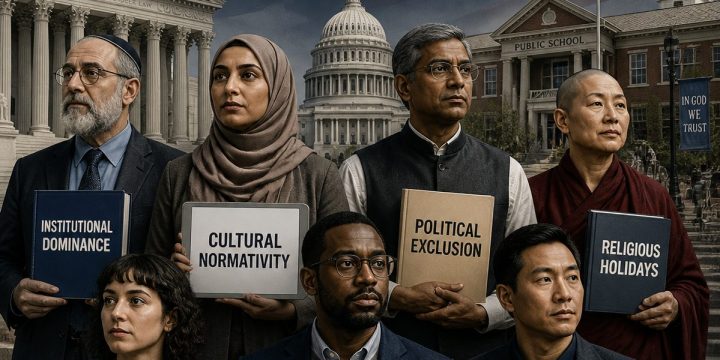
Major Criticisms of Christian Privilege in America A Scholarly Survey of the Principal Critiques See Responses to Critics of “Christian Privilege” in America Introduction The concept of "Christian privilege" refers to the social, cultural, legal, and institutional advantages that accrue to Christians in American society by virtue of their status as the dominant religious majority. First formally named in the academic literature by Lewis Z. Schlosser in 2003, the concept has since been elaborated by sociologists, education scholars, legal critics, psychologists, and civil liberties advocates. The following report catalogs the major criticisms of Christian privilege in America, presenting each critique in the words of its most prominent scholarly and activist voices. No attempt is made here to refute or qualify these critiques; they are presented to speak for themselves. …