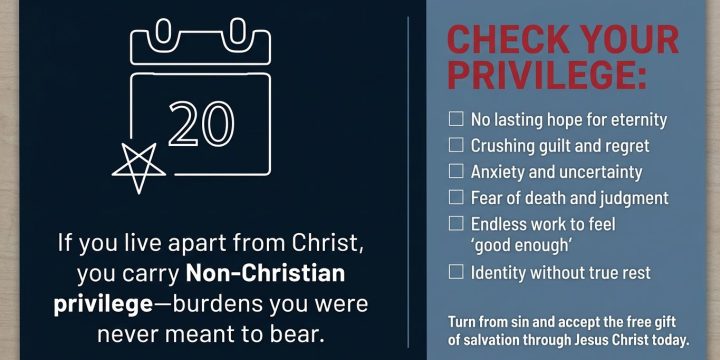
The phrase “check your privilege” has become a familiar slogan in modern Western culture. One of the clearest examples is the original “Check Your Christian Privilege” card. It places a calendar with a cross in the corner and the number 25—clearly evoking Christmas—next to a checklist of identity categories like race, sex, class, and ability. At the bottom, it quietly defines privilege as “unearned access to social power based on membership in a dominant social group.” The implication is simple: if your workplace or school recognizes your Christian holidays, you are part of an oppressive majority that owes the world an apology. On the surface, this looks like a compassionate attempt to raise awareness for minorities. But underneath, it subtly disciples Christians into seeing God’s gifts as something to be…
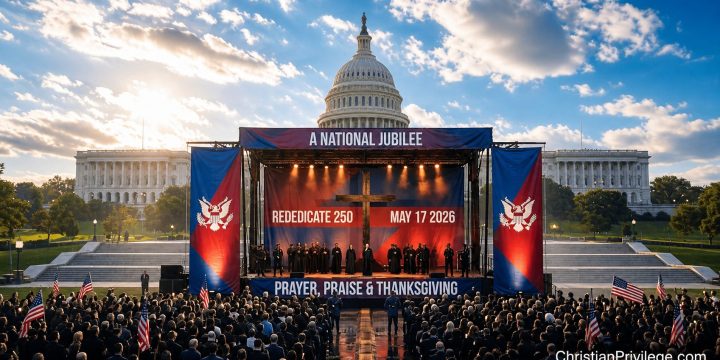
Rededicate 250 is a serious blending of faith and politics, but Matthew Taylor’s “Field Guide” overstates its novelty, its legal danger, and the inevitability of “Christian supremacy,” and it does so with selective facts and worst‑case interpretations. A more balanced look at the event, the Constitution, public opinion, and actual government practice shows why it is best read as a fear‑driven exaggeration rather than a neutral field guide. Rededicate 250: What Actually Happened Taylor frames Rededicate 250 as “a government‑sponsored religious dedication ceremony” that creates “a symbolic baptism of the American state in MAGA Christianity” and a “beachhead for narratives of Christian supremacy.” That language suggests a totally new, quasi‑theocratic turning point. But the public record paints a more ordinary picture: a big, partisan prayer rally on the National Mall,…
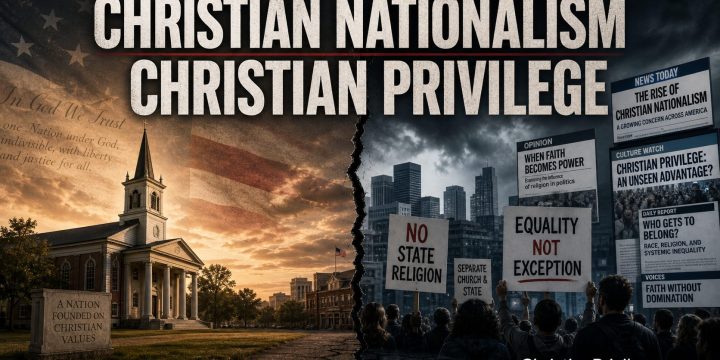
Christian Nationalism Christian Privilege: A Familiar Pattern of Criticism Public criticism of Christianity has not disappeared—it has evolved. What was once framed as opposition to “moral majority” influence is now reframed under the label of “Christian Nationalism.” According to Pew Research Center, awareness of the term has grown rapidly in recent years, signaling a cultural shift in how Christian influence is discussed. Rather than presenting entirely new concerns, many of these critiques echo longstanding objections: that Christianity holds too much cultural influence, that it shapes public policy, and that it marginalizes opposing viewpoints. The terminology may change, but the underlying argument remains consistent—Christian presence in public life is viewed with suspicion. This pattern suggests that “Christian Nationalism” is not a new phenomenon as much as it is a rebranded critique of…
What is Christian Nationalism is a vision for ordering public life so that a nation’s laws, symbols, and common culture are shaped by Christian faith and moral teaching, while still seeking the good of all its citizens. It assumes that Christianity offers a rich moral and spiritual heritage that can positively guide national identity, civic virtue, and public policy in ways that protect families, human dignity, and social cohesion. What is Christian Nationalism In contemporary discussion, many scholars describe Christian nationalism as the belief that a particular nation is defined in important ways by Christianity and that its government should preserve that Christian character in its laws, symbols, and public life, as explained in What Is Christian Nationalism? The Complete Guide. Others put it more theologically as the conviction that the…
The Center for Inquiry's (CFI) article on "Combating Religious Privilege in the United States" opens with the dramatic declaration that America is "riven top to bottom by religious privilege" and that religion "enjoys incredible power while taking no responsibility." These are sweeping assertions — and the facts don't support them. Below, we go point by point through the CFI's major claims and respond with documented evidence. Claim 1: America Is "Riven Top to Bottom" by Religious Privilege The CFI's charge: That society is saturated, at every level, with religious advantage. The reality: Religious influence in America is declining, not dominating. According to a major 2025 Pew Research Center Religious Landscape Study, Christianity's share of the U.S. adult population has stabilized after years of decline, sitting at about 62% today — down from 78% roughly…
Christian Privilege and the Promise of Neutrality The modern argument against Christian Privilege usually arrives dressed as a simple appeal to fairness. Christians, it says, have enjoyed too much cultural deference, too much moral influence, too much institutional familiarity, and too much access to the symbols and language of national life. The cure, we are told, is not persecution but neutrality. That word does enormous work. It sounds calm, procedural, civilized, almost antiseptic. But if the campaign against Christian Privilege were ever pursued seriously rather than rhetorically, neutrality would not remain neutral for long. It would require administrators, policies, standards, investigations, and enforcement mechanisms able to identify, measure, and reduce Christian influence wherever it appeared too visible, too normal, or too successful. That is the dirty secret buried inside the critique of Christian Privilege: its…
Christian Privilege and the Convenient Rewrite of American History The criticism of Christian Privilege often presents itself as morally brave because it claims to expose a hidden structure of favoritism long ignored by polite society. But in practice, the sharpest versions of that critique do not illuminate history so much as flatten it. They take a long, tangled, contradictory American story and force it into a simple script: Christianity equals dominance, public Christianity equals exclusion, and the more Christian a society appears, the less free it must be. That is not serious history. It is ideological editing. The real American story is far messier. As the Smithsonian put it, America’s religious past is an “often awkward, frequently embarrassing and occasionally bloody tale.” That line is worth dwelling on because it cuts against…
Christian Privilege and the Pathologizing of Normal Culture One of the most revealing weaknesses in the rhetoric around Christian Privilege is its tendency to treat ordinary cultural familiarity as if it were moral aggression. The argument often begins with a list of examples meant to prove that Christians enjoy unearned social advantages: Christmas is widely recognized, public life contains Christian symbols, strangers assume some biblical literacy, and institutions often understand Christian holidays or practices more readily than minority faith traditions. Those observations are not always false. In a country shaped for centuries by Christianity, of course Christian language and customs have been widely legible. But the anti-Christian Privilege framework makes a crucial mistake: it takes the ordinariness of a majority culture and treats that ordinariness itself as evidence of oppression. It confuses familiarity…
Christian Privilege and the Fantasy of Perfect Balance The criticism of Christian Privilege usually presents itself as a demand for fairness. The claim is that Christians, by virtue of numbers and history, enjoy disproportionate influence in law, culture, and institutions, and that justice requires “balancing” this influence so no tradition dominates. On the surface, this sounds like a simple matter of equity—just adjust the dials until every group’s social footprint matches its demographic size. That picture is a fantasy. Influence in a free society is not a resource that can be rationed by a central accountant. It emerges from millions of voluntary decisions: where people worship, which schools they found, what causes they fund, which books they write, how they vote, which charities they build, and how deeply their convictions shape their…
If Christian Scriptures Are True, Don't Christians Deserve Privilege? The controlling thesis of this article is straightforward: if the Christian Scriptures are true, then the central moral and political objections to Christian privilege lose much of their force, because a society is not acting irrationally or unjustly when it gives public honor, legal deference, or cultural preference to what is in fact true and good. That claim does not settle every prudential or constitutional question, and it does not justify cruelty, coercion, hypocrisy, or civil disabilities for dissenters. It does mean, however, that the modern critique of “Christian privilege” usually depends on a prior assumption that Christianity is merely one identity option among many and not the true account of God, man, sin, redemption, and public morality. ... Read More Below…